


Demonstrating trustworthiness when collecting and sharing genomic data: public views across 22 countries
- PMID: 34034801
- PMCID: PMC8147072
- DOI: 10.1186/s13073-021-00903-0
Demonstrating trustworthiness when collecting and sharing genomic data: public views across 22 countries
Abstract
Background: Public trust is central to the collection of genomic and health data and the sustainability of genomic research. To merit trust, those involved in collecting and sharing data need to demonstrate they are trustworthy. However, it is unclear what measures are most likely to demonstrate this.
Methods: We analyse the 'Your DNA, Your Say' online survey of public perspectives on genomic data sharing including responses from 36,268 individuals across 22 low-, middle- and high-income countries, gathered in 15 languages. We examine how participants perceived the relative value of measures to demonstrate the trustworthiness of those using donated DNA and/or medical information. We examine between-country variation and present a consolidated ranking of measures.
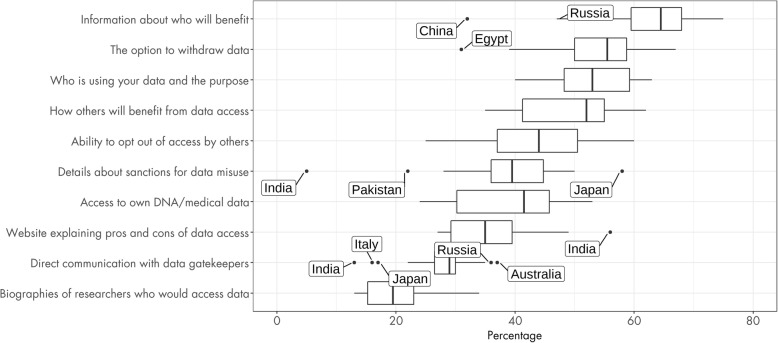
Results: Providing transparent information about who will benefit from data access was the most important measure to increase trust, endorsed by more than 50% of participants across 20 of 22 countries. It was followed by the option to withdraw data and transparency about who is using data and why. Variation was found for the importance of measures, notably information about sanctions for misuse of data-endorsed by 5% in India but almost 60% in Japan. A clustering analysis suggests alignment between some countries in the assessment of specific measures, such as the UK and Canada, Spain and Mexico and Portugal and Brazil. China and Russia are less closely aligned with other countries in terms of the value of the measures presented.
Conclusions: Our findings highlight the importance of transparency about data use and about the goals and potential benefits associated with data sharing, including to whom such benefits accrue. They show that members of the public value knowing what benefits accrue from the use of data. The study highlights the importance of locally sensitive measures to increase trust as genomic data sharing continues globally.
Conflict of interest statement
KM, DM, QH and SA declare no competing interests associated with their affiliations. The remaining authors declare no competing interests.
Figures


References
Publication types
MeSH terms
Grants and funding
LinkOut - more resources
Full Text Sources
Other Literature Sources
