


Preverbal infants expect agents exhibiting counterintuitive capacities to gain access to contested resources
- PMID: 34035341
- PMCID: PMC8149634
- DOI: 10.1038/s41598-021-89821-0
Preverbal infants expect agents exhibiting counterintuitive capacities to gain access to contested resources
Abstract
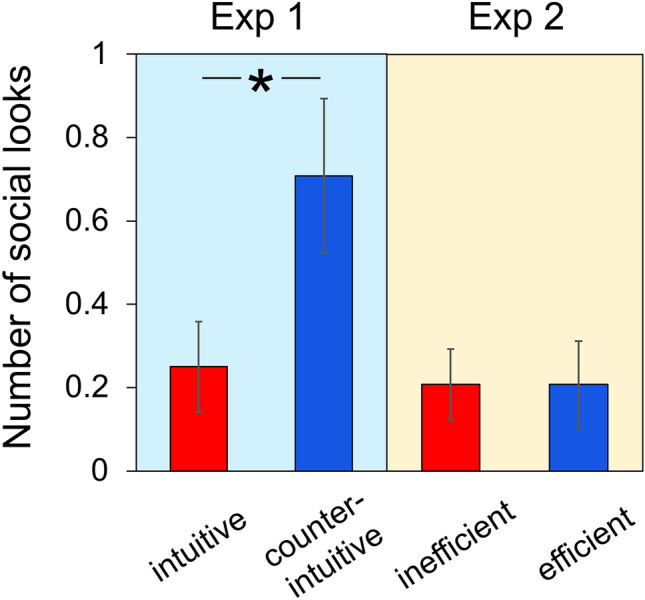
Claims to supernatural power have been used as a basis for authority in a wide range of societies, but little is known about developmental origins of the link between supernatural power and worldly authority. Here, we show that 12- to 16-month-old infants expect agents exhibiting counterintuitive capacities to win out in a two-way standoff over a contested resource. Infants watched two agents gain a reward using either physically intuitive or physically counterintuitive methods, the latter involving simple forms of levitation or teleportation. Infants looked longer, indicating surprise, when the physically intuitive agent subsequently outcompeted a physically counterintuitive agent in securing a reward. Control experiments indicated that infants' expectations were not simply motived by the efficiency of agents in pursuing their goals, but specifically the deployment of counterintuitive capacities. This suggests that the link between supernatural power and worldly authority has early origins in development.
Conflict of interest statement
The authors declare no competing interests.
Figures


References
-
- Weber M, Henderson AM, Parsons T. The Theory of Social and Economic Organization. Oxford University Press; 1947.
-
- Burkert W. Creation of the Sacred: Tracks of Biology in Early Religions. Harvard University Press; 1998.
-
- Bowie F. The Anthropology of Religion: An Introduction. Blackwell; 1999.
-
- Winkelman MJ. Shamans and other “magico-religious” healers: A cross-cultural study of their origins, nature, and social transformations. Ethos. 1990;18:308–352. doi: 10.1525/eth.1990.18.3.02a00040. - DOI
Publication types
MeSH terms
LinkOut - more resources
Full Text Sources
Other Literature Sources
Miscellaneous
