


Impact of National Economy and Policies on End-Stage Kidney Care in South Asia and Southeast Asia
- PMID: 34035962
- PMCID: PMC8118744
- DOI: 10.1155/2021/6665901
Impact of National Economy and Policies on End-Stage Kidney Care in South Asia and Southeast Asia
Abstract
Background: The association between economic status and kidney disease is incompletely explored even in countries with higher economy (HE); the situation is complex in lower economies (LE) of South Asia and Southeast Asia (SA and SEA).
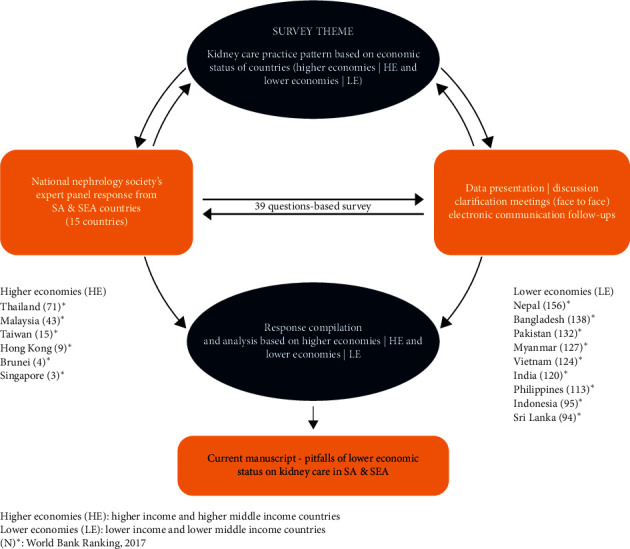
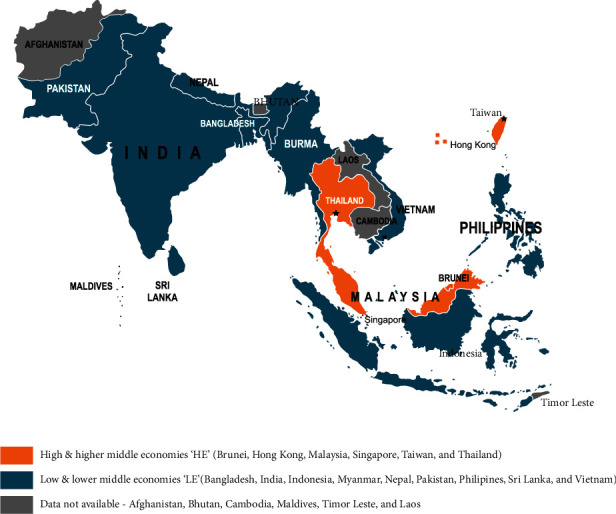
Methods: Fifteen countries of SA and SEA categorized as HE and LE, represented by the representatives of the national nephrology societies, participated in this questionnaire and interview-based assessment of the impact of economic status on renal care.
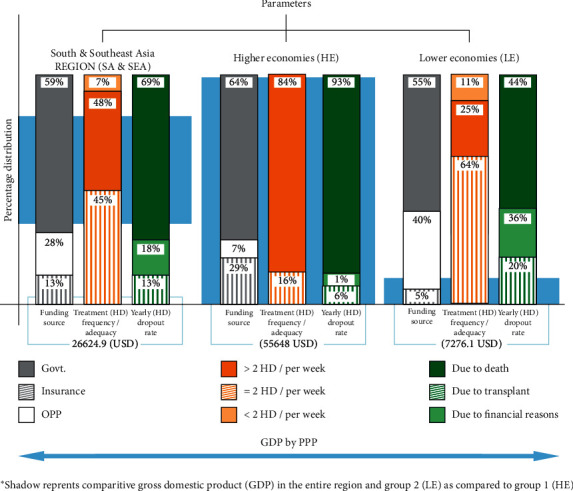
Results: Average incidence and prevalence of end-stage kidney disease (ESKD) per million population (pmp) are 1.8 times and 3.3 times higher in HE. Hemodialysis is the main renal replacement therapy (RRT) (HE-68%, LE-63%). Funding of dialysis in HE is mainly by state (65%) or insurance bodies (30%); out of pocket expenses (OOPE) are high in LE (41%). Highest cost for hemodialysis is in Brunei and Singapore, and lowest in Myanmar and Nepal. Median number of dialysis machines/1000 ESKD population is 110 in HE and 53 in LE. Average number of machines/dialysis units in HE is 2.7 times higher than LE. The HE countries have 9 times more dialysis centers pmp (median HE-17, LE-02) and 16 times more nephrologist density (median HE-14.8 ppm, LE-0.94 ppm). Dialysis sessions >2/week is frequently followed in HE (84%) and <2/week in LE (64%). "On-demand" hemodialysis (<2 sessions/week) is prevalent in LE. Hemodialysis dropout rates at one year are lower in HE (12.3%; LE 53.4%), death being the major cause (HE-93.6%; LE-43.8%); renal transplants constitute 4% (Brunei) to 39% (Hong Kong) of the RRT in HE. ESKD burden is expected to increase >10% in all the HE countries except Taiwan, 10%-20% in the majority of LE countries.
Conclusion: Economic disparity in SA and SEA is reflected by poor dialysis infrastructure and penetration, inadequate manpower, higher OOPE, higher dialysis dropout rates, and lesser renal transplantations in LE countries. Utility of RRT can be improved by state funding and better insurance coverage.
Copyright © 2021 Suceena Alexander et al.
Conflict of interest statement
The authors declare no conflicts of interest.
Figures
References
-
- Maheswaran R., Payne N., Meechan D., Burden R. P., Fryers P. R., Hutchinson A. Socioeconomic deprivation, travel distance, and renal replacement therapy in the Trent region, United Kingdom 2000: an ecological study. Journal of Epidemiology & Community Health. 2003;57(7):523–524. doi: 10.1136/jech.57.7.523. - DOI - PMC - PubMed
Publication types
LinkOut - more resources
Full Text Sources
Other Literature Sources
