


Atrial fibrillation burden, episode duration and frequency in relation to quality of life in patients with implantable cardiac monitor
- PMID: 34036145
- PMCID: PMC8134989
- DOI: 10.1016/j.ijcha.2021.100791
Atrial fibrillation burden, episode duration and frequency in relation to quality of life in patients with implantable cardiac monitor
Abstract
Aims: To assess the relation between atrial fibrillation (AF) characteristics and health-related quality of life (QoL), and which AF characteristic had the greatest impact.
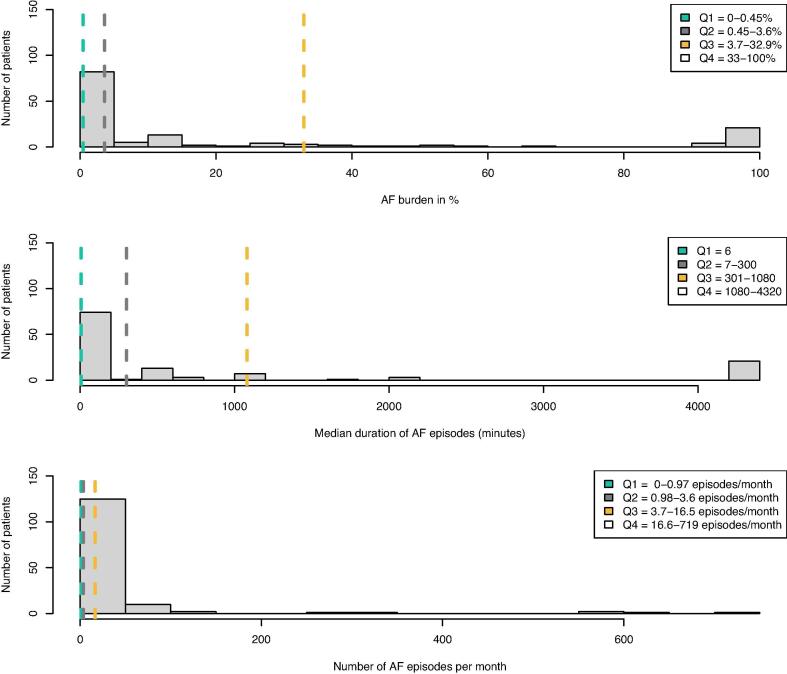
Method: The AF characteristics burden (percentage of time in AF), duration and number of AF episodes/month were obtained from implantable cardiac monitors during the 2-month run-in period in 150 patients included in the randomized CAPTAF trial comparing early ablation and antiarrhythmic drug therapy. The QoL was measured by the General Health and Vitality dimensions of the 36-Item Short-Form Health Survey. AF characteristics were analysed continuously and in quartiles (Q1-Q4).
Results: Greater AF burden (p = 0.003) and longer AF episodes (p = 0.013) were associated with impaired QoL (Vitality score only) in simple linear regression analyses. Greater AF burden was, however, the only AF characteristic associated with lower QoL, when adjusted for sex, type of AF, hypertension, heart rate above 110 beats per minute during AF, and beta-blocker use in multiple linear regression analyses. For every 10% increase in AF burden there was a 1.34-point decrease of Vitality score (95% confidence interval (CI) -2.67 to -0.02, p = 0.047). The Vitality score was 12 points lower (95% CI -22.73 to -1.27, p = 0.03) in patients with an AF burden > 33% (Q4) versus those with < 0.45% (Q1), but only in unadjusted analysis.
Conclusion: AF burden had a greater impact on QoL (Vitality), than the duration and number of AF episodes, corroborating that AF burden may be the preferred outcome measure of rhythm control in trials including relatively healthy AF populations.
Keywords: Atrial fibrillation; Atrial fibrillation burden; Health-related quality of life; Implantable cardiac monitor; Loop recorder; Randomized.
© 2021 The Authors.
Conflict of interest statement
Dr Blomström-Lundqvist reports receiving grants from Medtronic during the conduct of the study; and personal fees from Bayer, Sanofi, Boston Scientific, and Merck Sharp & Dohme outside the submitted work. Dr Bergfeldt reports receiving personal fees from Sanofi, Bristol-Myers Squibb, Bayer, and Pfizer outside the submitted work. Dr Raatikainen reports receiving grants from Biosense Webster outside the submitted work. All remaining authors have declared no conflicts of interest.
Figures
References
-
- Dorian P., Jung W., Newman D., Paquette M., Wood K., Ayers G.M. The impairment of health-related quality of life in patients with intermittent atrial fibrillation: implications for the assessment of investigational therapy. J. Am. Coll. Cardiol. 2000 Oct 1;36(4):1303–1309. - PubMed
-
- V. Bulková, M. Fiala, Š. Havránek, J. Šimek, L. Škňouřil, J. Januška, et al. Improvement in Quality of Life After Catheter Ablation for Paroxysmal Versus Long‐standing Persistent Atrial Fibrillation: A Prospective Study With 3‐Year Follow‐up. J. Am. Heart Assoc. [Internet]. 2014 Aug 15 [cited 2020 Feb 28];3(4). Available from: https://www.ahajournals.org/doi/10.1161/JAHA.114.000881 - PMC - PubMed
LinkOut - more resources
Full Text Sources
Other Literature Sources
Medical
