Spatial distribution and factors associated with low birth weight in Ethiopia using data from Ethiopian Demographic and Health Survey 2016: spatial and multilevel analysis
- PMID: 34036183
- PMCID: PMC8103935
- DOI: 10.1136/bmjpo-2020-000968
Spatial distribution and factors associated with low birth weight in Ethiopia using data from Ethiopian Demographic and Health Survey 2016: spatial and multilevel analysis
Abstract
Objective: This study aimed to assess the spatial distribution, individual and community-level factors associated with low birth weight in Ethiopia.
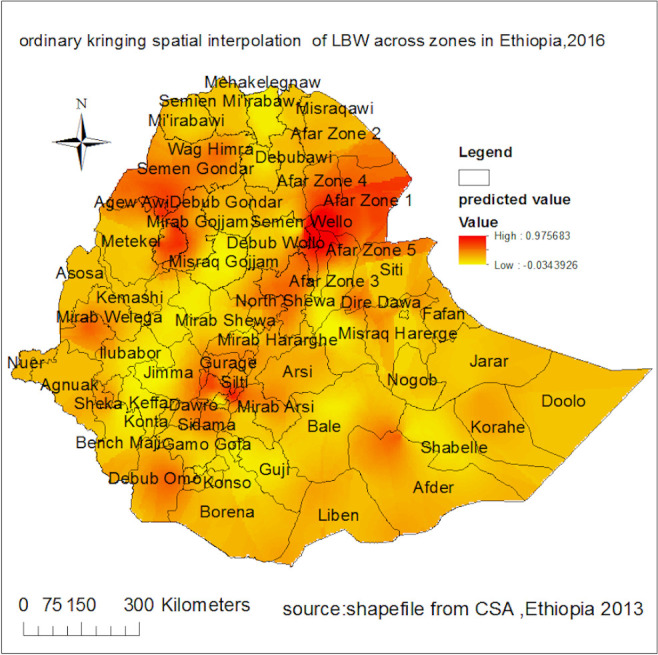
Method: Secondary data analysis was conducted using the 2016 Ethiopian Demographic and Health Survey data. A total of 2110 neonates were included in this study. Spatial autocorrelation analysis was conducted to assess the spatial clustering of LBW. Besides, the spatial scan statistics and ordinary kriging interpolation were done to detect the local level clusters and to assess predicted risk areas, respectively. Furthermore, a multilevel logistic regression model was fitted to determine individual and community-level factors associated with LBW. Finally, most likely clusters with log-likelihood ratio (LLR), relative risk and p value from spatial scan statistics and adjusted OR (AOR) with 95% CI for multilevel logistic regression model were reported.
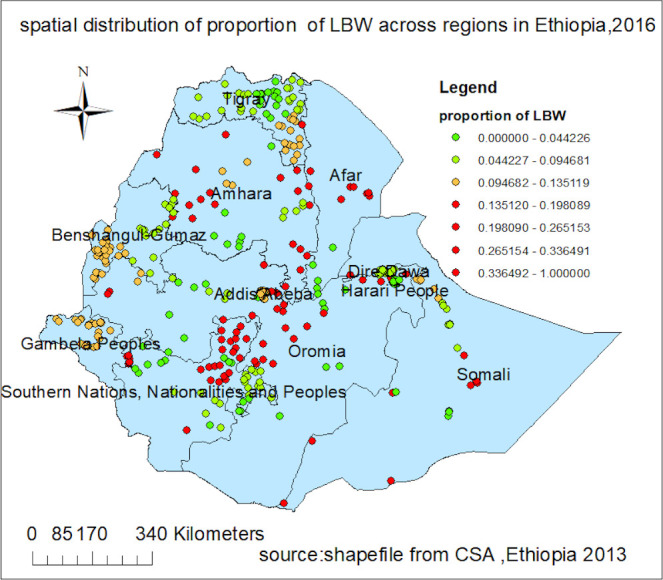
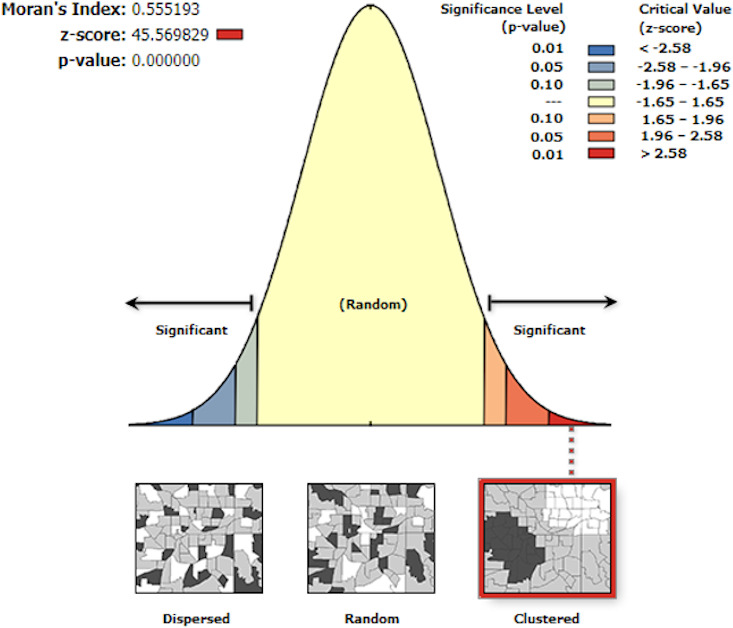
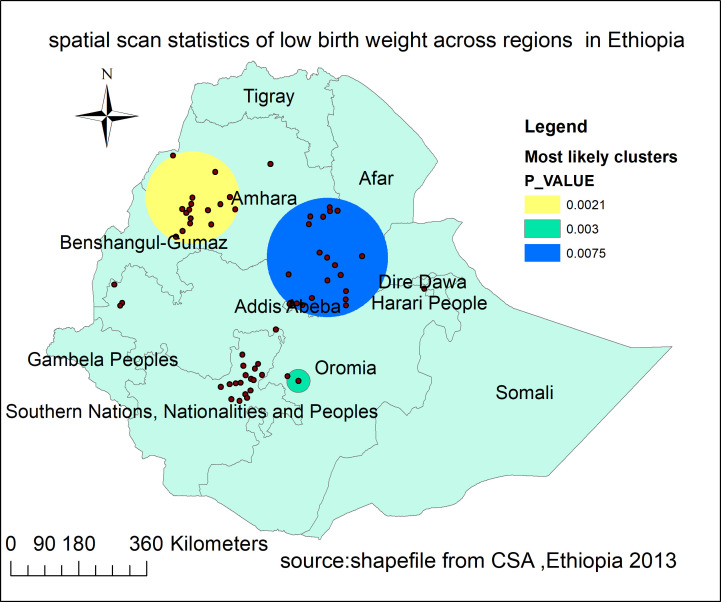
Results: LBW was spatially clustered in Ethiopia. Primary (LLR=11.57; p=0.002) clusters were detected in the Amhara region. Neonates within this spatial window had a 2.66 times higher risk of being LBW babies as compared with those outside the window. Besides, secondary (LLR=11.4; p=0.003; LLR=10.14, p=0.0075) clusters were identified at southwest Oromia, north Oromia, south Afar and southeast Amhara regions. Neonates who were born from severely anaemic (AOR=1.40, 95% CI (1.03 to 2.15)), and uneducated (AOR=1.90, 95% CI (1.23 to 2.93)) mothers, those who were born before 37 weeks of gestation (AOR=5.97, 95% CI (3.26 to 10.95)) and women (AOR=1.41, 95% CI (1.05 to 1.89)), had significantly higher odds of being LBW babies.
Conclusion: The high-risk areas of LBW were detected in Afar, Amhara and Oromia regions. Therefore, targeting the policy interventions in those hotspot areas and focusing on the improvement of maternal education, strengthening anaemia control programmes and elimination of modifiable causes of prematurity could be vital for reducing the LBW disparity in Ethiopia.
Keywords: epidemiology; health services research; neonatology.
© Author(s) (or their employer(s)) 2021. Re-use permitted under CC BY-NC. No commercial re-use. See rights and permissions. Published by BMJ.
Conflict of interest statement
Competing interests: None declared.
Figures
References
-
- Hug L, Sharrow D, You D. Levels & trends in child mortality: report 2017. Estimates developed by the UN Inter-agency Group for Child Mortality Estimation; 2017.
-
- World Health Organization . Health in 2015: from MDGs, millennium development goals to SDGs, sustainable development goals; 2015.
-
- World Health Organization . International statistical classification of diseases and related health problems: World Health organization 2004.
-
- world health organization . Low birth weight deaths in Ethiopia 2017. Available: https://www.worldlifeexpectancy.com/ethiopia-life-expectancy
MeSH terms
LinkOut - more resources
Full Text Sources
Other Literature Sources