


Demographic Assessment of Mono(2-ethylhexyl) Phthalate (MEHP) and Monoethyl Phthalate (MEP) Concentrations in Common Bottlenose Dolphins (Tursiops truncatus) From Sarasota Bay, FL, USA
- PMID: 34036207
- PMCID: PMC8137278
- DOI: 10.1029/2020GH000348
Demographic Assessment of Mono(2-ethylhexyl) Phthalate (MEHP) and Monoethyl Phthalate (MEP) Concentrations in Common Bottlenose Dolphins (Tursiops truncatus) From Sarasota Bay, FL, USA
Abstract
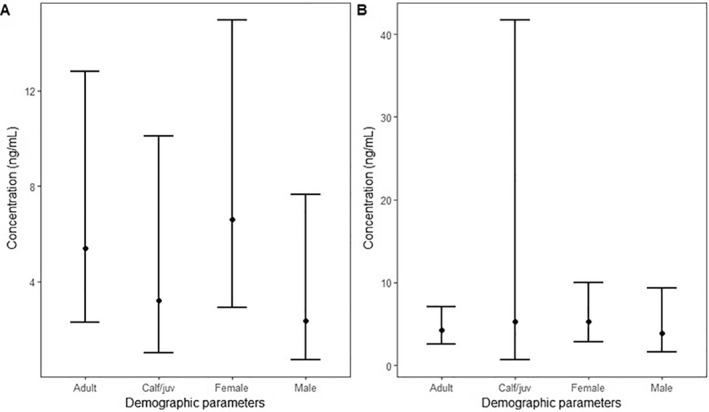
Common bottlenose dolphins (Tursiops truncatus) have previously demonstrated exposure to phthalate esters. Phthalates and phthalate esters are commonly added to consumer goods to enhance desirable properties. As the amount of plastic marine debris increases, these chemicals can easily leach from these products into the surrounding environment. To evaluate demographic variability in exposure, eight phthalate metabolites were quantified in urine samples collected from free-ranging bottlenose dolphins sampled in Sarasota Bay, FL, USA (2010-2019; n = 51). Approximately 75% of individual dolphins had detectable concentrations of at least one phthalate metabolite. The most frequently detected metabolites were mono(2-ethylhexyl) phthalate (MEHP; n = 28; GM = 4.57 ng/mL; 95% CI = 2.37-8.80; KM mean = 7.95; s.d. = 15.88) and monoethyl phthalate (MEP; GM = 4.51 ng/mL; 95% CI = 2.77-7.34; ROS mean = 2.24; s.d. = 5.58). Urinary concentrations of MEHP and MEP were not significantly different between sex (MEHP p = 0.09; MEP p = 0.22) or age class (i.e., calf/juvenile vs. adult; MEHP p = 0.67; MEP p = 0.13). Additionally, there were no significant group differences in the likelihood of MEHP or MEP detection for any demographic as determined by a Peto-Peto test. Frequency of detection was similar for both metabolites between males and females (MEHP p = 0.10; MEP p = 0.40) as well as between juveniles and adults (MEHP p = 0.50; MEP: p = 0.60). These findings suggest ubiquitous exposure risk for both sexes and age classes, warranting further investigation into potential sources and health implications.
Keywords: anthropogenic contaminant; endocrine disruptor; marine mammal.
© 2021. The Authors. GeoHealth published by Wiley Periodicals LLC on behalf of American Geophysical Union.
Conflict of interest statement
The authors declare no conflicts of interest relevant to this study.
Figures
References
-
- ATSDR . (2001). Toxicological profile for di‐N‐butyl phthalate. GA. - PubMed
-
- ATSDR . (2017). Interaction profile for chlorinated dibenzo ‐p‐ dioxins. POLYBROMINATED DIPHENYL ETHERS. - PubMed
-
- ATSDR . (2019). Toxicological profile for di(2‐Ethylhexyl)phthalate (DEHP) draft for public comment. GA. - PubMed
LinkOut - more resources
Full Text Sources
Other Literature Sources
Research Materials