


Comparison of Balanced Crystalloid Solutions: A Systematic Review and Meta-Analysis of Randomized Controlled Trials
- PMID: 34036269
- PMCID: PMC8133105
- DOI: 10.1097/CCE.0000000000000398
Comparison of Balanced Crystalloid Solutions: A Systematic Review and Meta-Analysis of Randomized Controlled Trials
Abstract
Objective: To summarize the evidence comparing various balanced crystalloid solutions.
Data sources: We searched MEDLINE, EMBASE, PUBMED, and CENTRAL databases.
Study selection: We included randomized controlled trials that directly compared the IV administration of one balanced crystalloid solution with another.
Data extraction and analysis: We examined metabolic and patient-important outcomes and conducted meta-analysis using random effects model. For comparisons or outcomes with insufficient data to allow for pooling, we describe results narratively. We assessed risk of bias for individual trials using the Cochrane risk of bias tool and certainty of evidence using Grading of Recommendations, Assessment, Development and Evaluations methodology.
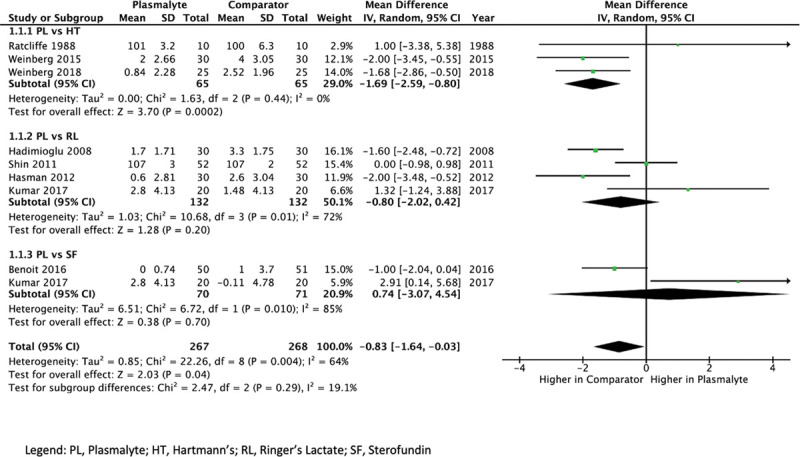
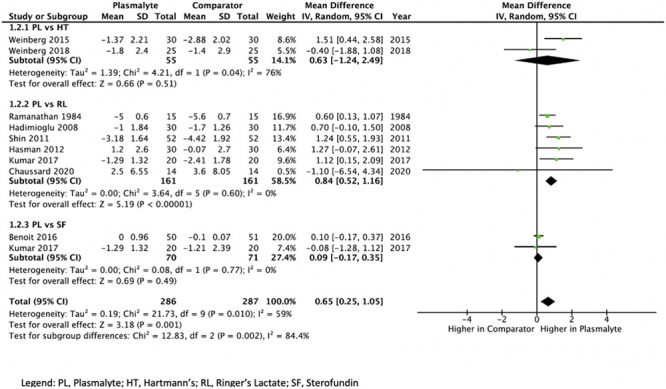
Data synthesis: We included 24 randomized controlled trials comparing Plasmalyte, Ringer's Lactate, Ringerfundin, Hartmann's solution, Ringer's Bicarbonate, Sterofundin, Kabilyte, Normosol, and novel balanced solutions. Of the included studies, 16 were performed in the perioperative setting, six in the ICU, one in the emergency department, and one in healthy volunteers. Administration of Plasmalyte resulted in a lower postinfusion serum chloride concentration (mean difference, 0.83 mmol/L lower; 95% CI, 0.03-1.64 mmol/L lower, low certainty), higher postinfusion base excess (mean difference, 0.65 mmol/L higher, 95% CI, 0.25-1.05 mmol/L higher, low certainty), and lower postinfusion serum lactate levels (mean difference, 0.46 mmol/L lower; 95% CI, 0.05-0.87 mmol/L lower, low certainty) compared with administration of any other balanced crystalloid. There were no important differences in postinfusion serum pH or potassium when comparing Plasmalyte with other balanced crystalloids. Data addressing other comparisons or examining the impact of different balanced crystalloids on patient-important outcomes were sparsely reported and too heterogeneous to allow for pooling.
Conclusions: Administration of Plasmalyte results in lower serum concentrations of chloride and lactate, and higher base excess than other balanced crystalloids. The certainty of evidence is low and requires further study in large randomized controlled trials to inform the choice of balanced crystalloid in patients requiring volume replacement.
Keywords: acid-base equilibrium; balanced solutions; crystalloids; fluid therapy.
Copyright © 2021 The Authors. Published by Wolters Kluwer Health, Inc. on behalf of the Society of Critical Care Medicine.
Conflict of interest statement
The authors have disclosed that they do not have any potential conflicts of interest.
Figures
References
-
- Myburgh JA, Mythen MG. Resuscitation fluids. N Engl J Med. 2013; 369:1243–1251 - PubMed
-
- Scheingraber S, Rehm M, Sehmisch C, et al. Rapid saline infusion produces hyperchloremic acidosis in patients undergoing gynecologic surgery. Anesthesiology. 1999; 90:1265–1270 - PubMed
-
- Langer T, Santini A, Scotti E, et al. Intravenous balanced solutions: From physiology to clinical evidence. Anaesthesiol Intensive Ther. 2015; 47:s78–s88 - PubMed
-
- Shaw AD, Bagshaw SM, Goldstein SL, et al. Major complications, mortality, and resource utilization after open abdominal surgery: 0.9% saline compared to plasma-lyte. Ann Surg. 2012; 255:821–829 - PubMed
Publication types
LinkOut - more resources
Full Text Sources
Other Literature Sources
