


Representation of Women in Top Executive Positions in General Medical-Surgical Hospitals in the United States
- PMID: 34036295
- PMCID: PMC8139257
- DOI: 10.1089/whr.2020.0111
Representation of Women in Top Executive Positions in General Medical-Surgical Hospitals in the United States
Abstract
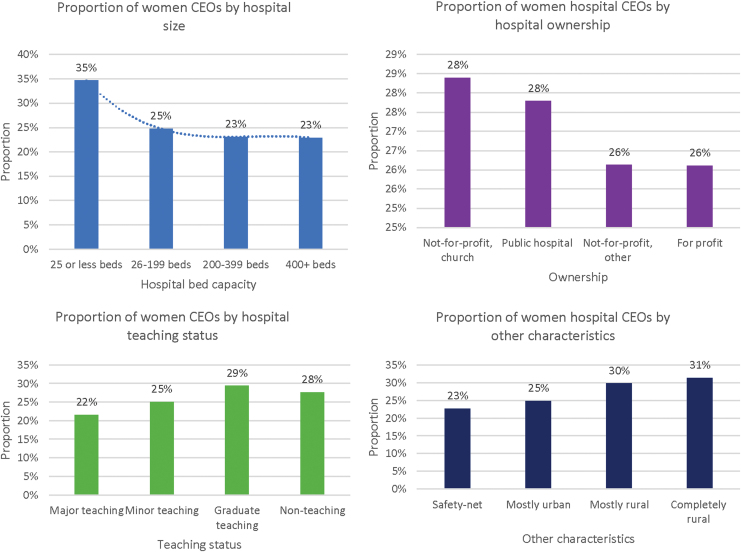
Background: Earlier surveys have reported a lack of representation of women in hospital leadership positions. This study sought to investigate the proportion of women in senior hospital leadership positions and to investigate whether hospital and community factors are associated with the likelihood of having women in executive positions. Methods: The main data of 4397 hospitals were sourced from the American Hospital Association. The study calculated the proportion of women for each position, with county-level adjusted standard errors and logistic transformed confidence intervals to determine the variation of women in chief officer positions across hospitals. The study also used multilevel mixed-effects logistic regressions to estimate the probability of having a female chief officer. Results: Women executives generally were underrepresented in all positions except in chief human resources and chief nursing officer positions, 73% (95% confidence interval [CI] 7175) and 91% (95% CI 8694), respectively. Women accounted for 13% (95% CI 821) of system chief executive officers (CEOs) and only 27% (95% CI 2628) of hospital CEOs. System size (number of hospitals) and hospital size (beds capacity) variables were statistically significant in five of the eight positions investigated. Overall, women were less likely to hold chief positions in large hospitals (400 beds and over) compared to small hospitals (under 100 beds). Conclusion: Women were underrepresented in hospital top positions and were less likely to hold executive positions in large systems or hospitals. The results suggest structural barriers that hinder women from advancing to top hospital positions.
Keywords: gender disparities; gender diversity in hospital leadership; hospital leadership.
Jason N. Mose 2021; Published by Mary Ann Liebert, Inc.
Conflict of interest statement
No competing financial interests exist.
Figures
References
-
- Bureau of Labor Statistics(BLS). Employed persons by detailed industry, sex, race, and Hispanic or Latino ethnicity 2018 [cited 2020]. Available at: https://www.bls.gov/cps/cpsaat18.htm Accessed October28, 2020
-
- Equal Employment Opportunity Commission(EEOC). Job Patterns For Minorities And Women In Private Industry (EEO-1)-Health Care and Social Assistance 2018 [cited 2020]. Available at: https://www1.eeoc.gov/eeoc/statistics/employment/jobpat-eeo1/2018/index.... Accessed October28, 2020
-
- American College of Healthcare Executives (ACHE). A comparison of the career attainments of men and women healthcare executives [White paper]. 2012 [cited 2020]. Available at: https://www.ache.org/-/media/ache/learning-center/research/2012genderrep... Accessed October28, 2020
-
- Lantz PM. Gender and leadership in healthcare administration: 21st century progress and challenges. J Healthc Manag 2008;53:291–301. - PubMed
-
- American College of Healthcare Executives (ACHE). A comparison of the career attainments of men and women healthcare executives [White paper]. 2006 [cited 2020]. Available at: https://www.ache.org/-/media/ache/learning-center/research/gender_study_... Accessed October28, 2020
LinkOut - more resources
Full Text Sources
Other Literature Sources