


Cut-off points for serum ferritin to identify low iron stores during the first year of life in a cohort of Mexican infants
- PMID: 34036744
- PMCID: PMC8476433
- DOI: 10.1111/mcn.13205
Cut-off points for serum ferritin to identify low iron stores during the first year of life in a cohort of Mexican infants
Abstract
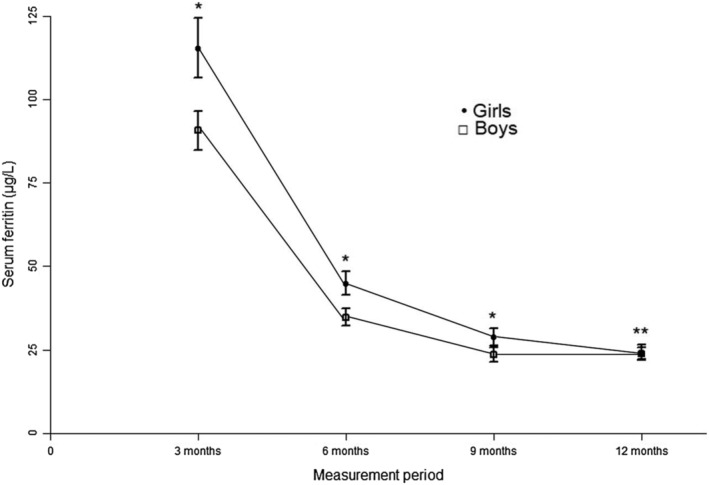
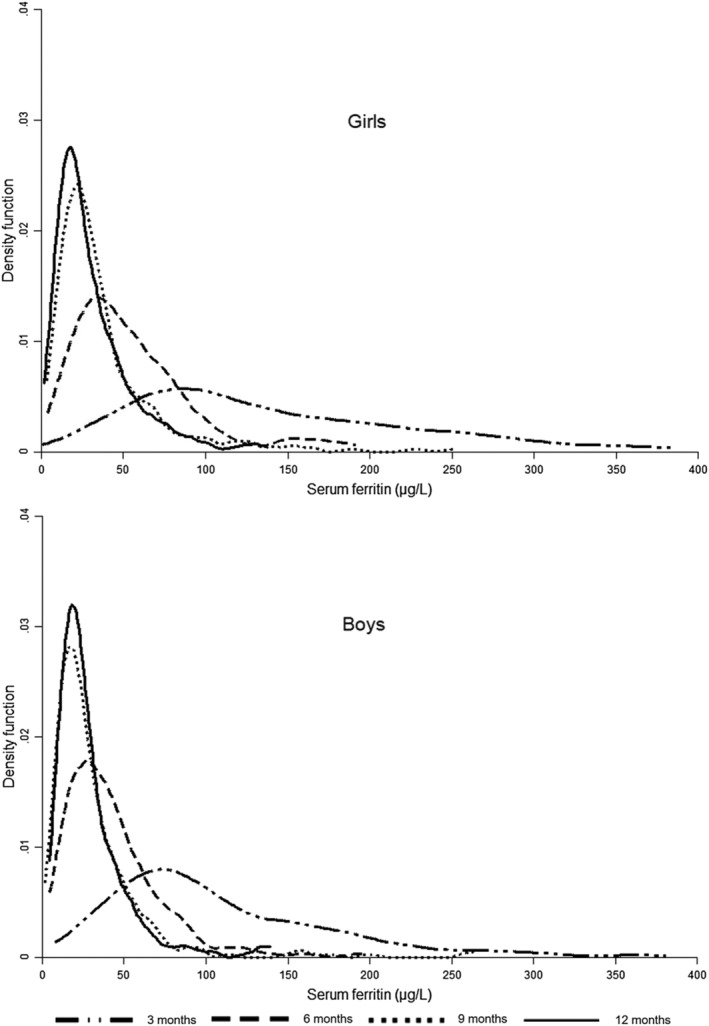
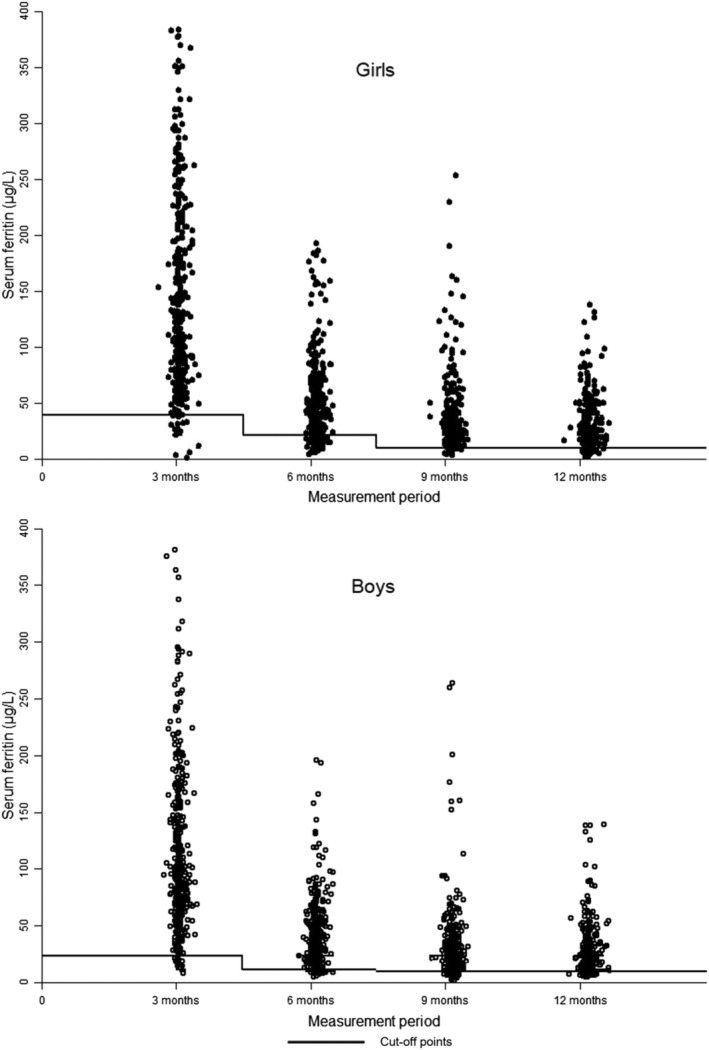
The aim of this study was to identify serum ferritin (SF) cut-off points (COPs) in a cohort of healthy full-term normal birth weight infants who had repeated measurements of SF and haemoglobin every 3 months during the first year of life. The study included 746 full-term infants with birth weight ≥2,500 g, having uncomplicated gestations and births. Participants received prophylactic iron supplementation (1 mg/day of iron element) from the first to the 12th month of life and did not develop anaemia during the first year of life. Two statistical methods were considered to identify COPs for low iron stores at 3, 6, 9 and 12 months of age: deviation from mean and cluster analysis. According to the K-means cluster analysis results by age and sex, COPs at 3 and 6 months for girls were 39 and 21 μg/L and for boys 23 and 11 μg/L, respectively. A single COP of 10 μg/L was identified, for girls and boys, at both 9 and 12 months. Given the physiological changes in SF concentration during the first year of life, our study identified dynamic COPs, which differed by sex in the first semester. Adequate SF COPs are necessary to identify low iron stores at an early stage of iron deficiency, which represents one of the most widespread public health problems around the world, particularly in low- and middle-income countries.
Keywords: K-means cluster analysis; assessment of iron status; epidemiology; infant iron status; iron deficiency; low iron stores; nutrition; public health; serum ferritin; serum ferritin cut-off points.
© 2021 The Authors. Maternal & Child Nutrition published by John Wiley & Sons Ltd.
Conflict of interest statement
The authors declare no conflict of interest.
Figures
References
-
- Aggett, P. J., Agostoni, C., Axelsson, I., Bresson, J. L., Goulet, O., Hernell, O., Koletzko, B., Lafeber, H. L., Michaelsen, K. F., Micheli, J. L., Rigo, J., Szajewska, H., & Weaver, L. T. (2002). Iron metabolism and requirements in early childhood: do we know enough?: A commentary by the ESPGHAN Committee on Nutrition. Journal of Pediatric Gastroenterology and Nutrition, 34(4), 337–345. 10.1097/00005176-200204000-00003 - DOI - PubMed
-
- Bergman, L. R., & Magnusson, D. (2001). Person‐centered Research. In Smelser N. J. & Baltes P. B. (Eds.), International encyclopedia of the social & behavioral sciences (pp. 11333–11339). Oxford: Pergamon. 10.1016/B0-08-043076-7/00764-6 - DOI
-
- Chandyo, R. K., Henjum, S., Ulak, M., Thorne‐Lyman, A. L., Ulvik, R. J., Shrestha, P. S., Locks, L., Fawzi, W., & Strand, T. A. (2016). The prevalence of anemia and iron deficiency is more common in breastfed infants than their mothers in Bhaktapur, Nepal. European Journal of Clinical Nutrition, 70(4), 456–462. 10.1038/ejcn.2015.199 - DOI - PMC - PubMed
-
- Colantonio, D. A., Kyriakopoulou, L., Chan, M. K., Daly, C. H., Brinc, D., Venner, A. A., Pasic, M. D., Armbruster, D., & Adeli, K. (2012). Closing the gaps in pediatric laboratory reference intervals: A CALIPER database of 40 biochemical markers in a healthy and multiethnic population of children. Clinical Chemistry, 58(5), 854–868. 10.1373/clinchem.2011.177741 - DOI - PubMed
Publication types
MeSH terms
Substances
LinkOut - more resources
Full Text Sources
Other Literature Sources
