


Changes in the behavioural determinants of health during the COVID-19 pandemic: gender, socioeconomic and ethnic inequalities in five British cohort studies
- PMID: 34039660
- PMCID: PMC8159672
- DOI: 10.1136/jech-2020-215664
Changes in the behavioural determinants of health during the COVID-19 pandemic: gender, socioeconomic and ethnic inequalities in five British cohort studies
Abstract
Background: The COVID-19 pandemic is expected to have far-reaching consequences on population health. We investigated whether these consequences included changes in health-impacting behaviours which are important drivers of health inequalities.
Methods: Using data from five representative British cohorts (born 2000-2002, 1989-1990, 1970, 1958 and 1946), we investigated sleep, physical activity (exercise), diet and alcohol intake (N=14 297). We investigated change in each behaviour (pre/during the May 2020 lockdown), and differences by age/cohort, gender, ethnicity and socioeconomic position (childhood social class, education attainment and adult financial difficulties). Logistic regression models were used, accounting for study design and non-response weights, and meta-analysis used to pool and test cohort differences in association.
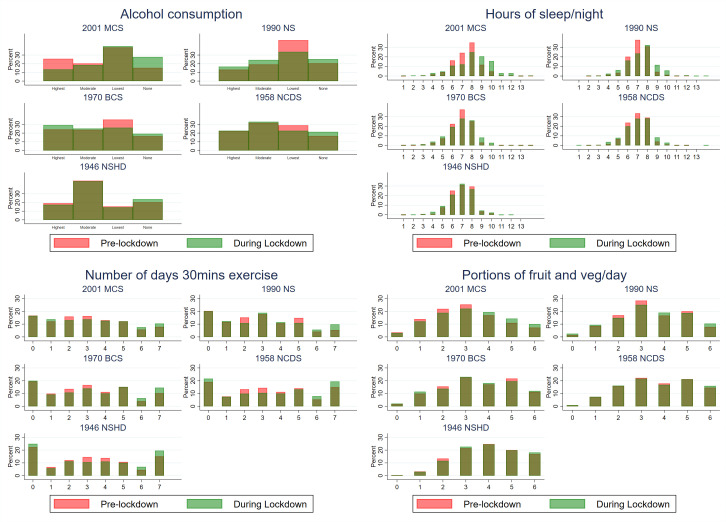
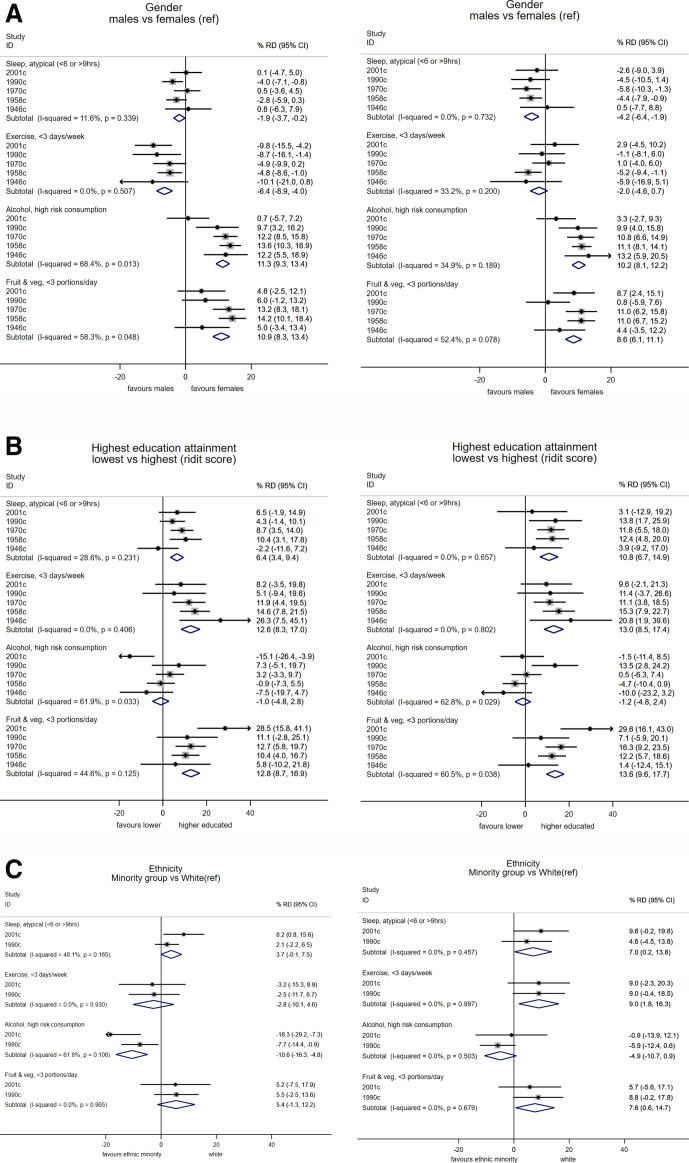
Results: Change occurred in both directions-shifts from the middle part of the distribution to both declines and increases in sleep, exercise and alcohol use. Older cohorts were less likely to report changes in behaviours while the youngest reported more frequent increases in sleep, exercise, and fruit and vegetable intake, yet lower alcohol consumption. Widening inequalities in sleep during lockdown were more frequent among women, socioeconomically disadvantaged groups and ethnic minorities. For other outcomes, inequalities were largely unchanged, yet ethnic minorities were at higher risk of undertaking less exercise and consuming lower amounts of fruit and vegetables.
Conclusions: Our findings provide new evidence on the multiple changes to behavioural outcomes linked to lockdown, and the differential impacts across generation, gender, socioeconomic circumstances across life, and ethnicity. Lockdown appeared to widen some (but not all) forms of health inequality.
Keywords: cohort studies; health; health inequalities; social epidemiology.
© Author(s) (or their employer(s)) 2021. Re-use permitted under CC BY. Published by BMJ.
Conflict of interest statement
Competing interests: None declared.
Figures
References
-
- Joyce R, Xu X. Sector shutdowns during the coronavirus crisis: which workers are most exposed. Institute for Fiscal Studies Briefing Note BN278 2020;6.
-
- GBD 2016 Risk Factors Collaborators . Global, regional, and national comparative risk assessment of 84 behavioural, environmental and occupational, and metabolic risks or clusters of risks, 1990–2016: a systematic analysis for the global burden of disease study 2016. Lancet 2017;390:1345–422. 10.1016/S0140-6736(17)32366-8 - DOI - PMC - PubMed
Publication types
MeSH terms
Grants and funding
LinkOut - more resources
Full Text Sources
Other Literature Sources
Medical
