. 2021 May 26;11(1):11055.
doi: 10.1038/s41598-021-90443-9.

Biological impacts on the lungs in rats internally exposed to radioactive 56MnO2 particle

Affiliations

Biological impacts on the lungs in rats internally exposed to radioactive 56MnO2 particle

Nariaki Fujimoto et al. Sci Rep. .

Abstract

To understand the radiation effects of the atomic bombing of Hiroshima and Nagasaki among the survivors, radiation from neutron-induced radioisotopes in soil should be considered in addition to the initial radiation directly received from the bombs. 56Mn, which emits both β particles and γ-rays, is one of the dominant radioisotopes created in soil by neutrons from the bomb. Thus we investigated the biological effects of internal exposure to 56MnO2 particle in the lung of male Wistar rats comparing to the effects of external 60Co-γ irradiation. Absorbed doses of internal irradiation of lungs were between 25 and 65 mGy in 56MnO2-exposed animals, while the whole body doses were between 41 and 100 mGy. Animals were examined on days 3 and 61 after the exposure. There were no remarkable pathological changes related to 56MnO2 particle exposure. However, mRNA and protein expressions of aquaporin 5 increased significantly in the lung tissue on day 3 postexposure in 56MnO2 groups (by 1.6 and 2.9 times, respectively, in the highest dose group). Smad7 mRNA expression was also significantly elevated by 30% in the highest dose group of 56MnO2. Our data demonstrated that internal exposure to 56MnO2 induced significant biological responses including gene expression changes in the lungs, while external 60Co-γ irradiation of 2 Gy did not show any changes.


Conflict of interest statement

The authors declare no competing interests.

Figures
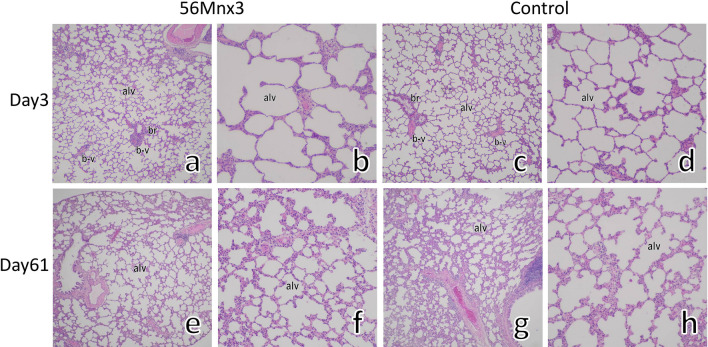
Figure 1
Figure 1
The rats' lungs on days 3 (ad) and 61 (eh) after 56MnO2 exposure and the control (HE staining). There were no significant histological alternations in the lungs among Mn56x3 (a,b,e,f) and the control (c,d,g,h) groups. The structure of alveoli (alv) was normal with bronchiole (br) and blood vessels (b-v) in the Mn56x3 group. There were no signs of thickening of the alveolus wall even on day 61 postexposure (f) compared to the control (h). Original magnification × 40 (a,c,e,g), or × 100 (b,d,f,h).
Figure 2
Figure 2
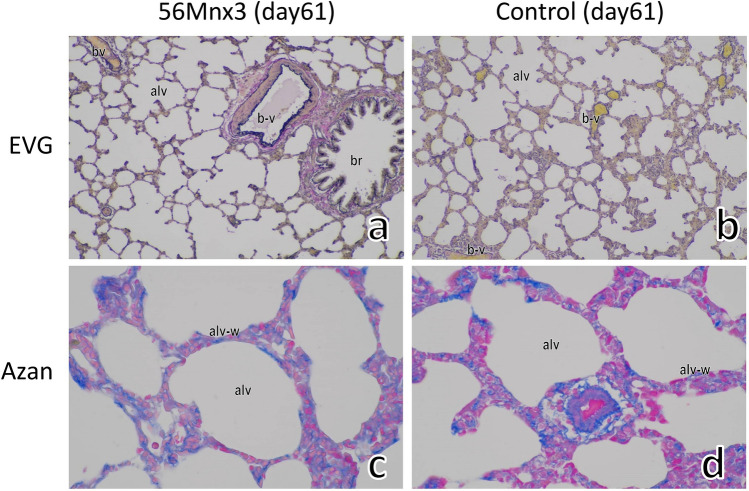
The lung of rats on day 61 after 56MnO2 exposure (a,c) and the control (b,d). EVG staining indicated no significant changes in elastin (dark blue or black color) in the alveoli (alv) by 56Mn exposure (a). Azan staining showed no signs of increased collagen deposition (blue color) in the alveolus wall (alv-w) in the 56Mnx3 group (c). Original magnification, × 100 (a,b), or × 400 (c,d).
Figure 3
Figure 3
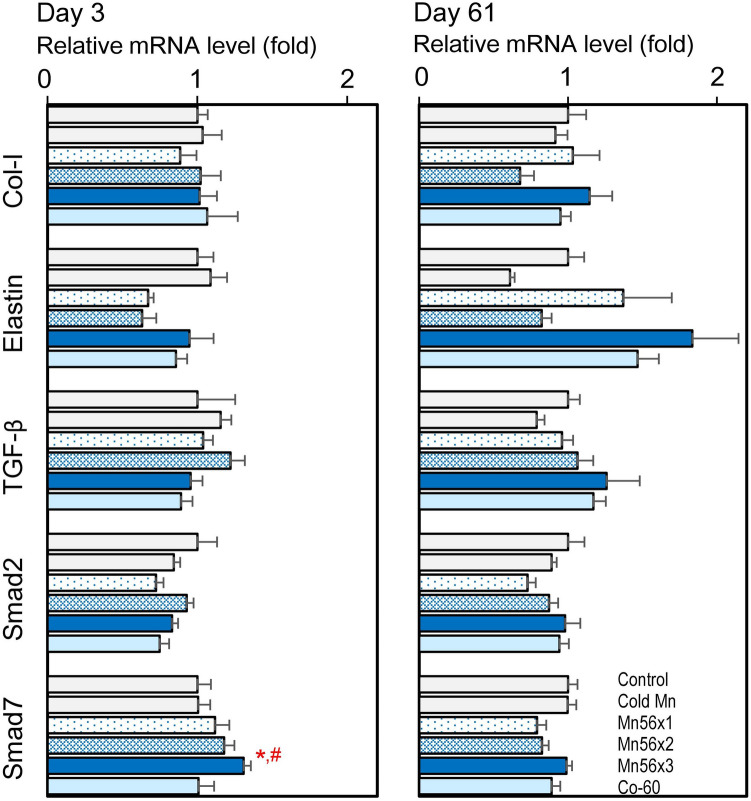
Relative mRNA expression levels of collagen-I, elastin, TGF-β, Smad2 and Smad7 genes in the lungs of rats on day 3 (left) and day 61 (right) after the exposure to 56MnO2 powder (Mn56x1, Mn56x2, Mn56x3), Cold MnO2 powder (Cold Mn) or 60Co-γ exposure (Co-60). *p < 0.05 vs. control; #p < 0.05 vs cold Mn.
Figure 4
Figure 4
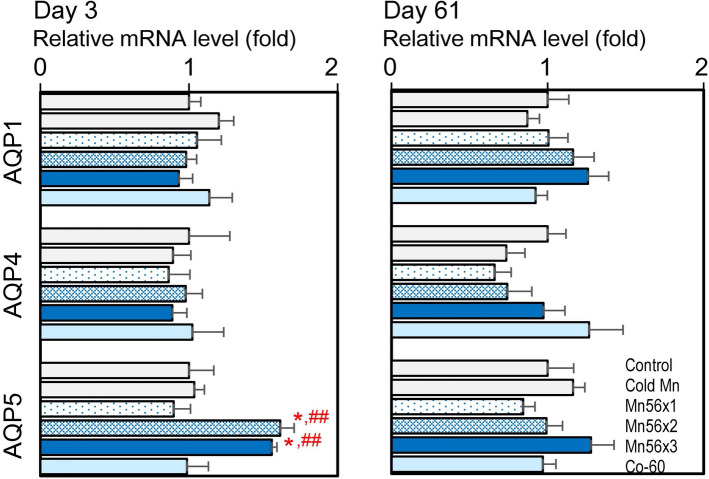
Relative mRNA expression levels of AQP1, AQP4, and AQP5 genes in the lungs of rats on day 3 (left) and day 61 (right) after the exposure to 56MnO2 powder (Mn56x1, Mn56x2, Mn56x3), Cold MnO2 powder (Cold Mn) or 60Co-γ exposure (Co-60). *p < 0.05 vs. control; ##p < 0.01 vs cold Mn.
Figure 5
Figure 5
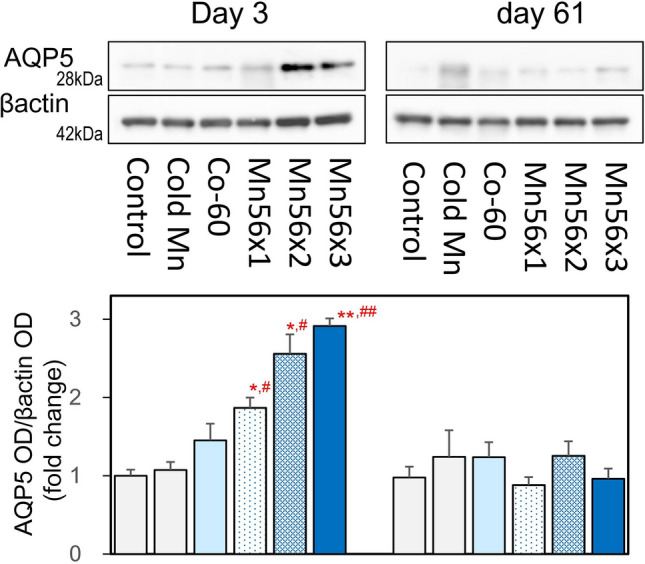
Western blot analysis and densitometry for AQP5 in the lung on postexposure days 3 and 61. β-Actin was presented as an internal control. Lysates extracted from the lung were examined. *p < 0.05, **p < 0.01 vs. control; #p < 0.05, ##p < 0.01 vs cold Mn.

References

    1. Imanaka T, Endo S, Tanaka K, Shizuma K. Gamma-ray exposure from neutron-induced radionuclides in soil in Hiroshima and Nagasaki based on DS02 calculations. Radiat. Environ. Biophys. 2008;47:331–336. doi: 10.1007/s00411-008-0164-1. - DOI - PubMed
    1. Tanaka K, et al. Skin dose from neutron-activated soil for early entrants following the A-bomb detonation in Hiroshima: Contribution from β and γ rays. Radiat. Environ. Biophys. 2008;47:323–330. doi: 10.1007/s00411-008-0172-1. - DOI - PubMed
    1. Shichijo K, et al. Internal exposure to neutron-activated 56Mn dioxide powder in Wistar rats—Part 2: Pathological effects. Radiat. Environ. Biophys. 2017;56:55–61. doi: 10.1007/s00411-016-0676-z. - DOI - PMC - PubMed
    1. Stepanenko V, et al. Internal exposure to neutron-activated 56Mn dioxide powder in Wistar rats: Part 1: Dosimetry. Radiat. Environ. Biophys. 2017;56:47–54. doi: 10.1007/s00411-016-0678-x. - DOI - PubMed
    1. Stepanenko V, et al. Internal doses in experimental mice and rats following exposure to neutron-activated 56MnO2 powder: Results of an international, multicenter study. Radiat. Environ. Biophys. 2020;59:683–692. doi: 10.1007/s00411-020-00870-x. - DOI - PMC - PubMed

Publication types

Substances

LinkOut - more resources