. 2021 May 26;11(1):10956.
doi: 10.1038/s41598-021-90527-6.

HDAC6 inhibitors sensitize non-mesenchymal triple-negative breast cancer cells to cysteine deprivation

Affiliations

HDAC6 inhibitors sensitize non-mesenchymal triple-negative breast cancer cells to cysteine deprivation

Tahiyat Alothaim et al. Sci Rep. .

Abstract

Triple-negative breast cancer (TNBC) is a highly malignant type of breast cancer and lacks effective therapy. Targeting cysteine-dependence is an emerging strategy to treat the mesenchymal TNBC. However, many TNBC cells are non-mesenchymal and unresponsive to cysteine deprivation. To overcome such resistance, three selective HDAC6 inhibitors (Tubacin, CAY10603, and Tubastatin A), identified by epigenetic compound library screening, can synergize with cysteine deprivation to induce cell death in the non-mesenchymal TNBC. Despite the efficacy of HDAC6 inhibitor, knockout of HDAC6 did not mimic the synthetic lethality induced by its inhibitors, indicating that HDAC6 is not the actual target of HDAC6 inhibitor in this context. Instead, transcriptomic profiling showed that tubacin triggers an extensive gene transcriptional program in combination with erastin, a cysteine transport blocker. Notably, the zinc-related gene response along with an increase of labile zinc was induced in cells by the combination treatment. The disturbance of zinc homeostasis was driven by PKCγ activation, which revealed that the PKCγ signaling pathway is required for HDAC6 inhibitor-mediated synthetic lethality. Overall, our study identifies a novel function of HDAC6 inhibitors that function as potent sensitizers of cysteine deprivation and are capable of abolishing cysteine-independence in non-mesenchymal TNBC.


Conflict of interest statement

The authors declare no competing interests.

Figures

Figure 1
Figure 1
Epigenetic compound library screening identifies HDAC6 inhibitors to promote cell death of cystine deprivation. (A,B) Relative cell survival of TNBC HCC38 and luminal T47D cells treated with epigenetic compounds under cystine-depleted (-Cys) and cystine-replete (+ Cys) conditions were determined by CellTiter-Glo assay at 72 h. (C,D) Cell viability of TNBC MDA-MB-436 cells was measured by ATP level (C; n = 3; *p < 0.01) or stained by crystal violet (D) under either cystine-replete (Con), cystine-depleted (-Cys), 5 μM tubacin (T), or 5 μM tubacin under cystine-depleted (-Cys + T) treatments for 72 h. (E,F) Survival rate of HCC38, HCC70, and T47D cells in response to either control (Con), 5 μM erastin, 5 μM tubacin, or combination of erastin and tubacin (E + T) were determined by trypan blue counting (E; **p < 0.001) or CellTiter-Glo assay (F; n = 3; #p < 0.001). (G) Cell viability of HCC38 cells was measured by CellTiter-Glo assay under either control (Con), 5 μM erastin, various concentrations of Cay10603 (Cay) 0.5, 1, and 2 μM, or erastin plus Cay (E + Cay) treatments for 48 h (n = 3; ##p < 0.005). (H) Relative cell survival of HCC38 was assessed by crystal violet staining after treatment with Con, 5 μM erastin, 2 μM Cay, or E + Cay for 48 h.
Figure 2
Figure 2
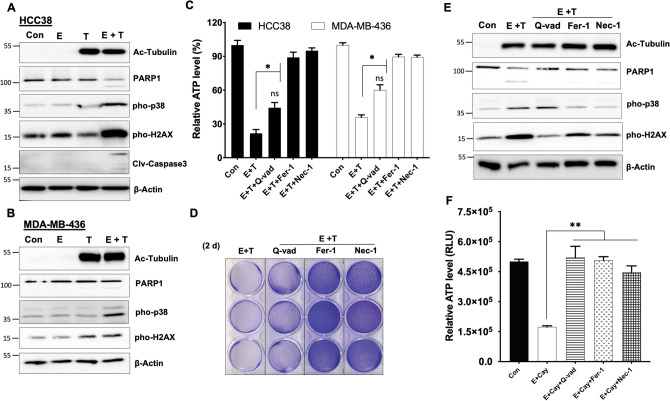
HDAC6 inhibitors synergize with erastin to induce a mixed type of cell death. (A,B) Immunoblot analysis of acetylated-tubulin, PARP1, cleaved Caspase-3, phosphorylated p38, and H2AX protein expression in HCC38 cells (A; 24 h) and in MDA-MB-436 cells (B; 36 h) under either control (Con), 5 μM erastin (E), 5 μM tubacin (T), or combination of erastin and tubacin (E + T) treatments; β-Actin serves as a protein normalization control. (C, D) Relative cell survival of HCC38 (48 h) and MDA-MB-436 (72 h) were measured by CellTiter-Glo assay (C; n = 3; *p < 0.001) or assessed by crystal violet staining in HCC38 (D) under either Con, combination of E + T, or E + T with different cell death inhibitors Q-Vad (10 μM), Fer-1(10 μM), Nec-1 (20 μM) treatments for 48 h. (E) Immunoblot analysis of indicated protein expression in HCC38 cells treated as (C) for 24 h. (F) Relative cell survival of HCC38 cells under either control (Con), combination of erastin and 2 μM Cay (E + Cay), or E + Cay with following death inhibitors Q-Vad 10 μM, Fer-1 (10 μM; **p < 0.005), Nec-1 (20 μM; **p < 0.005) treatments for 48 h.
Figure 3
Figure 3
Knockout of HDAC6 fails to mimic tubacin to induce synergistic cell death. (A–C) Immunoblotting analysis (Upper panel) of HDAC6 and acetylated tubulin in the empty vector (Vec) cells and sgRNA HDAC6 (gHDAC6) clones of HCC38 (A), MDA-MB-436 (B), and T47D (C) cells. Relative cell survival (Lower panel) was measured by the ATP level in indicated cells under either control (Con), 5 μM erastin, or combination of erastin and 5 μM tubacin (E + T) treatment for 72 h (n = 3). (D) Western blot analysis of indicted protein expression in HCC38 Vec or gHDAC6 HCC38 cells (Clone #1) under either control (Con), 5 μM erastin (E), 5 μM tubacin (T), or combination of erastin and tubacin (E + T) treatments for 24 h. (E) Cell viability was assessed by crystal violet staining in MDA-MB-436 Vec or gHDAC6 clones under either control (Con), erastin (E), or erastin plus different doses of tubacin (E + T) treatments for 72 h.
Figure 4
Figure 4
Tubacin synergizes with erastin to induce an extensive gene transcriptional response. (A) Heatmap cluster view of transcriptional profiling in HCC38 cells under treatments of either control (Con), 5 μM erastin (E), 5 μM tubacin (T), or combination of erastin and tubacin (E + T) for 24 h. (B) Gene enrichment of GSEA analysis in the gene expression profile induced by E + T. (C) RT-qPCR analysis of apoptotic gene expression in HCC38 and MDA-MB-436 (n = 3; *p < 0.001) cells treated as (A). (D) Immunoblot analysis of BCL-2 and BNIP3 protein expression in HCC38 cells. (E) RT-qPCR analysis of apoptotic gene expression (#p < 0.0001) in HCC38 Vector and gHDAC6 #1 cells treated as (A). (F) Immunoblot analysis of BNIP3 protein expression in HCC38 Vec and gHDAC6 #1 cells.
Figure 5
Figure 5
The zinc-related gene response is triggered by erastin plus tubacin. (A,B) RT-qPCR analysis of zinc-related gene expression (n = 3; *p < 0.005) in HCC38 cells (A; 24 h) and MDA-MB-436 (B; 36 h) under treatments of either control (Con), 5 μM erastin (E), 5 μM tubacin (T), or erastin plus tubacin (E + T). (C) RT-qPCR analysis of zinc-related gene expression (n = 3; **p < 0.005) in MDA-MB-436 (36 h) under treatments of either control (Con), 5 μM erastin (E), 5 μM Cay10603 (Cay), or erastin plus Cay10603 (E + Cay). (D) Live cell imaging of HCC38 cells that were treated as (A) for 18 h and stained by Fluozin-3 and DAPI (Hoechst 33342). The size of the scale bar is 100 μm. (E) Total cellular zinc was measured by ICP-AES analysis (n = 3; n.s., not significant) in MDA-MB-436 cells under either control (Con), 5 μM erastin (E), 5 μM tubacin (T), or erastin plus tubacin (E + T) treatments for 24 h. (F) Relative cell viability of HCC38 cells under either control or E + T with different concentrations of TPEN for 48 h (n = 3; n.s., not significant).
Figure 6
Figure 6
Inhibition of PKC suppresses increase of labile zinc and cell death. (A) Relative cell survival of HCC38 cells under either control or 5 μM erastin and 5 μM tubacin (E + T) treatments with or without PKC inhibitor Gö 6976 or Gö 6983 for 72 h (n = 3; *p < 0.005). (B) Western blot analysis in HCC38 cells that were treated as (A) for 24 h. (C,D) RT-qPCR expression analysis of apoptotic genes (C; **p < 0.001) and zinc-related genes (D; #p < 0.0001). (E) Living cell imaging of HCC38 cells that were treated as (A) for 18 h and stained by Fluozin-3 and DAPI (Hoechst 33342). The size of the scale bar is 50 μm.
Figure 7
Figure 7
PKCγ is required for the tubacin-mediated cell death. (A,B) Relative cell survival of HCC38 (A; n = 3; *p < 0.001) and MDA-MB-436 (B; n = 3; *p < 0.005) under either control (Con) or 5 μM erastin plus 5 μM tubacin (E + T) treatments with or without PKC inhibitors bisindolylmaleimideI (Bis) or sotrastaurin (Sotr) for 72 h. (C) Immunoblotting protein analysis in MDA-MB-436 cells under either Con or E + T treatments with or without Gö 6983 for indicated times. (D) Cell viability of HCC38 Vec and shPKCγ-#1cells under either Con, or erastin (5 μM) plus different doses of tubacin for 48 h (n = 4; **p < 0.01). (E) Immunoblotting protein analysis in HCC38 Vec and shPKCγ-#1cells under either Con or erastin plus tubacin for 24 h. (F) Cell viability of MDA-MB-436 Vec and shPKCγ-#1 cells under either Con or erastin (5 μM) with different doses of tubacin for 72 h (n = 4; ##p < 0.01).

References

    1. Cancer Genome Atlas, N Comprehensive molecular portraits of human breast tumours. Nature. 2012;490:61–70. doi: 10.1038/nature11412. - DOI - PMC - PubMed
    1. Bieche I, Lidereau R. Genome-based and transcriptome-based molecular classification of breast cancer. Curr. Opin. Oncol. 2011;23:93–99. doi: 10.1097/CCO.0b013e3283412ee0. - DOI - PubMed
    1. Dai X, et al. Breast cancer intrinsic subtype classification, clinical use and future trends. Am. J. Cancer Res. 2015;5:2929–2943. - PMC - PubMed
    1. Weigelt B, Peterse JL, van ‘t Veer LJ. Breast cancer metastasis: Markers and models. Nat. Rev. Cancer. 2005;5:591–602. doi: 10.1038/nrc1670. - DOI - PubMed
    1. DeSantis C, Siegel R, Bandi P, Jemal A. Breast cancer statistics, 2011. CA Cancer J. Clin. 2011;61:409–418. doi: 10.3322/caac.20134. - DOI - PubMed

Publication types

MeSH terms