


Receptor for advanced glycation end-products axis and coronavirus disease 2019 in inflammatory bowel diseases: A dangerous liaison?
- PMID: 34040321
- PMCID: PMC8130044
- DOI: 10.3748/wjg.v27.i19.2270
Receptor for advanced glycation end-products axis and coronavirus disease 2019 in inflammatory bowel diseases: A dangerous liaison?
Abstract
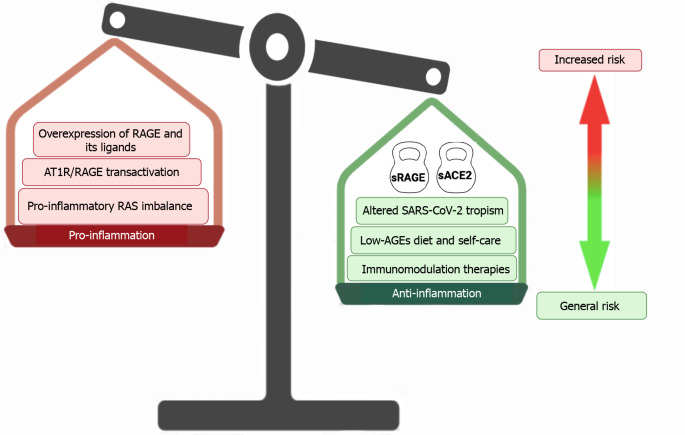
Compelling evidence supports the crucial role of the receptor for advanced glycation end-products (RAGE) axis activation in many clinical entities. Since the beginning of the coronavirus disease 2019 pandemic, there is an increasing concern about the risk and handling of severe acute respiratory syndrome coronavirus 2 (SARS-CoV-2) infection in inflammatory gastrointestinal disorders, such as inflammatory bowel diseases (IBD). However, clinical data raised during pandemic suggests that IBD patients do not have an increased risk of contracting SARS-CoV-2 infection or develop a more severe course of infection. In the present review, we intend to highlight how two potentially important contributors to the inflammatory response to SARS-CoV-2 infection in IBD patients, the RAGE axis activation as well as the cross-talk with the renin-angiotensin system, are dampened by the high expression of soluble forms of both RAGE and the angiotensin-converting enzyme (ACE) 2. The soluble form of RAGE functions as a decoy for its ligands, and soluble ACE2 seems to be an additionally attenuating contributor to RAGE axis activation, particularly by avoiding the transactivation of the RAGE axis that can be produced by the virus-mediated imbalance of the ACE/angiotensin II/angiotensin II receptor type 1 pathway.
Keywords: Advanced glycation; Alarmins; Angiotensin-converting enzyme 2; COVID-19; Inflammation; Inflammatory bowel diseases; Receptor for advanced glycation end-products; Receptor for advanced glycation end-products axis.
©The Author(s) 2021. Published by Baishideng Publishing Group Inc. All rights reserved.
Conflict of interest statement
Conflict-of-interest statement: The authors declare that there is no conflict of interest.
Figures
References
-
- Goyal P, Choi JJ, Pinheiro LC, Schenck EJ, Chen R, Jabri A, Satlin MJ, Campion TR Jr, Nahid M, Ringel JB, Hoffman KL, Alshak MN, Li HA, Wehmeyer GT, Rajan M, Reshetnyak E, Hupert N, Horn EM, Martinez FJ, Gulick RM, Safford MM. Clinical Characteristics of Covid-19 in New York City. N Engl J Med. 2020;382:2372–2374. - PMC - PubMed
-
- Hui KPY, Cheung MC, Perera RAPM, Ng KC, Bui CHT, Ho JCW, Ng MMT, Kuok DIT, Shih KC, Tsao SW, Poon LLM, Peiris M, Nicholls JM, Chan MCW. Tropism, replication competence, and innate immune responses of the coronavirus SARS-CoV-2 in human respiratory tract and conjunctiva: an analysis in ex-vivo and in-vitro cultures. Lancet Respir Med. 2020;8:687–695. - PMC - PubMed
-
- Guan WJ, Ni ZY, Hu Y, Liang WH, Ou CQ, He JX, Liu L, Shan H, Lei CL, Hui DSC, Du B, Li LJ, Zeng G, Yuen KY, Chen RC, Tang CL, Wang T, Chen PY, Xiang J, Li SY, Wang JL, Liang ZJ, Peng YX, Wei L, Liu Y, Hu YH, Peng P, Wang JM, Liu JY, Chen Z, Li G, Zheng ZJ, Qiu SQ, Luo J, Ye CJ, Zhu SY, Zhong NS China Medical Treatment Expert Group for Covid-19. Clinical Characteristics of Coronavirus Disease 2019 in China. N Engl J Med. 2020;382:1708–1720. - PMC - PubMed
-
- Huang C, Wang Y, Li X, Ren L, Zhao J, Hu Y, Zhang L, Fan G, Xu J, Gu X, Cheng Z, Yu T, Xia J, Wei Y, Wu W, Xie X, Yin W, Li H, Liu M, Xiao Y, Gao H, Guo L, Xie J, Wang G, Jiang R, Gao Z, Jin Q, Wang J, Cao B. Clinical features of patients infected with 2019 novel coronavirus in Wuhan, China. Lancet. 2020;395:497–506. - PMC - PubMed
Publication types
MeSH terms
Substances
LinkOut - more resources
Full Text Sources
Other Literature Sources
Medical
Miscellaneous
