


Pathophysiological mechanisms underlying gastrointestinal symptoms in patients with COVID-19
- PMID: 34040326
- PMCID: PMC8130047
- DOI: 10.3748/wjg.v27.i19.2341
Pathophysiological mechanisms underlying gastrointestinal symptoms in patients with COVID-19
Abstract
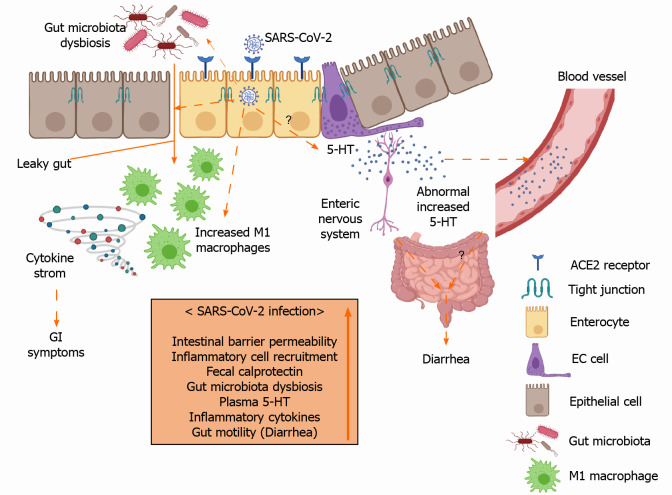
Gastrointestinal (GI) symptoms, such as diarrhea, abdominal pain, vomiting, and anorexia, are frequently observed in patients with coronavirus disease 2019 (COVID-19). However, the pathophysiological mechanisms connecting these GI symptoms to severe acute respiratory syndrome coronavirus 2 (SARS-CoV-2) infections remain elusive. Previous studies indicate that the entry of SARS-CoV-2 into intestinal cells leads to downregulation of angiotensin converting enzyme 2 (ACE2) receptors resulting in impaired barrier function. While intestinal ACE2 functions as a chaperone for the amino acid transporter B0AT1, the B0AT1/ACE2 complex within the intestinal epithelium acts as a regulator of gut microbiota composition and function. Alternations to the B0AT1/ACE2 complex lead to microbial dysbiosis through increased local and systemic immune responses. Previous studies have also suggested that altered serotonin metabolism may be the underlying cause of GI disorders involving diarrhea. The findings of elevated plasma serotonin levels and high fecal calprotectin in COVID-19 patients with diarrhea indicate that the viral infection evokes a systemic inflammatory response that specifically involves the GI. Interestingly, the elevated proinflammatory cytokines correlate with elevated serotonin and fecal calprotectin levels further supporting the evidence of GI inflammation, a hallmark of functional GI disorders. Moreover, the finding that rectal swabs of COVID-19 patients remain positive for SARS-CoV-2 even after the nasopharynx clears the virus, suggests that viral replication and shedding from the GI tract may be more robust than that of the respiratory tract, further indicating fecal-oral transmission as another important route of viral spread. This review summarized the evidence for pathophysiological mechanisms (impaired barrier function, gut inflammation, altered serotonin metabolism and gut microbiota dysbiosis) underlying the GI symptoms in patients with COVID-19.
Keywords: Angiotensin converting enzyme 2 receptor; COVID-19; Gastrointestinal symptoms; Gut microbiota dysbiosis; Impaired barrier function; Serotonin.
©The Author(s) 2021. Published by Baishideng Publishing Group Inc. All rights reserved.
Conflict of interest statement
Conflict-of-interest statement: The authors declare that the research was conducted in the absence of any commercial or financial relationships that could be construed as a potential conflict of interest.
Figures
References
-
- Hui DS, I Azhar E, Madani TA, Ntoumi F, Kock R, Dar O, Ippolito G, Mchugh TD, Memish ZA, Drosten C, Zumla A, Petersen E. The continuing 2019-nCoV epidemic threat of novel coronaviruses to global health - The latest 2019 novel coronavirus outbreak in Wuhan, China. Int J Infect Dis. 2020;91:264–266. - PMC - PubMed
-
- Lu R, Zhao X, Li J, Niu P, Yang B, Wu H, Wang W, Song H, Huang B, Zhu N, Bi Y, Ma X, Zhan F, Wang L, Hu T, Zhou H, Hu Z, Zhou W, Zhao L, Chen J, Meng Y, Wang J, Lin Y, Yuan J, Xie Z, Ma J, Liu WJ, Wang D, Xu W, Holmes EC, Gao GF, Wu G, Chen W, Shi W, Tan W. Genomic characterisation and epidemiology of 2019 novel coronavirus: implications for virus origins and receptor binding. Lancet. 2020;395:565–574. - PMC - PubMed
Publication types
MeSH terms
LinkOut - more resources
Full Text Sources
Other Literature Sources
Medical
Miscellaneous
