


Developmental Trajectories in Very Preterm Born Children Up to 8 Years: A Longitudinal Cohort Study
- PMID: 34041210
- PMCID: PMC8143520
- DOI: 10.3389/fped.2021.672214
Developmental Trajectories in Very Preterm Born Children Up to 8 Years: A Longitudinal Cohort Study
Abstract
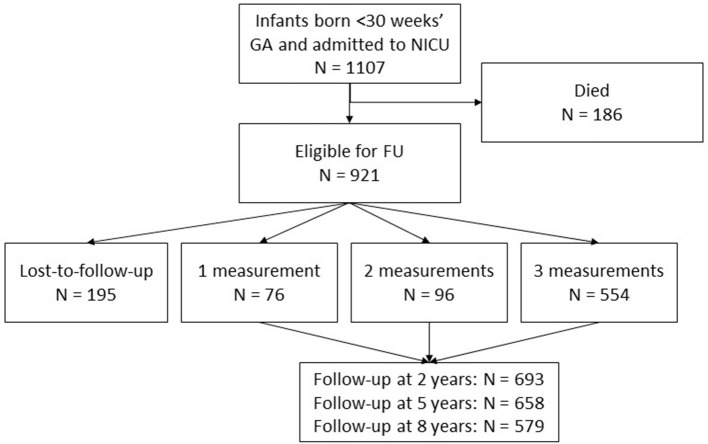
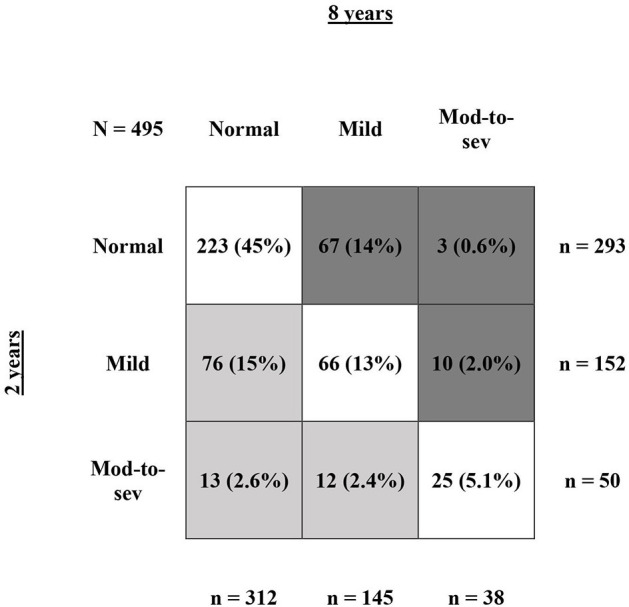
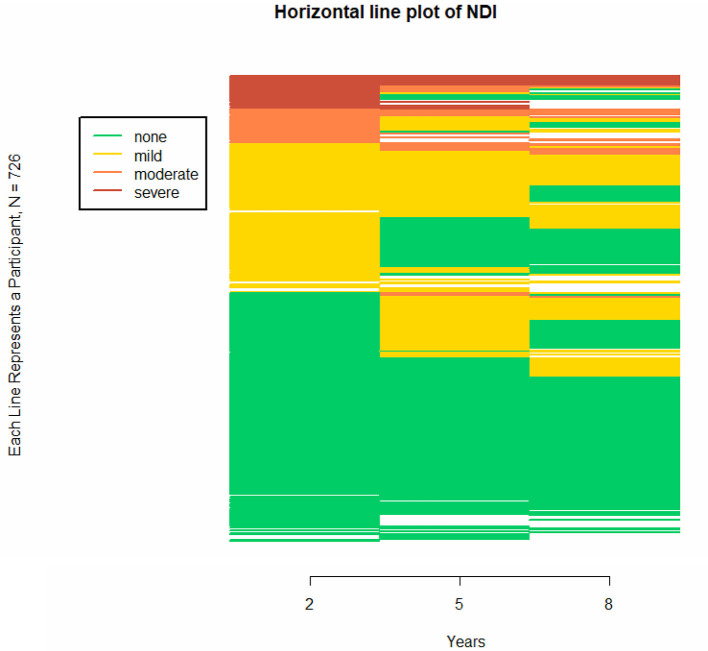
Aim: Long-term outcome data in preterm children is often limited to cross-sectional measurement of neurodevelopmental impairment (NDI) at the corrected age of 24-36 months. However, impairments may only become overt during childhood or resolve with time, and individual trajectories in outcome over time may vary. The primary aim of this study was to describe NDI in very preterm born children at three subsequent ages of 2, 5, and 8 years of age. As a secondary aim, a longitudinal analysis was performed on the individual longitudinal trajectories in NDI from 2 to 8 years of age. Methods: Single-center prospective cohort study including children born between 1990 and 2011 below 30 weeks' gestation and followed into 2019. The outcome measurement was NDI assessed at 2, 5, and 8 years of age. NDI is a composite score that includes cognitive, neurological, visual, and auditory functions, in which problems were categorized as none, mild, moderate, or severe. Cognitive function measured as total DQ/IQ score was assessed by standardized psychometric tests. Neurological, visual, and auditory functions were assessed by the neonatologist. Results: In total, 921 children were eligible for follow-up, of whom 726 (79%) children were assessed. No NDI was seen in 54, 54, and 62%, mild NDI was seen in 31, 36, and 30%, and moderate-to-severe NDI was seen in 15, 9.2, and 8.6% of the children at 2, 5, and 8 years, respectively. From 2 to 8 years, 63% of the children remained in the same NDI category, 20% of the children improved to a better NDI category, and 17% deteriorated toward a worse NDI category. No differences were found in baseline characteristics of infants that improved or deteriorated. Extreme prematurity, male gender and low parental education were associated with worse NDI status at all time points. Although we observed considerable individual variation over time in NDI status, the course of the trajectories in NDI were not associated with gestation, gender, and parental education. Conclusions: Continued follow-up until school life is essential in order to provide optimal and individually focused referrals and care when needed.
Keywords: NDI; longitudinal follow-up; neurodevelopmental outcome; trajectories; very preterm children.
Copyright © 2021 van Beek, van der Horst, Wetzer, van Baar, Vugs and Andriessen.
Conflict of interest statement
The authors declare that the research was conducted in the absence of any commercial or financial relationships that could be construed as a potential conflict of interest.
Figures
References
-
- Linsell L, Johnson S, Wolke D, O'Reilly H, Morris JK, Kurinczuk JJ, et al. . Cognitive trajectories from infancy to early adulthood following birth before 26 weeks of gestation: a prospective, population-based cohort study. Arch Dis Child. (2018) 103:363–70. 10.1136/archdischild-2017-313414 - DOI - PMC - PubMed
LinkOut - more resources
Full Text Sources
Other Literature Sources
Research Materials
