


A user-friendly decision support tool to assist one-health risk assessors
- PMID: 34041349
- PMCID: PMC8141943
- DOI: 10.1016/j.onehlt.2021.100266
A user-friendly decision support tool to assist one-health risk assessors
Abstract
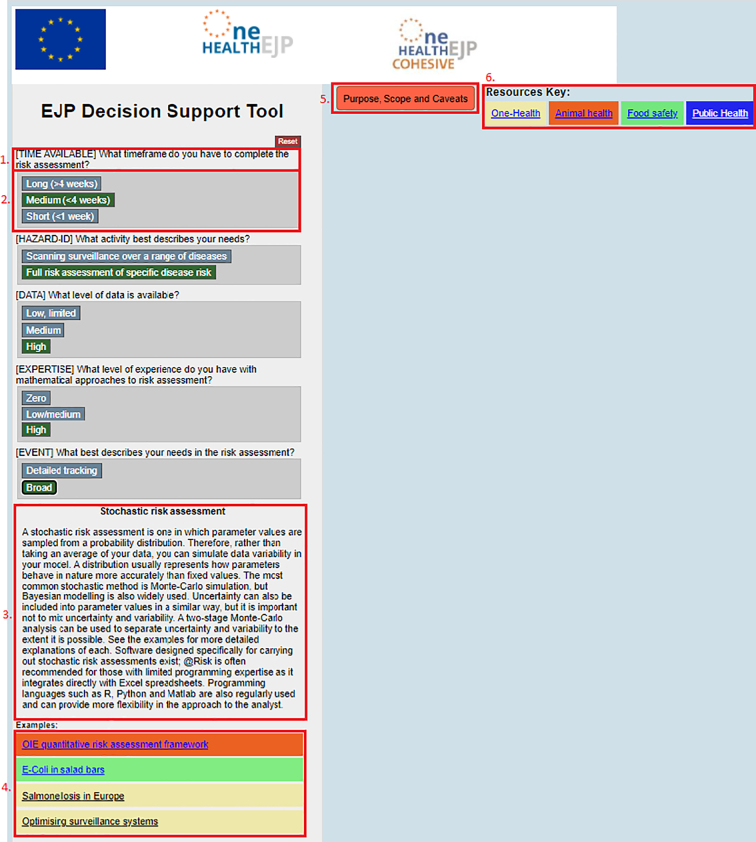
One-Health risk assessments are integral to developing efficient responses to disease threats, including global pandemics. However, short timeframes, inadequate disease-specific information and an insufficient skill-base make it hard for inexperienced assessors to distinguish between a large portfolio of approaches. The wrong choice can detract from the disease response. Here, we present an interactive decision support tool to help with this choice. A workshop with participants from diverse professional backgrounds provided six themes that should be considered when deciding on the best approach. Questions based on these themes were then developed to populate a decision tree which guides users to their most appropriate approach. One-Health risk assessment tools and literature were used as examples of the different approaches. The tool provides links to these examples and short descriptions of the approaches. Answers are easily changed, facilitating exploration though different approaches. The simple data structure of the tool means it is easy to update with more resources and approaches. It provides a valuable source of guidance and information for less experienced risk assessors.
Keywords: Decision tree; Online; Resources; User interface; Workshop; Zoonoses.
© 2021 Published by Elsevier B.V.
Conflict of interest statement
None
Figures
References
-
- World health organisation . Food & Agriculture Org; Geneva: 2019. Taking a Multisectoral One Health Approach: A Tripartite Guide to Addressing Zoonotic Diseases in Countries.
-
- Marks H., Coleman M. Qualitative and quantitative risk assessment. Food Control. 1999;10:289–297. doi: 10.1016/S0956-7135(99)00052-3. - DOI
-
- Hauser R., Breidenbach E. Swiss Federal Veterinary Office Risk Assessments: advantages and limitations of the qualitative method. Adv. Stat. Meth. Health Sci. 2007;7:519–526. doi: 10.1007/978-0-8176-4542-7_32. - DOI
LinkOut - more resources
Full Text Sources
Other Literature Sources
