


Seasonal influenza vaccination policies in the 194 WHO Member States: The evolution of global influenza pandemic preparedness and the challenge of sustaining equitable vaccine access
- PMID: 34041476
- PMCID: PMC8143996
- DOI: 10.1016/j.jvacx.2021.100097
Seasonal influenza vaccination policies in the 194 WHO Member States: The evolution of global influenza pandemic preparedness and the challenge of sustaining equitable vaccine access
Abstract
Introduction: As of 2018, 118 of 194 WHO Member States reported the presence of an influenza vaccination policy. Although influenza vaccination policies do not guarantee equitable access or ensure vaccination coverage, they are critical to establishing a coordinated influenza vaccination program, which can reduce morbidity and mortality associated with yearly influenza, especially in high-risk groups. Established programs can also provide a good foundation for pandemic preparedness and response.
Methods: We utilized EXCEL and STATA to evaluate changes to national seasonal influenza vaccination policies reported on the WHO/UNICEF Joint Reporting Forms on Immunization (JRF) in 2014 and 2018. To characterize countries with or without policies, we incorporated external data on World Bank income groupings, WHO regions, and immunization system strength (using 3 proxy indicators).
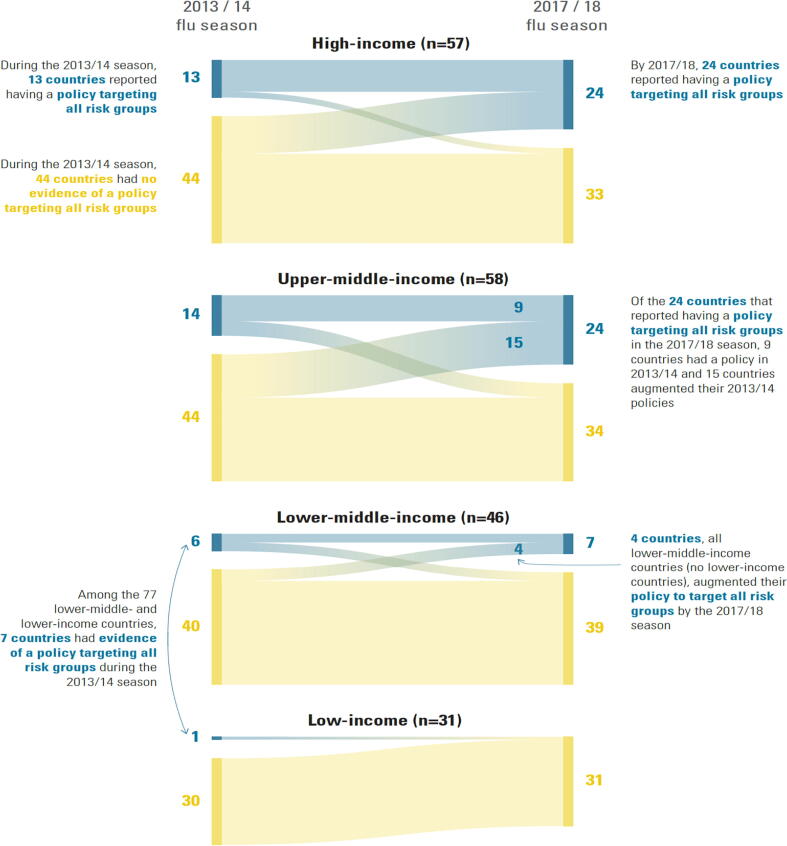
Results: From 2014 to 2018 there was a small net increase in national seasonal influenza vaccination policies from 114 (59%) to 118 (61%). There was an increase in policies targeting high-risk groups from 34 in 2014 (34 /114 policies, 29%) to 56 (56/118 policies, 47%) in 2018. Policies were consistently more frequent in high-income countries, in WHO Regions of the Americas (89% of countries) and Europe (89%), and in countries satisfying all three immunization system strength indicators. Low and low-middle income countries, representing 40% of the worlds' population, accounted for 52/61 (85%) of countries with no evidence of a policy in either year.
Conclusion: Our results demonstrate that national influenza vaccination policies vary significantly by region, income, and immunization system strength, and are less common in lower-income countries. Barriers to establishing and maintaining policies should be further examined as part of international efforts to expand influenza vaccination policies globally. Next generation influenza vaccine development should work to address barriers to influenza vaccination policy adoption, such as cost, logistics for adult vaccination, country priorities, need for yearly vaccination, and variations in seasonality.
Keywords: Global influenza vaccines; Influenza vaccination policy; Joint reporting form; Pandemic preparedness.
© 2021 Published by Elsevier Ltd.
Conflict of interest statement
The authors declare that they have no known competing financial interests or personal relationships that could have appeared to influence the work reported in this paper.
Figures



References
-
- World Health Organization, 70 years of influenza control. 2020, Timeline of key events related to influenza history, cited Nov 12, 2020. Available at https://www.who.int/influenza/gip-anniversary/en/.
-
- Centers for Disease Control, Influenza historic timeline. 2020, Timeline of significant events related to influenza, cited Nov 2, 2020. Available at https://www.cdc.gov/flu/pandemic-resources/pandemic-timeline-1930-and-be....
-
- World Health Organization, World health assembly adopts new international health regulations [Press release]. 2005, cited September 17, 2020. Available at https://www.who.int/mediacentre/news/releases/2005/pr_wha03/en/.
-
- World Health Assembly,Wha58.5, Strengthening pandemic-influenza preparedness and response. Document A58/13. 2005, https://apps.who.int/iris/bitstream/handle/10665/20355/WHA58_5-en.pdf?se....
Grants and funding
LinkOut - more resources
Full Text Sources
Other Literature Sources
Research Materials
