


Substance Use, Mental Health, and Weight-Related Behaviors During the COVID-19 Pandemic Among Metabolic and Bariatric Surgery Patients
- PMID: 34041701
- PMCID: PMC8154548
- DOI: 10.1007/s11695-021-05488-6
Substance Use, Mental Health, and Weight-Related Behaviors During the COVID-19 Pandemic Among Metabolic and Bariatric Surgery Patients
Abstract
Purpose: The impact of the COVID-19 pandemic on behavioral issues among those who have completed bariatric surgery (BS) is not well described in ethnically diverse populations. The aim of this study was to compare the impact of COVID-19 lockdown orders and after lockdown orders were lifted on substance use, mental health, and weight-related behaviors among a sample of post-BS adults.
Materials and methods: A retrospective medical chart review identified BS patients from one university-based obesity medicine clinic and two BS practices. An online non-anonymous survey was implemented in two phases: during lockdown (April 1-May 31, 2020) and after lockdown orders were lifted (June 1, 2020-September 30, 2020) to obtain information about the COVID-19 pandemic's impact on BS patients.
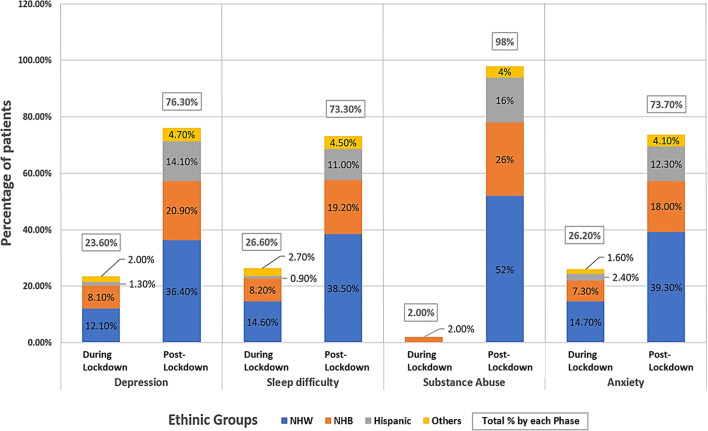
Results: A total of 189 (during lockdown=39, post-lockdown=150) participants (90.4% female, mean age 52.4 years, SD 11.1, 49.8% non-Hispanic White, 30.6% non-Hispanic Black, 16.1% Hispanic) participated. Lockdown participants were more likely to have sleep problems (74.3% vs. 56.1%, P=.039) and feel anxious (82.0% vs. 63.0%, P=.024) versus post-lockdown participants. A majority (83.4%) reported depression in both lockdown/post-lockdown. Post-lockdown participants were more than 20 times more likely to report substance use compared those in lockdown (aOR 20.56, 95% CI 2.66-158.4).
Conclusions and relevance: The COVID-19 pandemic is having a substantial negative impact on substance use, mental health, and weight-related health behaviors in diverse BS patients. These findings have important implications for post-BS patient care teams and may suggest the integration of screening tools to identify those at high risk for behavioral health issues.
Keywords: Bariatric surgery; Behaviors; COVID-19; Mental health; Substance use.
© 2021. The Author(s), under exclusive licence to Springer Science+Business Media, LLC, part of Springer Nature.
Conflict of interest statement
The authors declare no competing interests.
Figures
Similar articles
-
Substance use, mental health and weight-related behaviours during the COVID-19 pandemic in people with obesity.Clin Obes. 2021 Apr;11(2):e12440. doi: 10.1111/cob.12440. Epub 2021 Feb 4. Clin Obes. 2021. PMID: 33539652 Free PMC article.
-
Patients Undergoing Bariatric Surgery: a Special Risk Group for Lifestyle, Emotional and Behavioral Adaptations During the COVID-19 Lockdown. Lessons from the First Wave.Obes Surg. 2022 Feb;32(2):441-449. doi: 10.1007/s11695-021-05792-1. Epub 2021 Nov 17. Obes Surg. 2022. PMID: 34791617 Free PMC article.
-
Psychosocial, Lifestyle, and Body Weight Impact of COVID-19-Related Lockdown in a Sample of Participants with Current or Past History of Obesity in Spain.Obes Surg. 2021 May;31(5):2115-2124. doi: 10.1007/s11695-021-05225-z. Epub 2021 Jan 23. Obes Surg. 2021. PMID: 33486709 Free PMC article.
-
Impact of COVID-19 on the Destiny of Bariatric Patients.Nutrients. 2022 Dec 29;15(1):163. doi: 10.3390/nu15010163. Nutrients. 2022. PMID: 36615820 Free PMC article. Review.
-
An overview of mental health during the COVID-19 pandemic.Diagnosis (Berl). 2021 Jul 2;8(4):403-412. doi: 10.1515/dx-2021-0046. Print 2021 Nov 25. Diagnosis (Berl). 2021. PMID: 34214386 Review.
Cited by
-
Telephone-based cognitive behavioural therapy for patients with postoperative bariatric surgery to manage COVID-19 pandemic-related mental health issues and distress (TELE-BARICARE): a protocol for a randomised controlled trial.BMJ Open. 2022 Sep 15;12(9):e067393. doi: 10.1136/bmjopen-2022-067393. BMJ Open. 2022. PMID: 36109026 Free PMC article.
-
Patient and healthcare practitioner evaluation of patient-reported outcomes in bariatric surgery - a modified Delphi study.Int J Obes (Lond). 2024 Oct;48(10):1489-1497. doi: 10.1038/s41366-024-01594-4. Epub 2024 Jul 26. Int J Obes (Lond). 2024. PMID: 39060359 Free PMC article.
-
Supporting adolescents' mental health during COVID-19 by utilising lessons from the aftermath of the Great East Japan Earthquake.Humanit Soc Sci Commun. 2022;9(1):332. doi: 10.1057/s41599-022-01330-1. Epub 2022 Sep 23. Humanit Soc Sci Commun. 2022. PMID: 36187842 Free PMC article. Review.
-
The global evolution of mental health problems during the COVID-19 pandemic: A systematic review and meta-analysis of longitudinal studies.J Affect Disord. 2022 Oct 15;315:70-95. doi: 10.1016/j.jad.2022.07.011. Epub 2022 Jul 14. J Affect Disord. 2022. PMID: 35842064 Free PMC article.
-
Effect of COVID-19 Lockdowns on Physical Activity, Eating Behavior, Body Weight and Psychological Outcomes in a Post-Bariatric Cohort.Obes Surg. 2022 Jul;32(7):1-9. doi: 10.1007/s11695-022-06069-x. Epub 2022 Apr 29. Obes Surg. 2022. PMID: 35486289 Free PMC article.
References
-
- Callaway E. Time to use the p-word? Coronavirus enters dangerous new phase. Nature. 2020; 10.1038/d41586-020-00551-1. - PubMed
Publication types
MeSH terms
Grants and funding
LinkOut - more resources
Full Text Sources
Other Literature Sources
Medical
Miscellaneous
