


Association between maternal smoking history and congenital anomalies in children: Results from the Japan Environment and Children's Study
- PMID: 34041797
- PMCID: PMC8453515
- DOI: 10.1111/cga.12430
Association between maternal smoking history and congenital anomalies in children: Results from the Japan Environment and Children's Study
Abstract
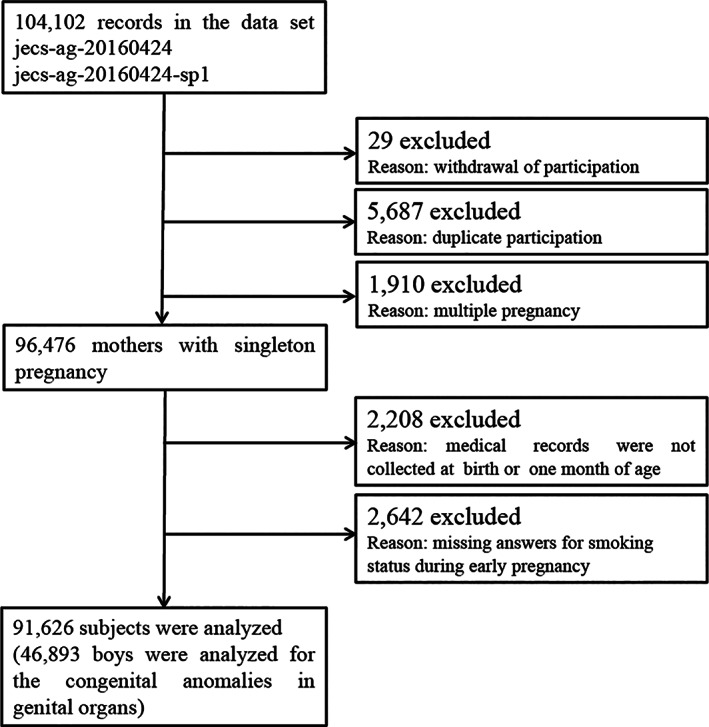
We investigated the relationship between maternal smoking history and congenital anomalies in children. Drawing on data from the Japan Environment and Children's Study collected between January 2011 and March 2014, the smoking habits of pregnant women were categorized as "never smoked," "quit before pregnancy, "quit after pregnancy," and "full smoking." Of the 91 626 participants examined, a total of 2199 (2.4%) infants were born with any congenital anomalies. Logistic regression analysis was used to determine the odds ratio for congenital anomalies in each group based on maternal smoking history. No significant difference was seen between the full-smoking and never smoked groups in the odds ratios for congenital anomalies of the nervous system; the eyes, ears, face, and neck; the cardiovascular system; or the musculoskeletal system. However, in the full-smoking group, the odds ratios for trisomy (adjusted odds ratio, 2.14; 95% confidence interval, 1.15-3.97) and any congenital anomalies (adjusted odds ratio, 1.35; 95% confidence interval, 1.09-1.67) were significantly higher compared with the never smoked group. Our results indicate that continuing to smoke during pregnancy is associated with increased risk of trisomy and any congenital anomalies in the general Japanese population.
Keywords: birth cohort; birth defects; congenital malformation; tobacco smoke; trisomy.
© 2021 The Authors. Congenital Anomalies published by John Wiley & Sons Australia, Ltd on behalf of Japanese Teratology Society.
Conflict of interest statement
The authors declare no conflict of interest.
Figures
References
-
- World Health Organization . Congenital anomalies. Fact Sheet 2020; http://www.who.int/mediacentre/factsheets/fs370/en/. Accessed 5 April 2021.
-
- Dwyer JB, Broide RS, Leslie FM. Nicotine and brain development. Birth Defects Res C Embryo Today. 2008;84(1):30‐44. - PubMed
-
- Norman CA, Halton DM. Is carbon monoxide a workplace teratogen? A review and evaluation of the literature. Ann Occup Hyg. 1990;34(4):335‐347. - PubMed
-
- Eriksen M, Mackay J, Schluger N, Islami F, Drope J. The tobacco atlas. In: 5thAtlanta: the American Cancer Society; 2015. Accessed 10 April 2021.
MeSH terms
Grants and funding
LinkOut - more resources
Full Text Sources
Other Literature Sources
Medical
