


Experiencing COVID-19 symptoms without the disease: The role of nocebo in reporting of symptoms
- PMID: 34041973
- PMCID: PMC8807543
- DOI: 10.1177/14034948211018385
Experiencing COVID-19 symptoms without the disease: The role of nocebo in reporting of symptoms
Abstract
Background: A nocebo effect occurs when inactive factors lead to worsening of symptoms or reduce treatment outcomes. Believing that one is or has been infected with COVID-19 may act as a nocebo. However, not much is known about potential nocebo effects associated with the reporting of COVID-19 symptoms.
Aim: An online survey investigated whether certainty of being infected with COVID-19, age, sex, cognitive, emotional and personality factors were associated with perceived severity of COVID-19 symptoms.
Methods: Participants (N=375) filled out an online survey containing 57 questions asking about symptoms resembling COVID-19, certainty of being infected with COVID-19, anxiety, stress and personality dimensions.
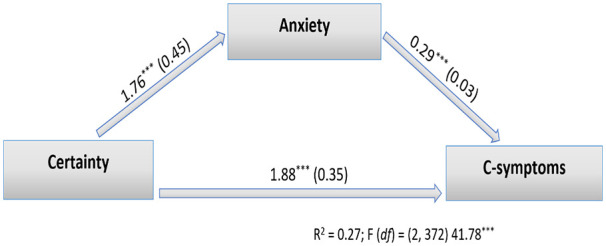
Results: Certainty of being infected with COVID-19 and anxiety predicted 27% of the variance in reporting of COVID-like symptoms. The mediation analysis showed that both higher certainty of being infected and anxiety independently predicted increased reports of COVID-like symptom. Females had higher anxiety and stress levels, and reported more COVID-like symptoms than males did. Older age was not associated with reporting COVID-like symptoms.
Conclusions: Believing to be infected with COVID-19, along with anxiety, can enhance the severity of COVID-like symptoms. Thus, the nocebo effect was due to both cognitive and emotional factors and was higher in females.
Keywords: COVID-19; coronavirus; negative emotions; nocebo effect; psychological factors.
Conflict of interest statement
Figures
References
-
- Petrie KJ, Rief W. Psychobiological mechanisms of placebo and nocebo effects: pathways to improve treatments and reduce side effects. Annu Rev Psychol 2019;70:599–625. - PubMed
-
- Lee SA. Coronavirus Anxiety Scale: a brief mental health screener for COVID-19 related anxiety. Death Stud 2020;44:393–401. - PubMed
MeSH terms
LinkOut - more resources
Full Text Sources
Other Literature Sources
Medical
