


Empanelment of health care facilities under Ayushman Bharat Pradhan Mantri Jan Arogya Yojana (AB PM-JAY) in India
- PMID: 34043664
- PMCID: PMC8158976
- DOI: 10.1371/journal.pone.0251814
Empanelment of health care facilities under Ayushman Bharat Pradhan Mantri Jan Arogya Yojana (AB PM-JAY) in India
Abstract
Introduction: India's Pradhan Mantri Jan Arogya Yojana (PM-JAY) is the world's largest health assurance scheme providing health cover of 500,000 INR (about USD 6,800) per family per year. It provides financial support for secondary and tertiary care hospitalization expenses to about 500 million of India's poorest households through various insurance models with care delivered by public and private empanelled providers. This study undertook to describe the provider empanelment of PM-JAY, a key element of its functioning and determinant of its impact.
Methods: We carried out secondary analysis of cross-sectional administrative program data publicly available in PM-JAY portal for 30 Indian states and 06 UTs. We analysed the state wise distribution, type and sector of empanelled hospitals and services offered through PM-JAY scheme across all the states and UTs.
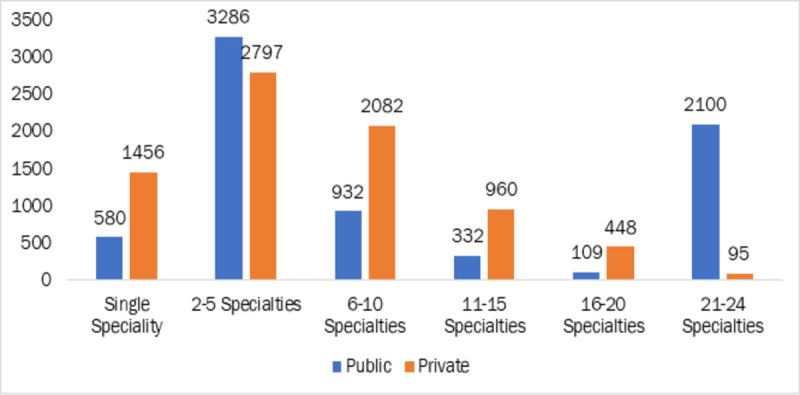
Results: We found that out of the total facilities empanelled (N = 20,257) under the scheme in 2020, more than half (N = 11,367, 56%) were in the public sector, while 8,157 (40%) facilities were private for profit, and 733 (4%) were private not for profit entities. State wise distribution of hospitals showed that five states (Karnataka (N = 2,996, 14.9%), Gujarat (N = 2,672, 13.3%), Uttar Pradesh (N = 2,627, 13%), Tamil Nadu (N = 2315, 11.5%) and Rajasthan (N = 2,093 facilities, 10.4%) contributed to more than 60% of empanelled PMJAY facilities: We also observed that 40% of facilities were offering between two and five specialties while 14% of empanelled hospitals provided 21-24 specialties.
Conclusion: A majority of the hospital empanelled under the scheme are in states with previous experience of implementing publicly funded health insurance schemes, with the exception of Uttar Pradesh. Reasons underlying these patterns of empanelment as well as the impact of empanelment on service access, utilisation, population health and financial risk protection warrant further study. While the inclusion and regulation of the private sector is a goal that may be served by empanelment, the role of public sector remains critical, particularly in underserved areas of India.
Conflict of interest statement
We are in full adherence of Plos One standard on sharing data and materials. I wish to confirm that all authors have no competing interests to declare.
Figures
References
-
- Nations United. Goal 3: Good health and well-being. In: Sustainable Development Goals Fund; [Internet]. 14 December 2015. [cited 13 Apr 2020]. Available: https://www.sdgfund.org/goal-3-good-health-and-well-being
-
- World Health Organization. Universal Health Coverage. In: WHO | Regional Office for Africa; [Internet]. [cited 13 Apr 2020]. Available: https://www.afro.who.int/health-topics/universal-health-coverage
-
- Lahariya C. “Ayushman Bharat” Program and Universal Health Coverage in India. Indian Pediatr. 2018;55: 495–506. - PubMed
-
- National Health Accounts Estimates for India 2016–17. National Health Accounts Technical Secretariat, National Health Systems Resource Centre, Ministry of Health & Family Welfare, Government of India; 2019. Available: http://nhsrcindia.org/sites/default/files/FINAL%20National%20Health%20Ac...
Publication types
MeSH terms
Grants and funding
LinkOut - more resources
Full Text Sources
Other Literature Sources
Medical
