Clinical and Procedural Outcomes with or without Balloon Guide Catheters during Endovascular Thrombectomy in Acute Ischemic Stroke: A Systematic Review and Meta-analysis with First-line Technique Subgroup Analysis
- PMID: 34045301
- PMCID: PMC8367631
- DOI: 10.3174/ajnr.A7164
Clinical and Procedural Outcomes with or without Balloon Guide Catheters during Endovascular Thrombectomy in Acute Ischemic Stroke: A Systematic Review and Meta-analysis with First-line Technique Subgroup Analysis
Abstract
Background: Balloon guide catheters are increasingly used to improve clot retrieval by temporarily stopping proximal blood flow during endovascular thrombectomy.
Purpose: Our aim was to provide a summary of the literature comparing the procedural and clinical outcomes of endovascular thrombectomy with or without balloon guide catheters, depending on the first-line technique used.
Data sources: We used PubMed/MEDLINE, EMBASE, and the Cochrane Database of Systematic Reviews.
Study selection: We chose studies that compared using balloon guide catheters with not using them.
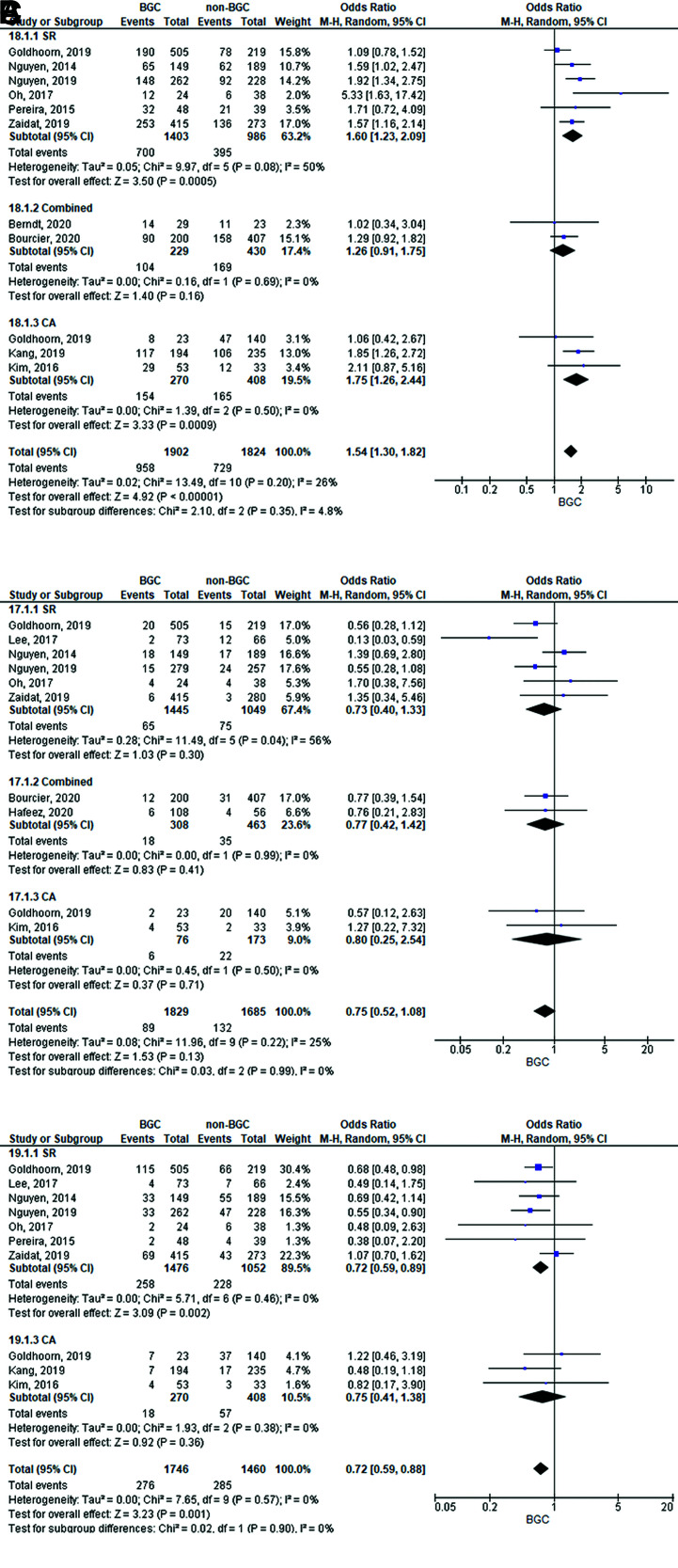
Data analysis: Random effects meta-analysis was performed to compare the procedural outcomes measured as the first-pass effect, successful reperfusion, number of passes, procedural duration, arterial puncture to reperfusion time, distal emboli, and clinical outcomes.
Data synthesis: Overall, a meta-analysis of 16 studies (5507 patients, 50.8% treated with balloon guide catheters and 49.2% without them) shows that the use of balloon guide catheters increases the odds of achieving a first-pass effect (OR = 1.92; 95% CI, 1.34-2.76; P < .001), successful reperfusion (OR = 1.85; 95% CI, 1.42-2.40; P < .001), and good functional outcome (OR =1.48; 95% CI, 1.27-1.73; P < .001). Balloon guide catheters reduce the number of passes (mean difference = -0.35; 95% CI, -0.65 to -0.04; P = .02), procedural time (mean difference = -19.73; 95% CI, -34.63 to -4.83; P = .009), incidence of distal or new territory emboli (OR = 0.5; 95% CI, 0.26-0.98; P = .04), and mortality (OR = 0.72; 95% CI, 0.62-0.85; P < .001). Similar benefits of balloon guide catheters are observed when the first-line technique was a stent retriever or contact aspiration, but not for a combined approach.
Limitations: The analysis was based on nonrandomized trials with a moderate risk of bias.
Conclusions: Current literature suggests improved clinical and procedural outcomes associated with the use of balloon guide catheters during endovascular thrombectomy, especially when using the first-line stent retriever.
© 2021 by American Journal of Neuroradiology.
Figures
References
-
- Powers WJ, Rabinstein AA, Ackerson T, et al. Guidelines for the Early Management of Patients with Acute Ischemic Stroke: 2019 update to the 2018 Guidelines for the Early Management of Acute Ischemic Stroke—a guideline for healthcare professionals from the American Heart Association/American Stroke Association. Stroke 2019;50:E344–418 10.1161/STR.0000000000000211 - DOI - PubMed
-
- Turc G, Bhogal P, Fischer U, et al. European Stroke Organisation (ESO) – European Society for Minimally Invasive Neurological Therapy (ESMINT) Guidelines on Mechanical Thrombectomy in Acute Ischaemic Stroke Endorsed by Stroke Alliance for Europe (SAFE). Eur Stroke J 2019;4:6–12 10.1177/2396987319832140 - DOI - PMC - PubMed
Publication types
MeSH terms
LinkOut - more resources
Full Text Sources
Other Literature Sources
Medical