Prognostic Utility of Disproportionately Enlarged Subarachnoid Space Hydrocephalus in Idiopathic Normal Pressure Hydrocephalus Treated with Ventriculoperitoneal Shunt Surgery: A Systematic Review and Meta-analysis
- PMID: 34045302
- PMCID: PMC8367621
- DOI: 10.3174/ajnr.A7168
Prognostic Utility of Disproportionately Enlarged Subarachnoid Space Hydrocephalus in Idiopathic Normal Pressure Hydrocephalus Treated with Ventriculoperitoneal Shunt Surgery: A Systematic Review and Meta-analysis
Abstract
Background: Disproportionately enlarged subarachnoid space hydrocephalus is a specific radiologic marker for idiopathic normal pressure hydrocephalus. However, controversy exists regarding the prognostic utility of disproportionately enlarged subarachnoid space hydrocephalus.
Purpose: Our aim was to evaluate the prevalence of disproportionately enlarged subarachnoid space hydrocephalus in idiopathic normal pressure hydrocephalus and its predictive utility regarding prognosis in patients treated with ventriculoperitoneal shunt surgery.
Data sources: We used MEDLINE and EMBASE databases.
Study selection: We searched for studies that reported the prevalence or the diagnostic performance of disproportionately enlarged subarachnoid space hydrocephalus in predicting treatment response.
Data analysis: The pooled prevalence of disproportionately enlarged subarachnoid space hydrocephalus was obtained. Pooled sensitivity, specificity, and area under the curve of disproportionately enlarged subarachnoid space hydrocephalus to predict treatment response were obtained. Subgroup and sensitivity analyses were performed to explain heterogeneity among the studies.
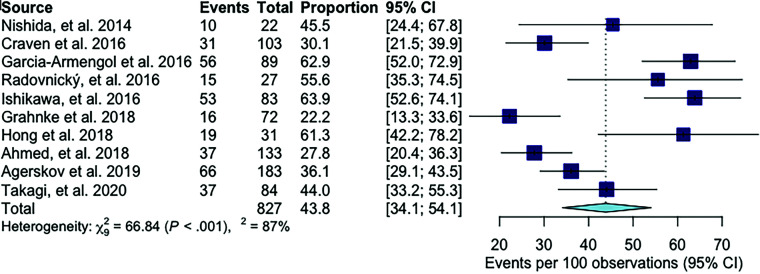
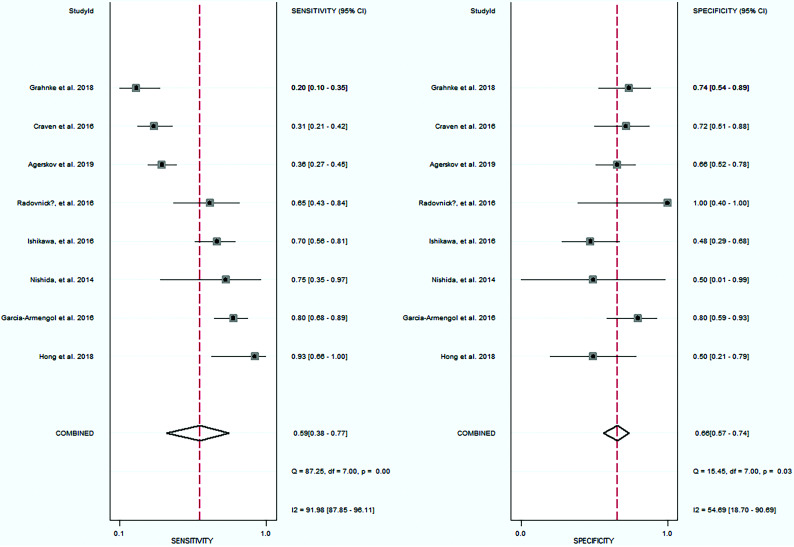
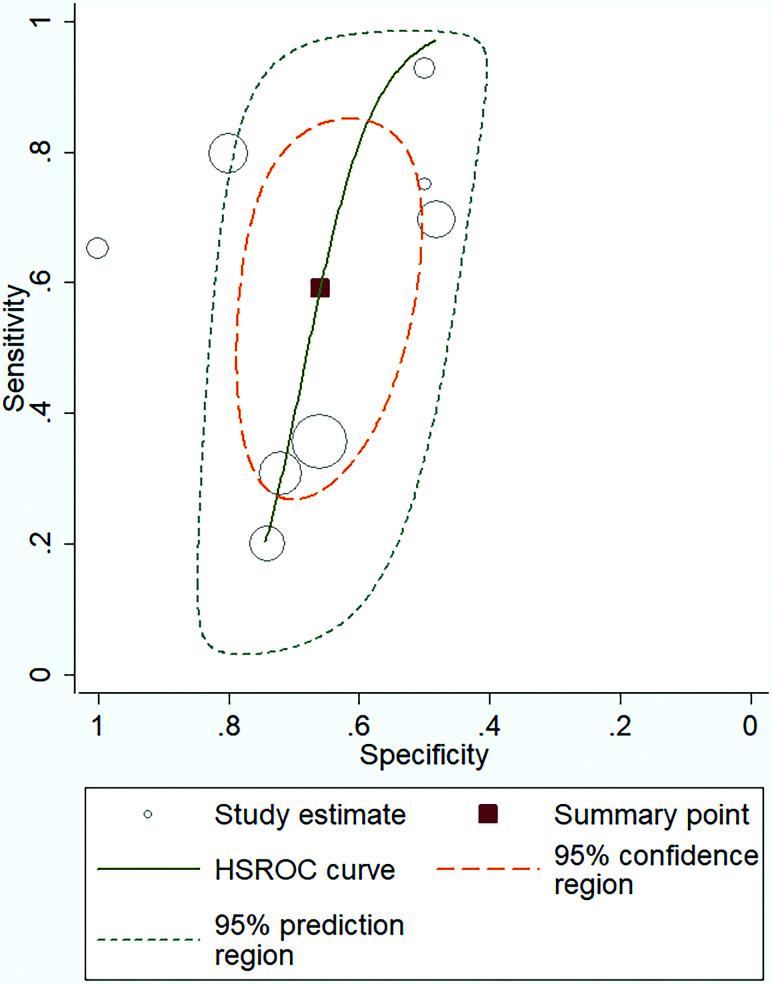
Data synthesis: Ten articles with 812 patients were included. The pooled prevalence of disproportionately enlarged subarachnoid space hydrocephalus in idiopathic normal pressure hydrocephalus was 44% (95% CI, 34%-54%). The pooled prevalence of disproportionately enlarged subarachnoid space hydrocephalus was higher in the studies using the second edition of the Japanese Guidelines for Management of Idiopathic Normal Pressure Hydrocephalus compared with the studies using the international guidelines without statistical significance (52% versus 43%, P = .38). The pooled sensitivity and specificity of disproportionately enlarged subarachnoid space hydrocephalus for prediction of treatment response were 59% (95% CI, 38%-77%) and 66% (95% CI, 57%-74%), respectively, with an area under the curve of 0.67 (95% CI, 0.63-0.71).
Limitations: The lack of an established method for assessing disproportionately enlarged subarachnoid space hydrocephalus using brain MR imaging served as an important cause of the heterogeneity.
Conclusions: Our meta-analysis demonstrated a relatively low prevalence of disproportionately enlarged subarachnoid space hydrocephalus in idiopathic normal pressure hydrocephalus and a poor diagnostic performance for treatment response.
© 2021 by American Journal of Neuroradiology.
Figures
Similar articles
-
Utility of MRI-based disproportionately enlarged subarachnoid space hydrocephalus scoring for predicting prognosis after surgery for idiopathic normal pressure hydrocephalus: clinical research.J Neurosurg. 2017 Dec;127(6):1436-1442. doi: 10.3171/2016.9.JNS161080. Epub 2017 Feb 3. J Neurosurg. 2017. PMID: 28156249
-
Idiopathic Intracranial Hypertension with Disproportionately Enlarged Subarachnoid Space Hydrocephalus on Imaging.Intern Med. 2023 Oct 15;62(20):3043-3046. doi: 10.2169/internalmedicine.1201-22. Epub 2023 Mar 8. Intern Med. 2023. PMID: 36889711 Free PMC article.
-
Absence of Disproportionately Enlarged Subarachnoid Space Hydrocephalus, a Sharp Callosal Angle, or Other Morphologic MRI Markers Should Not Be Used to Exclude Patients with Idiopathic Normal Pressure Hydrocephalus from Shunt Surgery.AJNR Am J Neuroradiol. 2019 Jan;40(1):74-79. doi: 10.3174/ajnr.A5910. Epub 2018 Dec 6. AJNR Am J Neuroradiol. 2019. PMID: 30523139 Free PMC article.
-
Radiological predictors of shunt response in the diagnosis and treatment of idiopathic normal pressure hydrocephalus: a systematic review and meta-analysis.Acta Neurochir (Wien). 2023 Feb;165(2):369-419. doi: 10.1007/s00701-022-05402-8. Epub 2022 Nov 26. Acta Neurochir (Wien). 2023. PMID: 36435931 Free PMC article.
-
Can preoperative brain imaging features predict shunt response in idiopathic normal pressure hydrocephalus? A PRISMA review.Neuroradiology. 2022 Nov;64(11):2119-2133. doi: 10.1007/s00234-022-03021-9. Epub 2022 Jul 24. Neuroradiology. 2022. PMID: 35871239
Cited by
-
[Brain MRI-Based Artificial Intelligence Software in Patients with Neurodegenerative Diseases: Current Status].Taehan Yongsang Uihakhoe Chi. 2022 May;83(3):473-485. doi: 10.3348/jksr.2022.0048. Epub 2022 May 25. Taehan Yongsang Uihakhoe Chi. 2022. PMID: 36238504 Free PMC article. Review. Korean.
-
Automated Idiopathic Normal Pressure Hydrocephalus Diagnosis via Artificial Intelligence-Based 3D T1 MRI Volumetric Analysis.AJNR Am J Neuroradiol. 2025 Jan 8;46(1):33-40. doi: 10.3174/ajnr.A8489. AJNR Am J Neuroradiol. 2025. PMID: 39251255
-
Preoperative imaging biomarkers combined with tap test for predicting shunt surgery outcome in idiopathic normal pressure hydrocephalus: a multicenter retrospective study.Front Aging Neurosci. 2025 Feb 27;17:1509493. doi: 10.3389/fnagi.2025.1509493. eCollection 2025. Front Aging Neurosci. 2025. PMID: 40084042 Free PMC article.
-
qDESH: a method to quantify disproportionately enlarged subarachnoid space hydrocephalus.Fluids Barriers CNS. 2025 Jul 1;22(1):67. doi: 10.1186/s12987-025-00677-2. Fluids Barriers CNS. 2025. PMID: 40597328 Free PMC article.
-
Regional brain volume changes in Hakim's disease versus Alzheimer's and mild cognitive impairment.Brain Commun. 2025 Mar 26;7(2):fcaf122. doi: 10.1093/braincomms/fcaf122. eCollection 2025. Brain Commun. 2025. PMID: 40235958 Free PMC article.
References
Publication types
MeSH terms
LinkOut - more resources
Full Text Sources
Other Literature Sources