


Central nervous system-related safety and tolerability of add-on ketamine to antidepressant medication in treatment-resistant depression: focus on the unique safety profile of bipolar depression
- PMID: 34046159
- PMCID: PMC8138297
- DOI: 10.1177/20451253211011021
Central nervous system-related safety and tolerability of add-on ketamine to antidepressant medication in treatment-resistant depression: focus on the unique safety profile of bipolar depression
Abstract
Background: There is evidence supporting the use of ketamine in treatment-resistant depression (TRD). However, there are some safety and tolerability concerns associated with ketamine. This study aimed to investigate ketamine's safety and tolerability to the central nervous system and to assess the relationship between dissociative symptomology and psychometric outcomes during and after intravenous ketamine treatment concurrent with treatment by varying psychotropic medications in treatment-refractory inpatients with major depressive disorder (MDD) and bipolar disorder (BP).
Methods: A total of 49 patients with MDD and BP were included in this study. The subjects were administered ketamine and were assessed for changes using an observational protocol.
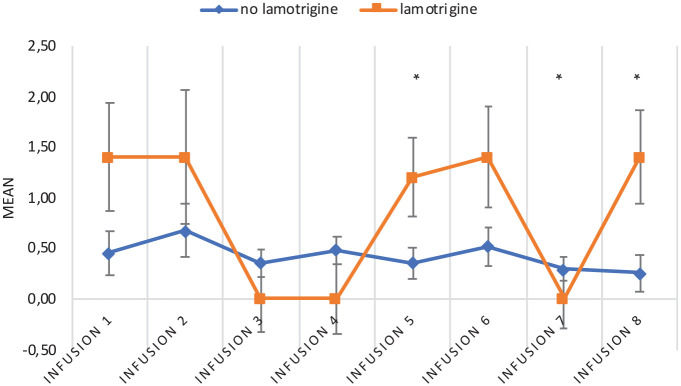
Results: No antidepressants were associated with psychomimetic symptomatology except for citalopram (p = 0.019). Patients treated with citalopram showed a higher intensity of psychomimetic symptomatology. The use of classic mood-stabilizers was significantly associated with an increase in psychomimetic symptomatology according to the Brief Psychiatric Rating Scale (BPRS; lamotrigine p = 0.009, valproate p = 0.048, lithium p = 0.012). No sequelae were observed.
Conclusions: Despite the limitations that this study may be underpowered due to the small sample size, the sample consisted of a heterogeneous TRD population in a single site, and there no blinding of who underwent only acute ketamine administration, our observations indicate ketamine use requires close safety and tolerability monitoring with regards to psychomimetic and dissociative symptoms in TRD-BP and careful management for MDD patients.ClinicalTrials.gov identifier: NCT04226963.
Keywords: dissociation; ketamine; psychosis; safety; tolerability; treatment-resistant depression.
© The Author(s), 2021.
Conflict of interest statement
Conflict of interest statement: W has received research support from Actavis, Eli Lilly, Minerva Neurosciences, Sunovion Pharmaceuticals, KCR, Janssen, Otsuka, Apodemus, Cortexyme, Acadia. WJC has received research support from Actavis, Alkermes, Allergan, Auspex, Biogen, Bristol-Myers Squibb, Cephalon, Eli Lilly, Ferrier, Forest Laboratories, Gedeon Richter, GW Pharmaceuticals, Janssen, KCR, Lundbeck, Orion, Otsuka, Sanofi, and Servier; he has served on speakers bureaus for Adamed, Angelini, AstraZeneca, Bristol-Myers Squibb, Celon, GlaxoSmithKline, Janssen, Krka, Lekam, Lundbeck, Novartis, Orion, Pfizer, Polfa Tarchomin, Sanofi, Servier, and Zentiva; and he has served as a consultant for GW Pharmaceuticals, Janssen, KCR, Quintiles, and Roche. MG-W has received research support from Janssen, Servier, Alkermes, KCR, Lilly, Biogen, Celon; JS has received research support from Actavis, Eli Lilly, Minerva Neurosciences, Sunovion Pharmaceuticals, KCR, Janssen, Otsuka, Apodemus, Cortexyme, Acadia.
Figures


References
-
- Berman RM, Cappiello A, Anand A, et al. Antidepressant effects of ketamine in depressed patients. Biol Psychiatry 2000; 47: 351–354. - PubMed
-
- McCloud TL, Caddy C, Jochim J, et al. Ketamine and other glutamate receptor modulators for depression in bipolar disorder in adults. Cochrane Database Syst Rev 2015; 9: CD011611. - PubMed
-
- Short B, Fong J, Galvez V, et al. Side-effects associated with ketamine use in depression: a systematic review. Lancet Psychiatry 2018; 5: 65–78. - PubMed
Associated data
LinkOut - more resources
Full Text Sources
Other Literature Sources
Medical
