Review
. 2021 Jul;78(13):5325-5339.
doi: 10.1007/s00018-021-03856-0. Epub 2021 May 27.

Recent progress in mass spectrometry-based strategies for elucidating protein-protein interactions

Affiliations
Review

Recent progress in mass spectrometry-based strategies for elucidating protein-protein interactions

Teck Yew Low et al. Cell Mol Life Sci. 2021 Jul.

Abstract

Protein-protein interactions are fundamental to various aspects of cell biology with many protein complexes participating in numerous fundamental biological processes such as transcription, translation and cell cycle. MS-based proteomics techniques are routinely applied for characterising the interactome, such as affinity purification coupled to mass spectrometry that has been used to selectively enrich and identify interacting partners of a bait protein. In recent years, many orthogonal MS-based techniques and approaches have surfaced including proximity-dependent labelling of neighbouring proteins, chemical cross-linking of two interacting proteins, as well as inferring PPIs from the co-behaviour of proteins such as the co-fractionating profiles and the thermal solubility profiles of proteins. This review discusses the underlying principles, advantages, limitations and experimental considerations of these emerging techniques. In addition, a brief account on how MS-based techniques are used to investigate the structural and functional properties of protein complexes, including their topology, stoichiometry, copy number and dynamics, are discussed.

Keywords: Affinity purification coupled to mass spectrometry (AP-MS); Co-fractionation mass spectrometry (coFrac-MS); Cross-linking mass spectrometry (XL-MS); Proximity-dependent biotinylation coupled to MS (PDB-MS); Thermal proximity coaggregation (TPCA).


Conflict of interest statement

The authors declare that there are no conflicts of interest.

Figures
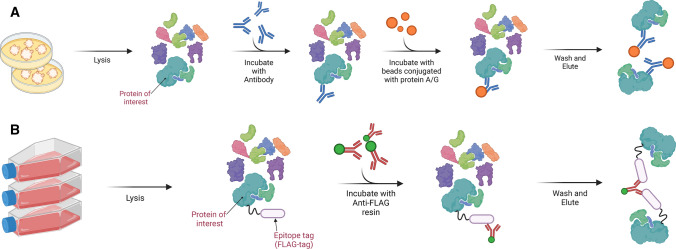
Fig. 1
Fig. 1
The AP-MS workflow. A A specific antibody can be used to selectively capture an untagged protein of interest (POI) that is expressed at physiological levels from the protein lysate. This untagged POI binds to other protein interactors directly or indirectly. Subsequently, beads conjugated with protein A/G are added to the protein mixture to capture the antibodies together with the protein assemblies. This is then followed by the washing and elution step to release the POI and its interactors for LC–MS/MS analysis. B For bait proteins lacking suitable antibodies, the POI can be genetically fused with an epitope tag, such as FLAG-tag or HA-tag. This bait-tag fusion construct can then be transfected transiently or stably into selected cell lines. Subsequently, resins conjugated to anti-epitope tag antibodies are added so that the POI and its interactors can be selectively enriched
Fig. 2
Fig. 2
The PDB-MS workflow. In PDB, a biotin ligase (BioID), a horseradish peroxidase (HRP) or a peroxidase (APEX) is genetically fused to a selected bait protein and expressed in a chosen cell line. In vivo labelling is achieved by adding biotins (BioID) or biotin phenols (APEX) to the cells, whereby these molecules are converted to reactive biotin intermediates. These reactive intermediates then diffuse away from the enzyme in a distance-dependent manner to covalently modify lysine (BioID) or tyrosine (APEX) residues located in close proximity. After performing cell lysis in harsh, denaturing conditions, biotinylated proteins are enriched using resin conjugated with streptavidin or neutravidin for subsequent quantitative proteomics analysis
Fig. 3
Fig. 3
The XL-MS workflow. Chemical crosslinking can be performed in vitro using extensively purified protein assemblies or in vivo using intact cells. The first step of chemical crosslinking involves adding a selected crosslinker to the protein mixture or cells. After chemical crosslinking, crosslinked proteins are digested to yield peptides. Typically, three types of cross-linked peptides are produced, i.e., the mono-linked peptides, the loop-linked peptides and the cross-linked peptides, among the many unlabelled peptides and unreacted crosslinkers. Due to the heterogeneity, the total pool of proteolyzed peptides is subjected to fractionation to enrich cross-linked peptides, subsequently mass-analysed by LC–MS/MS
Fig. 4
Fig. 4
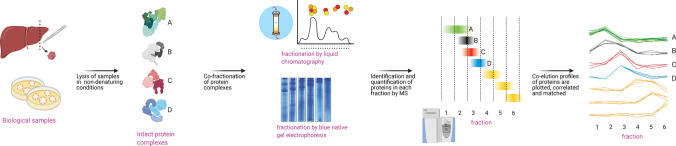
The coFrac-MS workflow. Samples are lysed in mild conditions to preserve the integrity of protein complexes, separated under native or near-native conditions using column chromatography or native gel electrophoresis into fractions. Each fraction is then individually subjected to quantitative, bottom-up LC–MS/MS analysis. With the assistance of dedicated computational algorithms, the abundance of each protein is then plotted as co-migration profiles across fractions to construct an interactome network
Fig. 5
Fig. 5
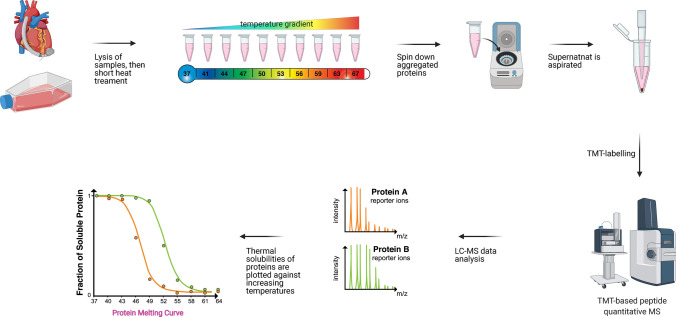
The TPCA workflow. TPCA can be performed on intact cells or cell lysate. Lysed samples are first divided into an equal amount of aliquots and subjected to heat treatment with an increasing temperature gradient. Heat treatment induces denaturation and coaggregation of interacting proteins, which then co-precipitate. Upon centrifugation, the supernatant consisting of soluble proteins from different temperature treatment is retrieved for isobaric TMT-labelling and quantitative LC–MS/MS analysis. The abundance of each soluble proteins identified and quantified is then plotted against the temperatures to generate the “protein melting curve”

References

    1. Stumpf MPH, Thorne T, de Silva E, et al. Estimating the size of the human interactome. Proc Natl Acad Sci USA. 2008;105:6959–6964. doi: 10.1073/pnas.0708078105. - DOI - PMC - PubMed
    1. Senior AW, Evans R, Jumper J, et al. Improved protein structure prediction using potentials from deep learning. Nature. 2020;577:706–710. doi: 10.1038/s41586-019-1923-7. - DOI - PubMed
    1. Titeca K, Lemmens I, Tavernier J, Eyckerman S. Discovering cellular protein-protein interactions: technological strategies and opportunities. Mass Spectrom Rev. 2019;38:79–111. doi: 10.1002/mas.21574. - DOI - PubMed
    1. Wu Z, Malty R, Moutaoufik MT, et al. Advances in experimental medicine and biology. New York LLC: Springer; 2019. A tag-based affinity purification mass spectrometry workflow for systematic isolation of the human mitochondrial protein complexes; pp. 83–100. - PubMed
    1. Vandemoortele G, Eyckerman S, Gevaert K. Pick a tag and explore the functions of your pet protein. Trends Biotechnol. 2019;37:1078–1090. doi: 10.1016/j.tibtech.2019.03.016. - DOI - PubMed