


Poverty, Material Hardship, and Telomere Length Among Latina/o Children
- PMID: 34047997
- PMCID: PMC8162160
- DOI: 10.1007/s40615-021-01072-x
Poverty, Material Hardship, and Telomere Length Among Latina/o Children
Abstract
Background: Despite increased attention on the links between poverty and the health and wellbeing of youth, few have attempted to understand the physiological consequences associated with different forms of economic disadvantage among Latina/o children. The present study begins to address this gap by (1) examining whether different forms of economic disadvantage were related to telomere length for Latina/o children and (2) determining whether parents' nativity shapes economic disadvantage-telomere length relationships.
Methods: Data were drawn from the Fragile Families and Child Wellbeing Study, a longitudinal, stratified multistage probability sample of couples and children in 20 large US cities. The sample consisted of 417 Latina/o children and their parents that were followed from birth to age 9. Ordinary least squares regressions were used to examine relationships between economic disadvantage and telomere length.
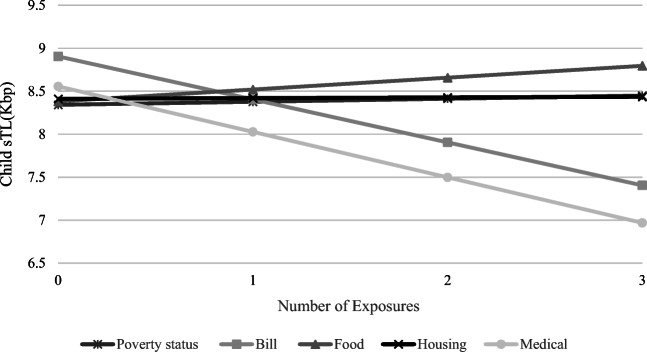
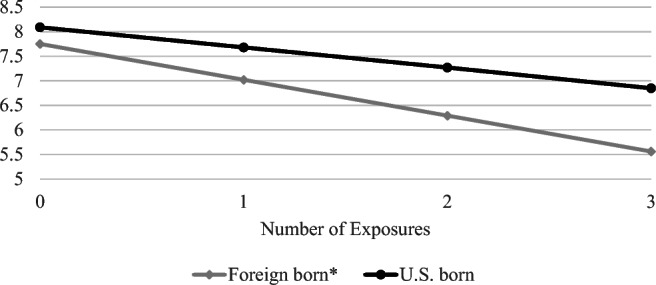
Results: Findings revealed that poverty status was not significantly related to telomere length, whereas some forms of material hardship were shown to play a role in the risk of premature cellular aging. More specifically, medical hardship and difficulty paying bills were associated with shorter telomere length at age 9. Results also provide minimal evidence economic disadvantage-telomere length patterns varied by parents' nativity. Only medical hardship was related to shorter telomere length at age 9 for children with at least one foreign-born parent.
Conclusion: Overall, results indicate that the risk of premature cellular aging depends on the measure of economic disadvantage under investigation. Findings from this study can inform targeted strategies designed to reduce the deleterious consequences associated with economic deprivation.
Keywords: Latina/o health; Material hardship; Nativity; Telomere length.
© 2021. W. Montague Cobb-NMA Health Institute.
Conflict of interest statement
The author declares no competing interests.
Figures
References
-
- Murphey, D, Madill R, and Lina Guzman. Making math count more for young Latino children. Washington, DC: Child Trends. 2017. https://www.hsfoundation.org/wp-content/uploads/Early-Math-Report-2.8.pdf. Accessed 1 March 2021.
-
- Phelan JC, Link BG. Is racism a fundamental cause of inequalities in health? Annu Rev Sociol. 2015;41:311–330. doi: 10.1146/annurev-soc-073014-112305. - DOI
-
- Child Trends Databank. Children in poverty. 2019. https://www.childtrends.org/?indicators=children-in-poverty. Accessed 1 March 2021.
-
- Thomas, D, Richard F. Prior to COVID-19, child poverty rates had reached record lows in the U.S. Pew Research Center. 2020. Pew Research Center. https://www.pewresearch.org/fact-tank/2020/11/30/prior-to-covid-19-child.... Accessed 1 March 2021.
-
- Krogstad JM, Lopez MH. Coronavirus Economic Downturn Has Hit Latinos Especially Hard. Pew research Center. 2020;4. https://www.pewresearch.org/hispanic/wp-content/uploads/sites/5/2020/08/... Accessed 4 March 2021.
MeSH terms
LinkOut - more resources
Full Text Sources
Other Literature Sources
Miscellaneous