


Bronchial angiogenesis in horses with severe asthma and its response to corticosteroids
- PMID: 34048095
- PMCID: PMC8295704
- DOI: 10.1111/jvim.16159
Bronchial angiogenesis in horses with severe asthma and its response to corticosteroids
Abstract
Background: Severe asthma in horses is characterized by structural changes that thicken the lower airway wall, a change that is only partially reversible by current treatments. Increased vascularization contributes to the thickening of the bronchial wall in humans with asthma and is considered a potential new therapeutic target.
Objective: To determine the presence of angiogenesis in the bronchi of severely asthmatic horses, and if present, to evaluate its reversibility by treatment with corticosteroids.
Animals: Study 1: Bronchial samples from asthmatic horses in exacerbation (7), in remission (7), and aged-matched healthy horses. Study 2: Endobronchial biopsy samples from asthmatic horses in exacerbation (6) and healthy horses (6) before and after treatment with dexamethasone.
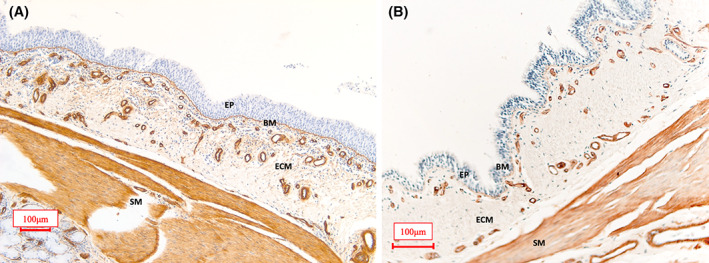
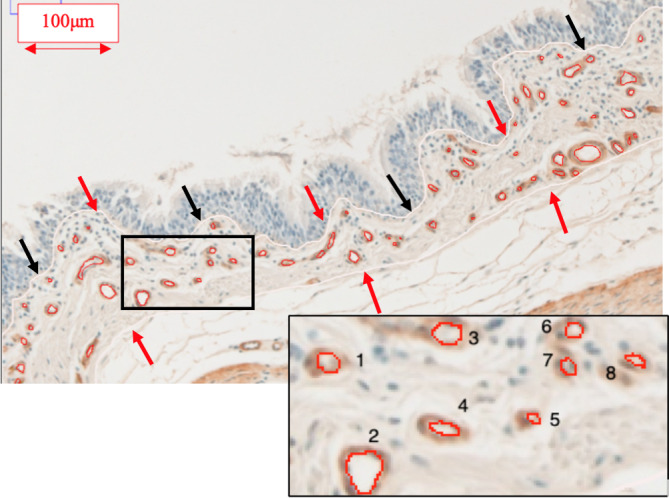
Methods: Blinded, randomized controlled study. Immunohistochemistry was performed using collagen IV as a marker for vascular basement membranes. Number of vessels, vascular area, and mean vessel size in the bronchial lamina propria were measured by histomorphometry. Reversibility of vascular changes in Study 2 was assessed after 2 weeks of treatment with dexamethasone.
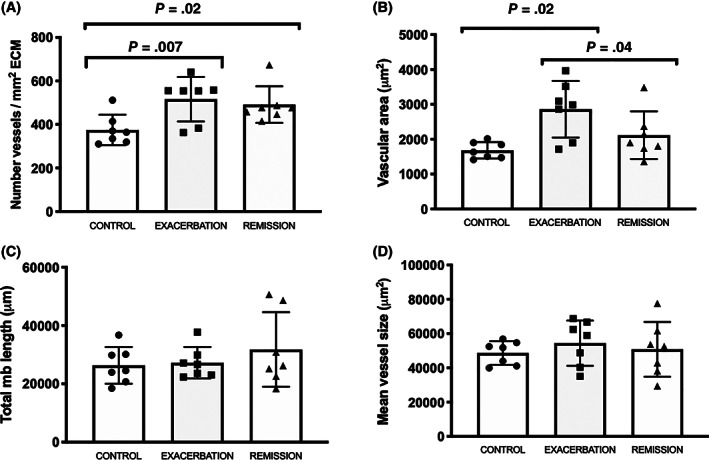
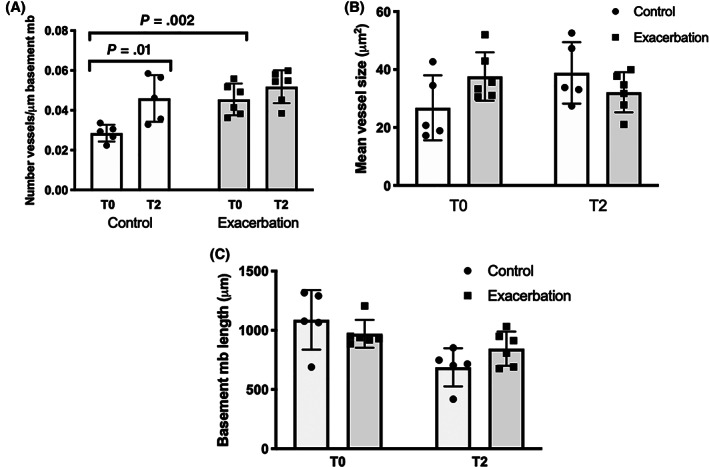
Results: The number of vessels and vascular area were increased in the airway walls of asthmatic horses in exacerbation (P = .01 and P = .02, respectively) and in remission (P = .02 and P = .04, respectively) when compared to controls. In Study 2, the differences observed between groups disappeared after 2 weeks of treatment with corticosteroids because of the increased number of vessels in healthy horses.
Conclusions and clinical importance: Angiogenesis contributes to thickening of the airway wall in asthmatic horses and was not reversed by a 2-week treatment with corticosteroids.
Keywords: angiogenesis; asthma; collagen IV; horses; immunohistochemistry.
© 2021 The Authors. Journal of Veterinary Internal Medicine published by Wiley Periodicals LLC on behalf of American College of Veterinary Internal Medicine.
Conflict of interest statement
Authors declare no conflict of interest.
Figures
References
-
- Pirie RS, Couetil LL, Robinson NE, et al. Equine asthma: an appropriate, translational and comprehendible terminology? Equine Vet J. 2016;48:403‐405. - PubMed
-
- Pirie RS. Recurrent airway obstruction: a review. Equine Vet J. 2014;46:276‐288. - PubMed
-
- Bullone M, Lavoie J‐P. Asthma “of horses and men”—how can equine heaves help us better understand human asthma immunopathology and its functional consequences? Mol Immunol. 2015;66:97‐105. - PubMed
-
- Bullone M, Lavoie J‐P. The equine asthma model of airway remodeling: from a veterinary to a human perspective. Cell Tissue Res. 2020;380:223‐236. - PubMed
MeSH terms
Substances
Grants and funding
LinkOut - more resources
Full Text Sources
Other Literature Sources
Medical
