Review
. 2021 Oct 1;111(2):337-359.
doi: 10.1016/j.ijrobp.2021.05.110. Epub 2021 May 25.

Proton Therapy for Breast Cancer: A Consensus Statement From the Particle Therapy Cooperative Group Breast Cancer Subcommittee

Affiliations
Review

Proton Therapy for Breast Cancer: A Consensus Statement From the Particle Therapy Cooperative Group Breast Cancer Subcommittee

Robert W Mutter et al. Int J Radiat Oncol Biol Phys. .

Abstract

Radiation therapy plays an important role in the multidisciplinary management of breast cancer. Recent years have seen improvements in breast cancer survival and a greater appreciation of potential long-term morbidity associated with the dose and volume of irradiated organs. Proton therapy reduces the dose to nontarget structures while optimizing target coverage. However, there remain additional financial costs associated with proton therapy, despite reductions over time, and studies have yet to demonstrate that protons improve upon the treatment outcomes achieved with photon radiation therapy. There remains considerable heterogeneity in proton patient selection and techniques, and the rapid technological advances in the field have the potential to affect evidence evaluation, given the long latency period for breast cancer radiation therapy recurrence and late effects. In this consensus statement, we assess the data available to the radiation oncology community of proton therapy for breast cancer, provide expert consensus recommendations on indications and technique, and highlight ongoing trials' cost-effectiveness analyses and key areas for future research.


Conflict of interest statement

Conflicts of Interest: Dr. Mailhot reports travel funds from Varian (2017) and IBA (2018); Dr. Bradley reports travel funds from IBA (2018); Dr. Ho reports no disclosures related to this submission. Unrelated to this manuscript, Dr. Ho has received research funding from Merck and GSK and received consulting fees from La Roche Posay; Dr. Fagundes reports being a consultant for Augmenix and Boston Scientific related to lecturing and training of new users of rectal spacers. Dr. Amos reports no disclosures related to this submission. Unrelated to this manuscript, Dr. Amos reports being on the scientific advisory board and receiving honoraria from TAE Life Sciences. Dr. Xuanfeng has a patent related to spot-scanning proton arc therapy and this patent has been licensed to IBA. The rest of the authors report no disclosures.

Figures

Figure 1:
Figure 1:
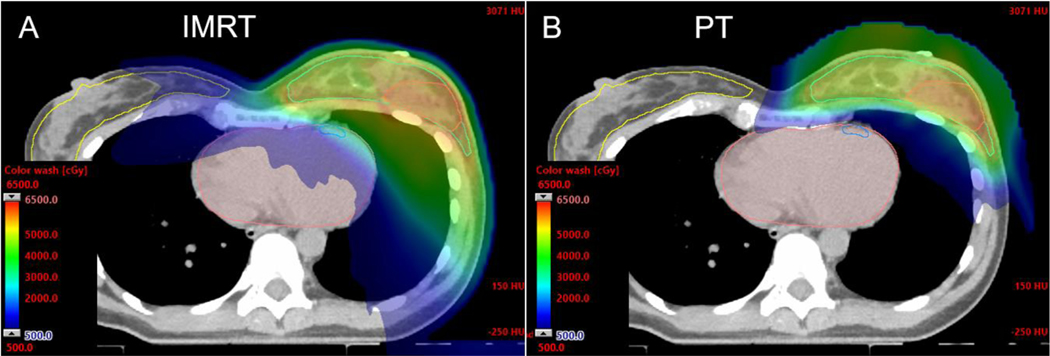
Axial CT dose color wash from an IMRT plan (A) and multi-field optimized PBS PT plan (B) for whole breast and RNI demonstrating improved heart, lung, contralateral breast, and other soft tissue sparing with PT. The lumpectomy cavity CTV is highlighted in orange where a simultaneous integrated boost is administered to 56.26 Gy in 25 fractions, with the breast and nodal volumes (not shown) receiving 50 Gy.
Figure 2:
Figure 2:
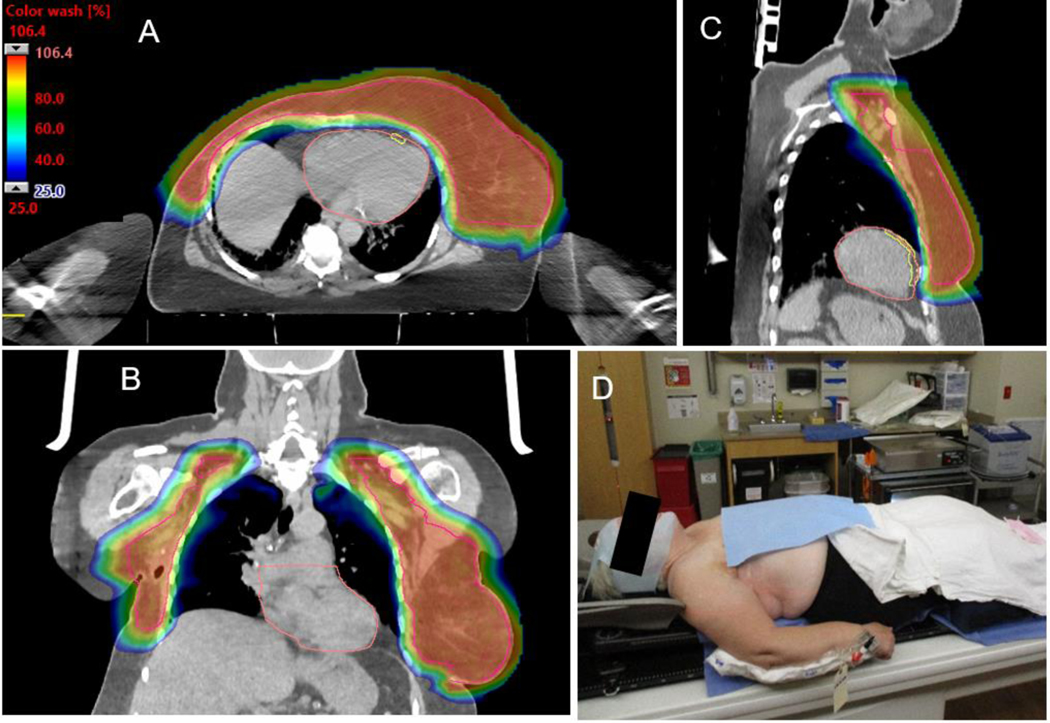
Axial (A), coronal (B), and sagittal (C) 25% color wash images demonstrating comprehensive CTV coverage (pink) with a homogeneous dose (maximum dose 106.4% of prescription) and excellent normal tissue sparing for recurrent breast right breast cancer with ipsilateral and contralateral axillary metastases. (D) Medical comorbidities necessitated an arms down immobilization. The arm is in an akimbo position to attempt to maximize separation between the arm and CTV.
Figure 3:
Figure 3:
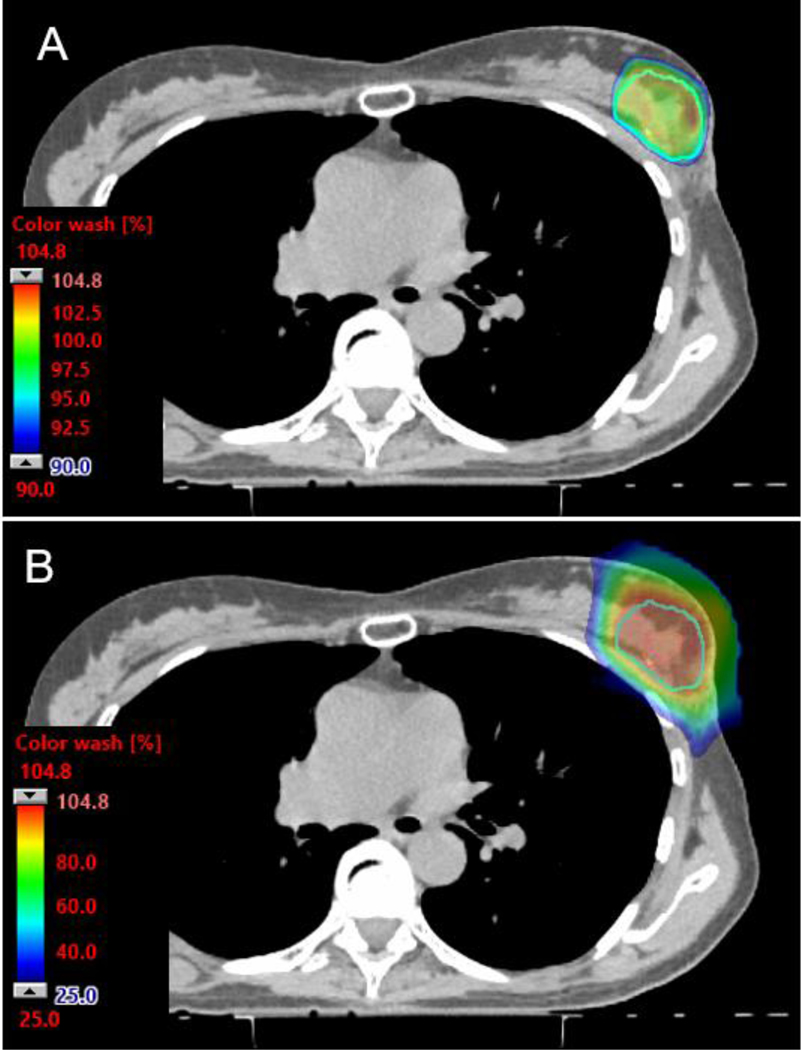
Axial CT dose color wash images from a PBS PT APBI plan. The 90% color wash (A) demonstrates the high level of conformality and skin-sparing properties of the PBS technique. (B) The 25% color wash at the same level demonstrates exquisite normal tissue sparing, including of non-target breast tissue.
Figure 4:
Figure 4:
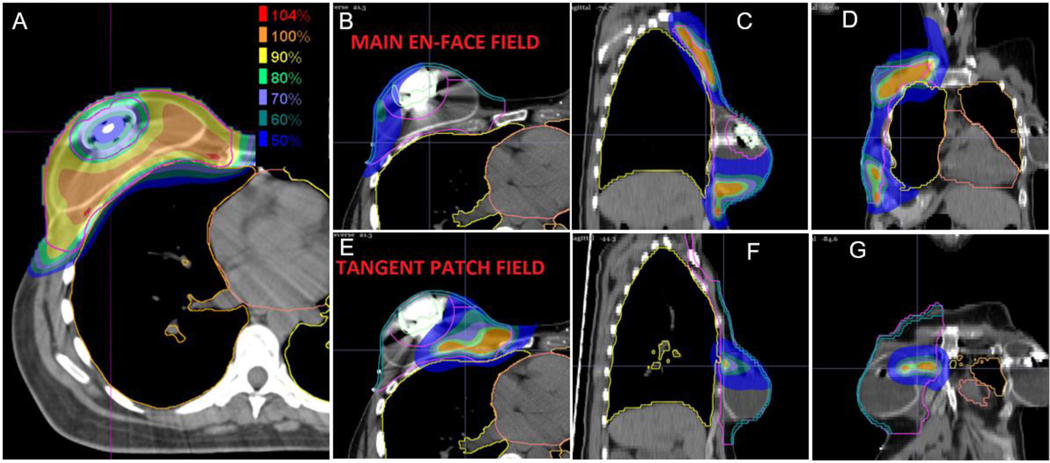
Axial (A, B, E), sagittal (C, F), and coronal (D, G) 50% color wash images demonstrating a two proton field, multi field optimization (MFO) plan avoiding delivery through the magnetic expander port of the reconstructed breast while achieving comprehensive target coverage. Individual dose deposition profiles from the en face field (B-D) and the more tangential beam angle (D-F) are displayed.
Figure 5:
Figure 5:
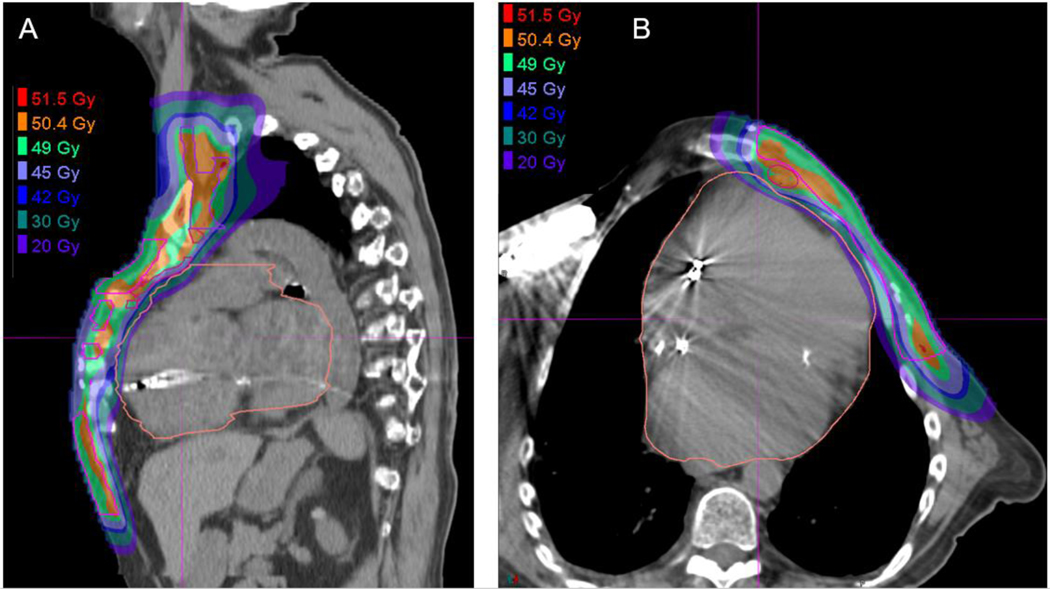
Sagittal (A) and axial (B) 20 Gy color wash images of a patient with locally advanced left breast cancer and pectus carinatum, a deformity of the chest characterized by protrusion of the sternum and ribs, demonstrating excellent coverage of the chest wall (pink) and IMN (red) CTV and normal tissue sparing despite the unfavorable anatomy.

Comment in

  • In Regard to Mutter et al.
    Struikmans H, Mast ME, Petoukhova AL, Poortmans PM. Struikmans H, et al. Int J Radiat Oncol Biol Phys. 2022 Apr 1;112(5):1288-1289. doi: 10.1016/j.ijrobp.2021.12.156. Int J Radiat Oncol Biol Phys. 2022. PMID: 35286883 No abstract available.
  • In Reply to Struikmans et al.
    Mutter RW, Choi JI, Jimenez RB, Kirova YM, Fagundes M, Haffty BG, Amos RA, Bradley JA, Chen PY, Ding X, Carr AM, Taylor LM, Pankuch M, Vega RBM, Ho AY, Nyström PW, McGee LA, Urbanic JJ, Cahlon O, Maduro JH, MacDonald SM. Mutter RW, et al. Int J Radiat Oncol Biol Phys. 2022 Apr 1;112(5):1289-1290. doi: 10.1016/j.ijrobp.2021.12.155. Int J Radiat Oncol Biol Phys. 2022. PMID: 35286884 No abstract available.

References

    1. Marks LB, Yorke ED, Jackson A, et al. Use of normal tissue complication probability models in the clinic. Int J Radiat Oncol Biol Phys 2010;76:S10–9. - PMC - PubMed
    1. Fontanilla HP, Woodward WA, Lindberg ME, et al. Current clinical coverage of Radiation Therapy Oncology Group-defined target volumes for postmastectomy radiation therapy. Pract Radiat Oncol 2012;2:201–9. - PubMed
    1. Thorsen LB, Thomsen MS, Berg M, et al. CT-planned internal mammary node radiotherapy in the DBCG-IMN study: benefit versus potentially harmful effects. Acta oncologica 2014;53:1027–34. - PubMed
    1. MacDonald SM, Harisinghani MG, Katkar A, Napolitano B, Wolfgang J, Taghian AG. Nanoparticle-enhanced MRI to evaluate radiation delivery to the regional lymphatics for patients with breast cancer. Int J Radiat Oncol Biol Phys 2010;77:1098–104. - PubMed
    1. Taylor C, Correa C, Duane FK, et al. Estimating the Risks of Breast Cancer Radiotherapy: Evidence From Modern Radiation Doses to the Lungs and Heart and From Previous Randomized Trials. J Clin Oncol 2017;35:1641–9. - PMC - PubMed

Publication types