Quantitation of multiple injection dynamic PET scans: an investigation of the benefits of pooling data from separate scans when mapping kinetics
- PMID: 34049293
- PMCID: PMC8284854
- DOI: 10.1088/1361-6560/ac0683
Quantitation of multiple injection dynamic PET scans: an investigation of the benefits of pooling data from separate scans when mapping kinetics
Abstract
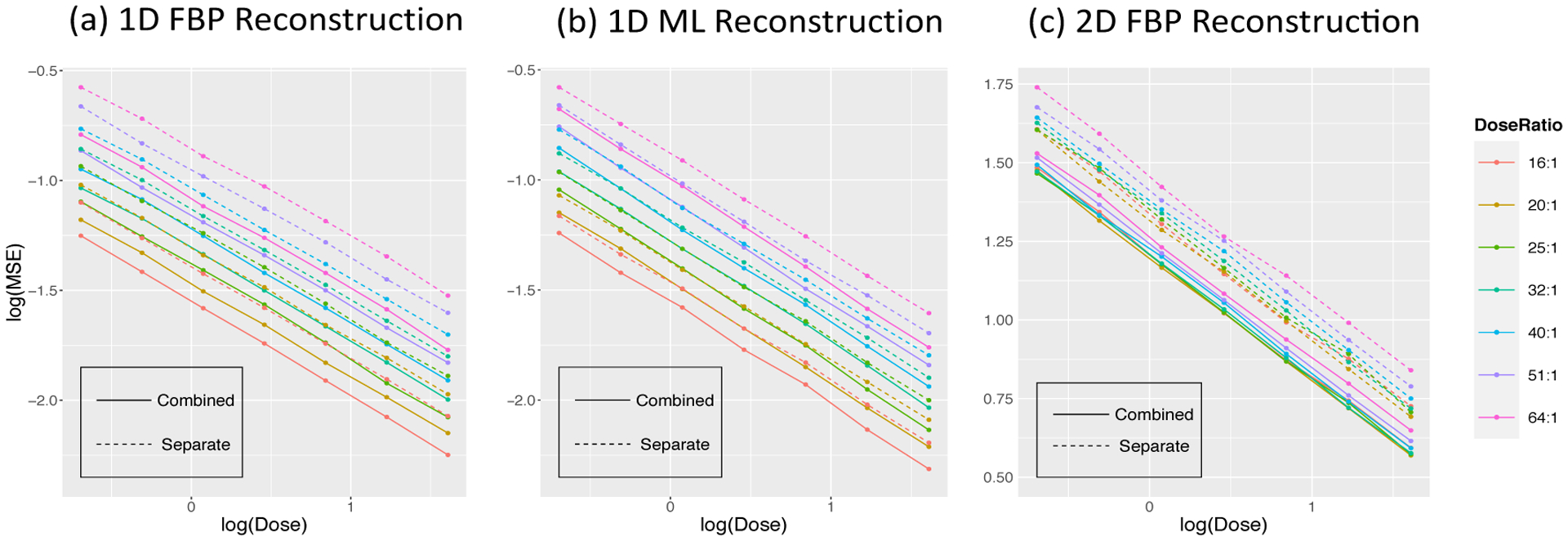
Multiple injection dynamic positron emission tomography (PET) scanning is used in the clinical management of certain groups of patients and in medical research. The analysis of these studies can be approached in two ways: (i) separate analysis of data from individual tracer injections, or (ii), concatenate/pool data from separate injections and carry out a combined analysis. The simplicity of separate analysis has some practical appeal but may not be statistically efficient. We use a linear model framework associated with a kinetic mapping scheme to develop a simplified theoretical understanding of separate and combined analysis. The theoretical framework is explored numerically using both 1D and 2D simulation models. These studies are motivated by the breast cancer flow-metabolism mismatch studies involving15O-water (H2O) and18F-Fluorodeoxyglucose (FDG) and repeat15O-H2O injections used in brain activation investigations. Numerical results are found to be substantially in line with the simple theoretical analysis: mean square error characteristics of alternative methods are well described by factors involving the local voxel-level resolution of the imaging data, the relative activities of the individual scans and the number of separate injections involved. While voxel-level resolution has dependence on scan dose, after adjustment for this effect, the impact of a combined analysis is understood in simple terms associated with the linear model used for kinetic mapping. This is true for both data reconstructed by direct filtered backprojection or iterative maximum likelihood. The proposed analysis has potential to be applied to the emerging long axial field-of-view PET scanners.
Keywords: FBP and ML reconstructions; H2O-FDG dual-tracer study; combined kinetic analysis; dynamic PET; non-parametric residue mapping; repeat H2O study.
Creative Commons Attribution license.
Figures




References
-
- Beason-Held LL, Desmond RE, Herscovitch P and Carson RE (1999). Bolus injection versus slow infusion of [15o] water for positron emission tomography activation studies, Journal of Cerebral Blood Flow and Metabolism 19(8): 843–852. - PubMed
-
- Cunningham VJ and Jones T (1993). Spectral analysis of dynamic pet studies, Journal of Cerebral Blood Flow and Metabolism 13(1): 15–23. - PubMed
-
- Deo AK, Borson S, Link JM, Domino K, Eary JF, Ke B, Richards TL, Mankoff DA, Minoshima S, O’Sullivan F et al. (2014). Activity of p-glycoprotein, a β-amyloid transporter at the blood–brain barrier, is compromised in patients with mild alzheimer disease, Journal of Nuclear Medicine 55(7): 1106–1111. - PMC - PubMed
Publication types
MeSH terms
Substances
Grants and funding
LinkOut - more resources
Full Text Sources
Other Literature Sources
Medical
Miscellaneous