


Higher Carbohydrate Amount and Lower Glycemic Index Increase Hunger, Diet Satisfaction, and Heartburn in Overweight and Obese Adults in the OmniCarb Randomized Clinical Trial
- PMID: 34049396
- PMCID: PMC8349117
- DOI: 10.1093/jn/nxab128
Higher Carbohydrate Amount and Lower Glycemic Index Increase Hunger, Diet Satisfaction, and Heartburn in Overweight and Obese Adults in the OmniCarb Randomized Clinical Trial
Abstract
Background: The Dietary Approaches to Stop Hypertension (DASH) diet, a high-carbohydrate diet, is highly recommended based on its cardiovascular risk benefits, yet adherence remains persistently low. How subjective impressions of this diet contribute to adherence has not been thoroughly explored. The OmniCarb trial, which compared DASH-style diets varying in glycemic index (GI) and carbohydrate amount, surveyed subjective impressions of such diets.
Objectives: We examined the effects of GI and carbohydrate amount on qualitative aspects of diet acceptability through secondary outcomes in the OmniCarb trial.
Methods: OmniCarb was a randomized, crossover trial of 4 DASH-style diets varying by GI (≥65 compared with ≤45) and carbohydrate amount (40% compared with 58% kcal) in overweight or obese (BMI ≥25 kg/m2) adults (n = 163). Participants consumed each diet in random order over 5-wk periods, separated by 2-wk washouts. At baseline and the end of each feeding period, participants rated hunger, diet satisfaction, and gastrointestinal symptoms (diarrhea/loose stools, constipation, bloating, nausea, and heartburn).
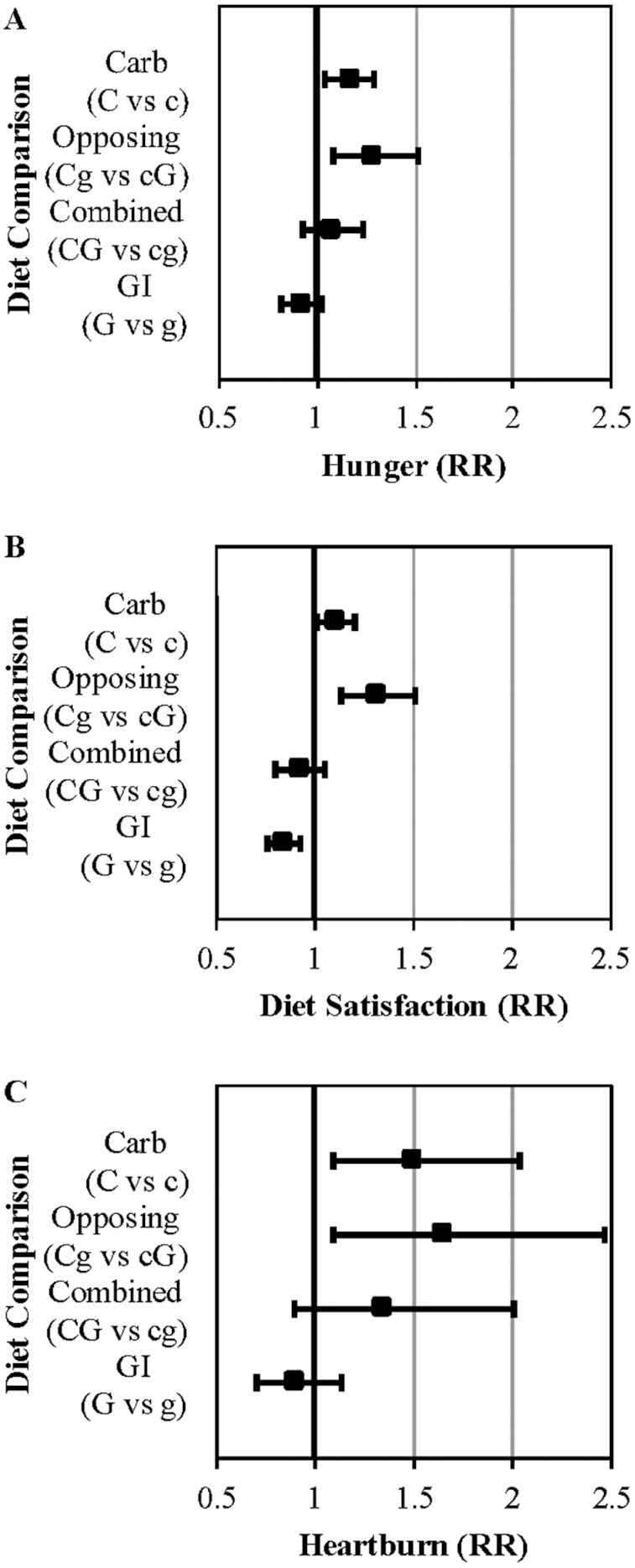
Results: Participant mean age was 52 y, with 52% women, 51% non-Hispanic black, and 56% obese (BMI ≥30). Compared with baseline, all intervention diets decreased heartburn, increased diarrhea/loose stools, and increased bloating, but did not significantly affect constipation or nausea. Compared with lower carbohydrate diets, higher carbohydrate diets increased hunger (RR: 1.16; 95% CI: 1.04, 1.30), increased diet satisfaction (RR: 1.10; 95% CI: 1.01, 1.20), and increased heartburn (RR: 1.49; 95% CI: 1.09, 2.04). Compared with lower GI diets, higher GI diets did not affect hunger (RR: 0.92; 95% CI: 0.83, 1.02), decreased diet satisfaction (RR: 0.83; 95% CI: 0.75, 0.92), and did not affect heartburn (RR: 0.89; 95% CI: 0.70, 1.13). There were no between-diet differences for diarrhea/loose stools, constipation, bloating, and nausea.
Conclusions: Although a higher carbohydrate amount in DASH-style diets can increase diet satisfaction, it can also decrease satiety and increase heartburn in adults with overweight or obesity.This trial is registered at clinicaltrials.gov as NCT00608049.
Keywords: OmniCarb; carbohydrates; diet satisfaction; gastrointestinal symptoms; glycemic index; hunger.
Published by Oxford University Press on behalf of the American Society for Nutrition 2021.
Figures

References
-
- Patnode CD, Evans CV, Senger CA, Redmond N, Lin JS. Behavioral counseling to promote a healthful diet and physical activity for cardiovascular disease prevention in adults without known cardiovascular disease risk factors: updated evidence report and systematic review for the US Preventive Services Task Force. JAMA. 2017;318:175–93. - PubMed
-
- Liu S, Manson JE. Dietary carbohydrates, physical inactivity, obesity, and the “metabolic syndrome” as predictors of coronary heart disease. Curr Opin Lipidol. 2001;12(4):395–404. - PubMed
-
- Appel LJ, Moore TJ, Obarzanek E, Vollmer WM, Svetkey LP, Sacks FM, Bray GA, Vogt TM, Cutler JA, Windhauser MMet al. . A clinical trial of the effects of dietary patterns on blood pressure. DASH Collaborative Research Group. N Engl J Med. 1997;336(16):1117–24. - PubMed
-
- Siervo M, Lara J, Chowdhury S, Ashor A, Oggioni C, Mathers JC. Effects of the Dietary Approach to Stop Hypertension (DASH) diet on cardiovascular risk factors: a systematic review and meta-analysis. Br J Nutr. 2015;113(1):1–15. - PubMed
Publication types
MeSH terms
Substances
Associated data
Grants and funding
LinkOut - more resources
Full Text Sources
Other Literature Sources
Medical
