


Lifestyle is associated with thyroid function in subclinical hypothyroidism: a cross-sectional study
- PMID: 34049544
- PMCID: PMC8161919
- DOI: 10.1186/s12902-021-00772-z
Lifestyle is associated with thyroid function in subclinical hypothyroidism: a cross-sectional study
Abstract
Background: Few studies have focused on the association between lifestyle and subclinical hypothyroidism (SCH). The purpose of this study was to investigate the association between lifestyle and thyroid function in SCH.
Methods: This study was a part of a community-based and cross-sectional study, the Epidemiological Survey of Thyroid Diseases in Fujian Province, China. A total of 159 participants with SCH (81 males and 78 females) and 159 euthyroid (87 males and 72 females) participants without any missing data were included in the analysis. General information and lifestyle information including sleep, exercise, diet and smoking habits of the participants was collected by questionnaire and Pittsburgh sleep quality index scale (PSQI) was collected. Thyroid stimulating hormone (TSH), free thyroxine (FT4), thyroid peroxidase antibody (TPOAb), thyroid globulin antibody (TgAb) and urine iodine concentration (UIC) were tested. Thyroid homeostasis parameter thyroid' s secretory capacity (SPINA-GT), Jostel's TSH index (TSHI), thyrotroph T4 sensitivity index (TTSI) were calculated. Logistic regression and multiple linear regression were performed to assess associations.
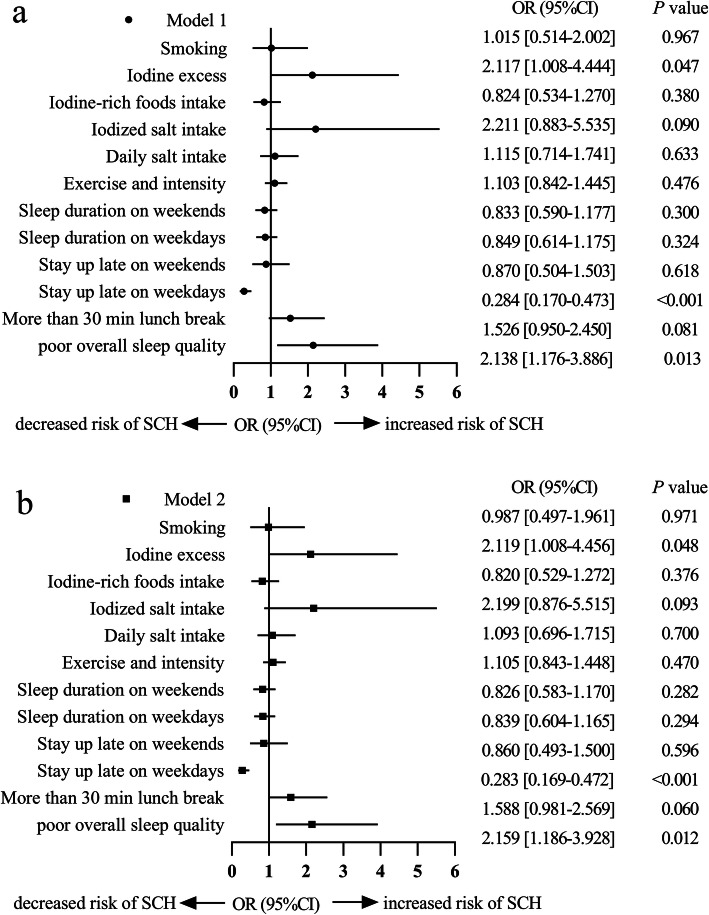
Results: Compared with euthyroid subjects, patients with SCH were more likely to have poor overall sleep quality (15.1 vs.25.8 %, P = 0.018) and l less likely to stay up late on weekdays (54.7 vs. 23.9 % P < 0.001). In SCH group, exercise was the influencing factor of TSH (β= -0.224, P = 0.004), thyroid secretory capacity (β = 0.244, P = 0.006) and thyrotropin resistance (β = 0.206, P = 0.009). Iodine excess was the influencing factor of thyroid secretory capacity (β = 0.209, P = 0.001) and pituitary thyroid stimulating function (β = 0.167, P = 0.034). Smoking was the influencing factor of pituitary thyroid stimulating function (β = 0.161, P = 0.040). Staying up late on weekends was the influencing factor of thyroid secretory capacity (β = 0.151, P = 0.047). After adjusting for possible confounders, logistic regression showed that those with poor overall sleep quality assessed by PSQI and iodine excess had an increased risk of SCH (OR 2.159, 95 %CI 1.186-3.928, P = 0.012 and OR 2.119, 95 %CI 1.008-4.456, P = 0.048, respectively).
Conclusions: Lifestyle including sleep, smoking, diet and exercise was closely related to thyroid function especially thyroid homeostasis in SCH.
Keywords: Cross-sectional study; Lifestyle; Subclinical hypothyroidism; Thyroid function.
Conflict of interest statement
Authors have no conflict of interests.
Figures
References
-
- Delitala AP, Scuteri A, Maioli M, Mangatia P, Vilardi L, Erre GL. Subclinical hypothyroidism and cardiovascular risk factors. Minerva Med. 2019;110(6):530–545. - PubMed
-
- Teng X, Shan Z, Chen Y, Lai Y, Yu J, Shan L, Bai X, Li Y, Li N, Li Z, et al. More than adequate iodine intake may increase subclinical hypothyroidism and autoimmune thyroiditis: a cross-sectional study based on two Chinese communities with different iodine intake levels. Eur J Endocrinol. 2011;164(6):943–950. doi: 10.1530/EJE-10-1041. - DOI - PubMed
MeSH terms
Substances
Grants and funding
- 2017Y9060/the Studies on Interventions for Multiple Risk Factors and Metabolic Models of Type 2 Diabetes Mellitus in Fujian Province, China
- 2017Y9060/the Studies on Interventions for Multiple Risk Factors and Metabolic Models of Type 2 Diabetes Mellitus in Fujian Province, China
- 2017Y9060/the Studies on Interventions for Multiple Risk Factors and Metabolic Models of Type 2 Diabetes Mellitus in Fujian Province, China
- 2017Y9060/the Studies on Interventions for Multiple Risk Factors and Metabolic Models of Type 2 Diabetes Mellitus in Fujian Province, China
- 2017Y9060/the Studies on Interventions for Multiple Risk Factors and Metabolic Models of Type 2 Diabetes Mellitus in Fujian Province, China
- 2016B019/the Epidemiological Survey of Thyroid Disease in Fujian Province, China
- 2016B019/the Epidemiological Survey of Thyroid Disease in Fujian Province, China
- 2016B019/the Epidemiological Survey of Thyroid Disease in Fujian Province, China
- 2016B019/the Epidemiological Survey of Thyroid Disease in Fujian Province, China
- 2016B019/the Epidemiological Survey of Thyroid Disease in Fujian Province, China
- 2016B019/the Epidemiological Survey of Thyroid Disease in Fujian Province, China
- 2016B019/the Epidemiological Survey of Thyroid Disease in Fujian Province, China
- 2016B019/the Epidemiological Survey of Thyroid Disease in Fujian Province, China
- 201402005/the Research Fund for Public Welfare from National Health and Family Planning Commission of China
- 201402005/the Research Fund for Public Welfare from National Health and Family Planning Commission of China
- 201402005/the Research Fund for Public Welfare from National Health and Family Planning Commission of China
- 201402005/the Research Fund for Public Welfare from National Health and Family Planning Commission of China
LinkOut - more resources
Full Text Sources
Other Literature Sources
Medical
Research Materials
Miscellaneous
