


Hypocretin/Orexin Receptor Pharmacology and Sleep Phases
- PMID: 34052813
- PMCID: PMC8171809
- DOI: 10.1159/000514963
Hypocretin/Orexin Receptor Pharmacology and Sleep Phases
Abstract
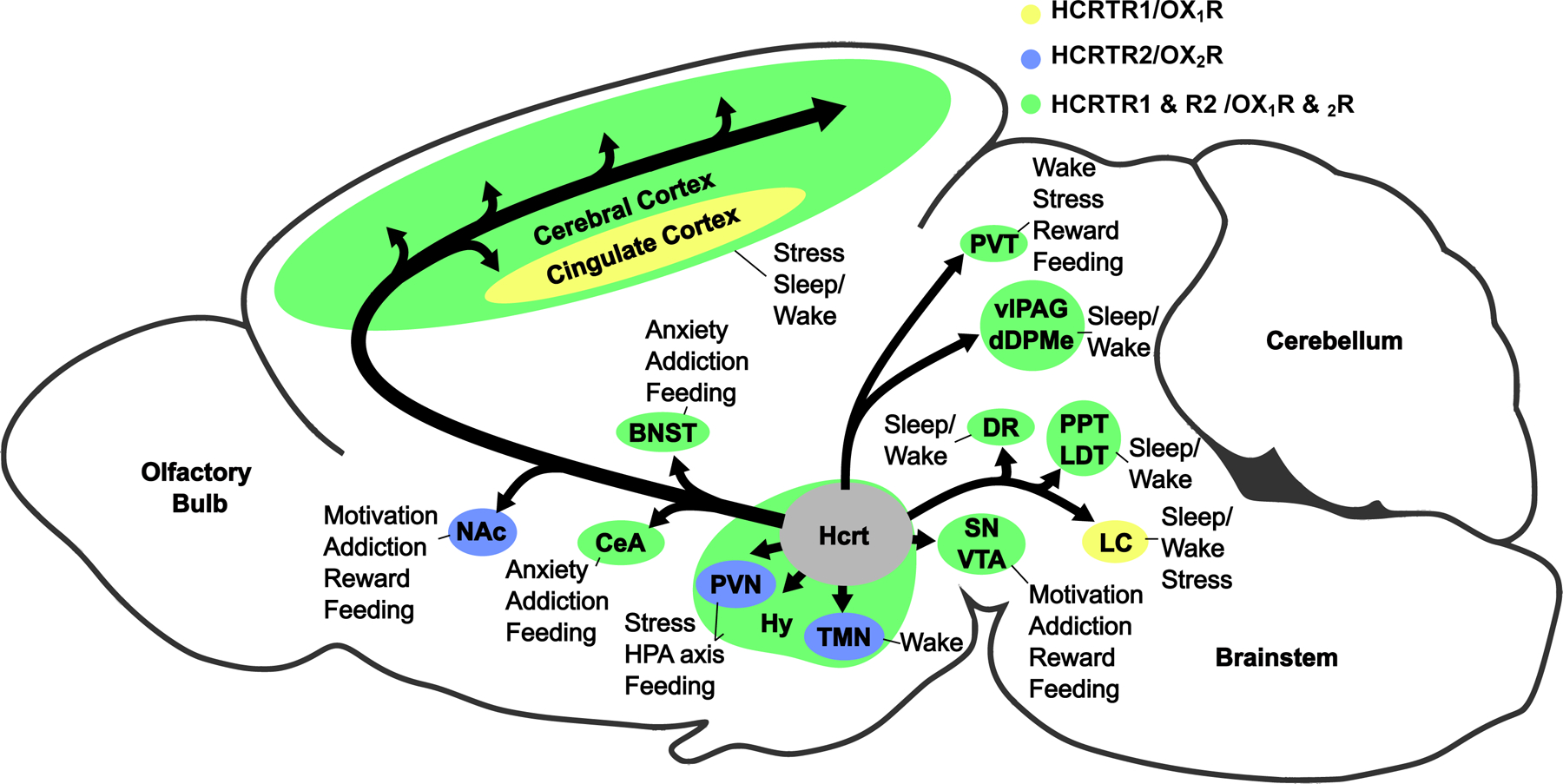
The hypocretins/orexins are two excitatory neuropeptides, alternately called HCRT1 or orexin-A and HCRT2 or orexin-B, that are the endogenous ligands for two G-protein-coupled receptors, HCRTR1/OX1R and HCRTR2/OX2R. Shortly after the discovery of this system, degeneration of hypocretin/orexin-producing neurons was implicated in the etiology of the sleep disorder narcolepsy. The involvement of this system in a disorder characterized by the loss of control over arousal state boundaries also suggested its role as a critical component of endogenous sleep-wake regulatory circuitry. The broad projections of the hypocretin/orexin-producing neurons, along with differential expression of the two receptors in the projection fields of these neurons, suggest distinct roles for these receptors. While HCRTR1/OX1R is associated with regulation of motivation, reward, and autonomic functions, HCRTR2/OX2R is strongly linked to sleep-wake control. The association of hypocretin/orexin with these physiological processes has led to intense interest in the therapeutic potential of compounds targeting these receptors. Agonists and antagonists for the hypocretin/orexin receptors have shown potential for the treatment of disorders of excessive daytime somnolence and nocturnal hyperarousal, respectively, with the first antagonists approved by the US Food and Drug Administration (FDA) in 2014 and 2019 for the treatment of insomnia. These and related compounds have also been useful tools to advance hypocretin/orexin neurobiology.
© 2021 The Author(s). Published by S. Karger AG, Basel.
Conflict of interest statement
Conflicts of interest
TSK received consultancy fees from Idorsia Pharmaceuticals Ltd during the development of this book, has been a Consultant for SK Life Sciences, Alkermes Pharmaceuticals and Vida Ventures, and has received research funds from Alkermes and Supernus Pharmaceuticals. The authors have no other conflicts of interest to declare.
Figures
Similar articles
-
Orexin in sleep, addiction and more: is the perfect insomnia drug at hand?Neuropeptides. 2013 Dec;47(6):477-88. doi: 10.1016/j.npep.2013.10.009. Epub 2013 Oct 23. Neuropeptides. 2013. PMID: 24215799 Review.
-
Inactivation of hypocretin receptor-2 signaling in dopaminergic neurons induces hyperarousal and enhanced cognition but impaired inhibitory control.Mol Psychiatry. 2024 Feb;29(2):327-341. doi: 10.1038/s41380-023-02329-z. Epub 2023 Dec 21. Mol Psychiatry. 2024. PMID: 38123729 Free PMC article.
-
Orexin (hypocretin) receptor agonists and antagonists for treatment of sleep disorders. Rationale for development and current status.CNS Drugs. 2013 Feb;27(2):83-90. doi: 10.1007/s40263-012-0036-8. CNS Drugs. 2013. PMID: 23359095 Review.
-
TAK-925, an orexin 2 receptor-selective agonist, shows robust wake-promoting effects in mice.Pharmacol Biochem Behav. 2019 Dec;187:172794. doi: 10.1016/j.pbb.2019.172794. Epub 2019 Oct 22. Pharmacol Biochem Behav. 2019. PMID: 31654653
-
OX2R-selective orexin agonism is sufficient to ameliorate cataplexy and sleep/wake fragmentation without inducing drug-seeking behavior in mouse model of narcolepsy.PLoS One. 2022 Jul 22;17(7):e0271901. doi: 10.1371/journal.pone.0271901. eCollection 2022. PLoS One. 2022. PMID: 35867683 Free PMC article.
Cited by
-
Suvorexant enhances oxycodone-induced respiratory depression in male rats.Drug Alcohol Depend. 2024 Nov 1;264:112434. doi: 10.1016/j.drugalcdep.2024.112434. Epub 2024 Sep 6. Drug Alcohol Depend. 2024. PMID: 39255740
-
Modafinil, an atypical CNS stimulant?Adv Pharmacol. 2024;99:287-326. doi: 10.1016/bs.apha.2023.10.006. Epub 2023 Nov 22. Adv Pharmacol. 2024. PMID: 38467484 Free PMC article.
-
Modulation of sleep behavior in zebrafish larvae by pharmacological targeting of the orexin receptor.Front Pharmacol. 2022 Oct 10;13:1012622. doi: 10.3389/fphar.2022.1012622. eCollection 2022. Front Pharmacol. 2022. PMID: 36339591 Free PMC article.
-
Influence of functional gene polymorphisms on human behaviour: the case of CCR5.J Psychiatry Neurosci. 2021 Dec 16;46(6):E659-E662. doi: 10.1503/jpn.210197. Print 2021 Nov-Dec. J Psychiatry Neurosci. 2021. PMID: 34916235 Free PMC article. No abstract available.
-
The determination of the novel insomnia medication lemborexant using a validated liquid chromatography-tandem mass spectrometry method, and its quantitation in clinical and forensic samples.Forensic Toxicol. 2025 Jul 16. doi: 10.1007/s11419-025-00733-4. Online ahead of print. Forensic Toxicol. 2025. PMID: 40670896
References
-
- Sakurai T, Amemiya A, Ishii M, Matsuzaki I, Chemelli RM, Tanaka H, et al. Orexins and orexin receptors: a family of hypothalamic neuropeptides and G protein-coupled receptors that regulate feeding behavior. Cell. 1998;92(4):573–85. - PubMed
-
- Chemelli RM, Willie JT, Sinton CM, Elmquist JK, Scammell T, Lee C, et al. Narcolepsy in orexin knockout mice: molecular genetics of sleep regulation. Cell. 1999;98(4):437–51. - PubMed
-
- Lin L, Faraco J, Li R, Kadotani H, Rogers W, Lin X, et al. The sleep disorder canine narcolepsy is caused by a mutation in the hypocretin (orexin) receptor 2 gene. Cell. 1999;98(3):365–76. - PubMed
Publication types
MeSH terms
Substances
Grants and funding
LinkOut - more resources
Full Text Sources
Other Literature Sources
Medical
