


Gender Matters: Nonlinear Relationships Between Heart Rate Variability and Depression and Positive Affect
- PMID: 34054402
- PMCID: PMC8155374
- DOI: 10.3389/fnins.2021.612566
Gender Matters: Nonlinear Relationships Between Heart Rate Variability and Depression and Positive Affect
Abstract
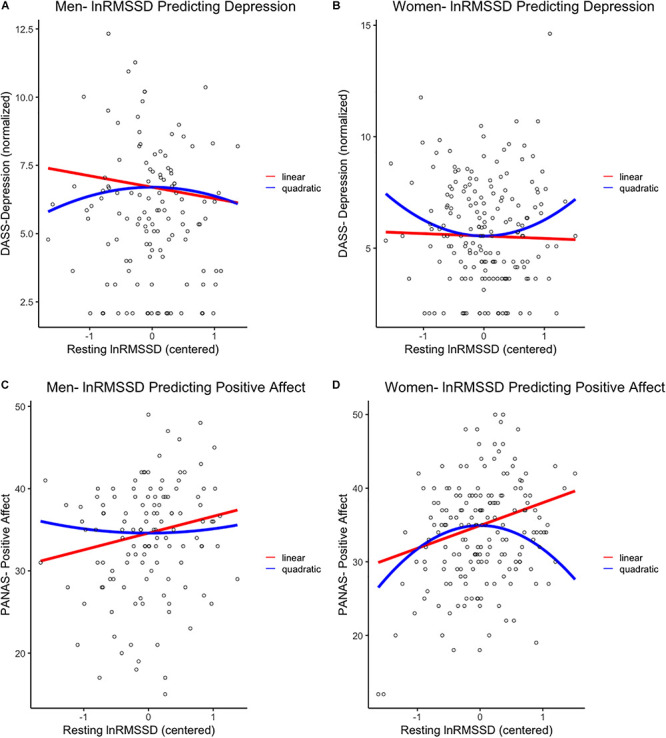
Vagally mediated heart rate variability (vmHRV), a measure of the parasympathetic nervous system's control over the heart, is often negatively related to maladaptive emotional outcomes. Recent work suggests that quadratic relationships involving these factors may be present; however, research has not investigated gender differences in these nonlinear functions. To address this gap, the current study tested for quadratic relationships between resting vmHRV and depression and positive affect while investigating gender differences in these relationships. Significant quadratic effects were found between resting vmHRV and reports of both depression symptoms and positive affect in women but not men. Specifically, the lowest levels of depression and the highest levels of positive affect were found at moderate vmHRV in women. These results suggest that examinations of vmHRV's nonlinear associations require the consideration of gender. Our findings are interpreted based on proposed differential neuropsychological mechanisms of vmHRV in men versus women.
Keywords: autonomic nervous system; depression; emotion; gender; gender differences; heart rate variability; nonlinear; positive affect.
Copyright © 2021 Spangler, Dunn, Aldao, Feeling, Free, Gillie, Vasey, Williams, Koenig and Thayer.
Conflict of interest statement
The authors declare that the research was conducted in the absence of any commercial or financial relationships that could be construed as a potential conflict of interest.
Figures
References
LinkOut - more resources
Full Text Sources
Other Literature Sources
Miscellaneous
