


p53 Rather Than β-Catenin Mediated the Combined Hypoglycemic Effect of Cinnamomum cassia (L.) and Zingiber officinale Roscoe in the Streptozotocin-Induced Diabetic Model
- PMID: 34054538
- PMCID: PMC8155675
- DOI: 10.3389/fphar.2021.664248
p53 Rather Than β-Catenin Mediated the Combined Hypoglycemic Effect of Cinnamomum cassia (L.) and Zingiber officinale Roscoe in the Streptozotocin-Induced Diabetic Model
Abstract
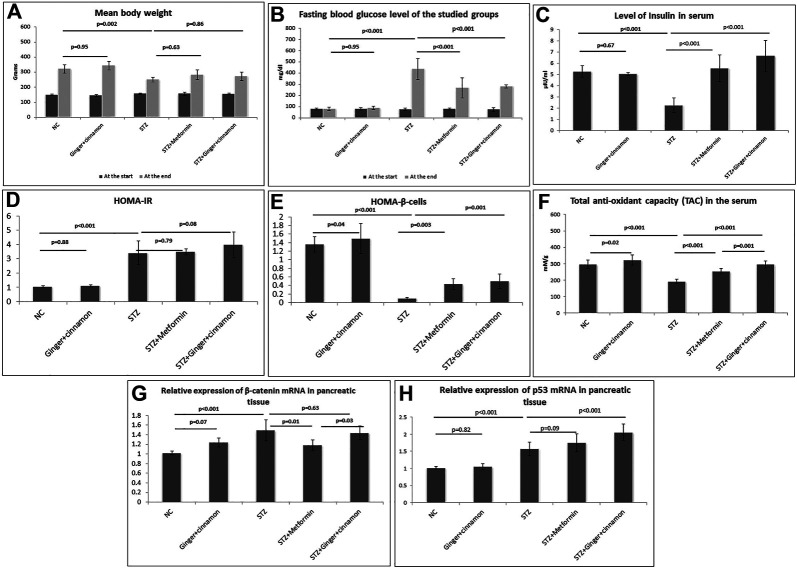
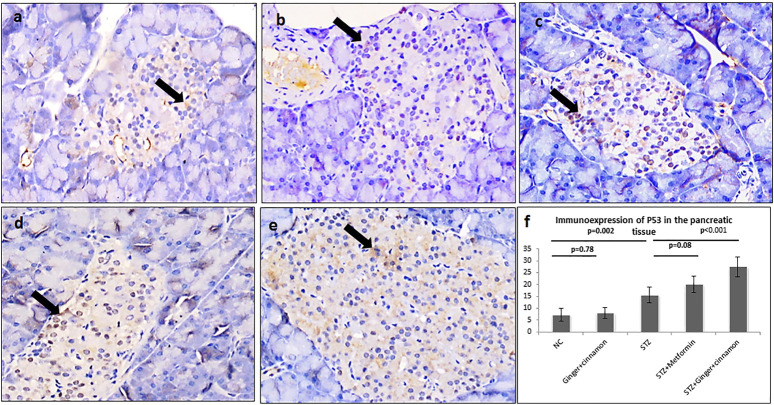
Background: The antioxidant, hypoglycemic, and insulin-enhancing effects of ginger and cinnamon were previously confirmed in experimental and human studies, while the combined effect of ginger and cinnamon was not thoroughly investigated until now. Objectives: This study was designed to assess the antidiabetic effect of combined administration of ginger (Zingiber officinale Roscoe) and cinnamon (Cinnamomum cassia L.) in streptozotocin (STZ)-induced diabetic rats compared to metformin and to explain the mechanism behind this effect. Materials and methods: STZ was utilized to induce diabetes mellitus in male Sprague-Dawley rats. Assessments of fasting blood glucose level (BGL), the total antioxidant capacity (TAC), serum insulin, HOMA-IR, and HOMA-β cells were performed. Pancreatic gene expression of β-catenin and p53 was assessed using RT-PCR. Assessment of histopathological alterations of pancreatic islet cells was performed using routine and immunohistochemical techniques. Results: BGL significantly decreased (p = 0.01), while serum insulin and TAC significantly increased (p < 0.001) in both metformin- and ginger plus cinnamon-treated groups compared to the untreated diabetic group. HOMA-β cell index significantly increased (p = 0.001) in ginger plus cinnamon, indicating their enhancing effect on insulin secretion in diabetic conditions. p53 gene expression was significantly upregulated (p < 0.001), while β-catenin was insignificantly downregulated (p = 0.32) in ginger plus cinnamon-treated groups. Insulin immunoexpression in β cells significantly increased (p = 0.001, p = 0.004) in metformin- and ginger plus cinnamon-treated groups, respectively. Conclusions: The combined administration of ginger and cinnamon has a significant hypoglycemic and antioxidant effect in STZ-induced diabetes mostly through enhancing repair of islet cells mediated via upregulation of pancreatic p53 expression. Therefore, testing this effect in diabetic patients is recommended.
Keywords: antioxidants; cinnamon; diabetes mellitus; ginger; insulin; p53; pancreas; β-catenin.
Copyright © 2021 Ayuob, Al-Shathly, Bakhshwin, Al-Abbas, Shaer, Al Jaouni and Hamed.
Conflict of interest statement
The authors declare that the research was conducted in the absence of any commercial or financial relationships that could be construed as a potential conflict of interest.
Figures



References
-
- Afifi N. M. (2012). Effect of Mesenchymal Stem Cell Therapy on Recovery of Streptozotocin-Induced Diabetes Mellitus in Adult Male Albino Rats. The Egypt. J. Histol. 35, 458–469. 10.1097/01.ehx.0000418062.59636.5b - DOI
-
- Afoulous S., Ferhout H., Raoelison E. G., Valentin A., Moukarzel B., Couderc F., et al. (2013). Chemical Composition and Anticancer, Antiinflammatory, Antioxidant and Antimalarial Activities of Leaves Essential Oil of Cedrelopsis Grevei. Food Chem. Toxicol. 56, 352–362. 10.1016/j.fct.2013.02.008 - DOI - PubMed
-
- Ahmad R. A., Serati-Nouri H., Serati-Nouri H., Majid F. A. A., Sarmidi M. R., Aziz R. A. (2015). Assessment of Potential Toxicological Effects of Cinnamon Bark Aqueous Extract in Rats. Ijbbb 5, 36–44. 10.17706/ijbbb.2015.5.1.36-44 - DOI
LinkOut - more resources
Full Text Sources
Other Literature Sources
Research Materials
Miscellaneous
