


Computational Modeling for Antiarrhythmic Drugs for Atrial Fibrillation According to Genotype
- PMID: 34054570
- PMCID: PMC8155488
- DOI: 10.3389/fphys.2021.650449
Computational Modeling for Antiarrhythmic Drugs for Atrial Fibrillation According to Genotype
Erratum in
-
Corrigendum: Computational modeling for antiarrhythmic drugs for atrial fibrillation according to genotype.Front Physiol. 2022 Dec 2;13:991997. doi: 10.3389/fphys.2022.991997. eCollection 2022. Front Physiol. 2022. PMID: 36531166 Free PMC article.
Abstract
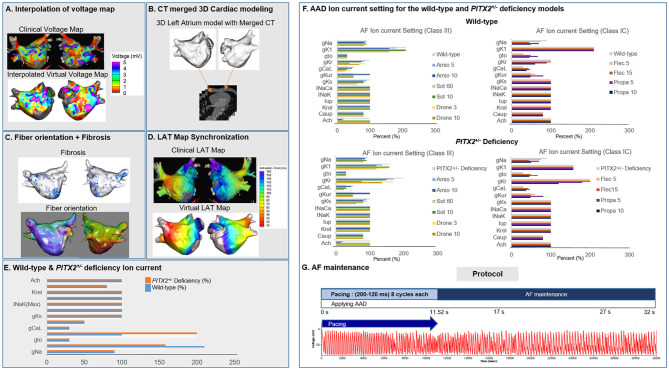
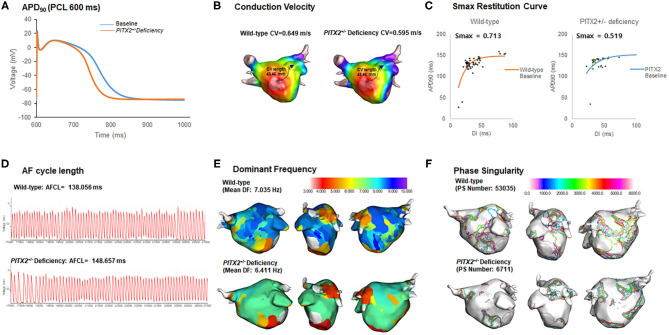
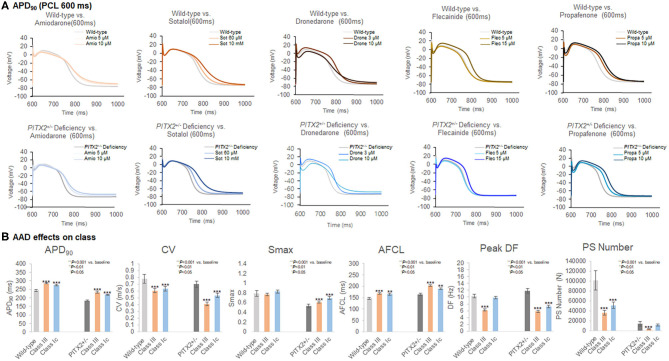
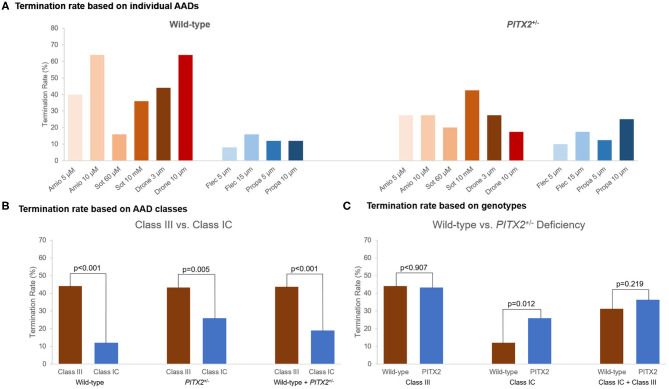
Background: The efficacy of antiarrhythmic drugs (AAD) can vary in patients with atrial fibrillation (AF), and the PITX2 gene affects the responsiveness of AADs. We explored the virtual AAD (V-AAD) responses between wild-type and PITX2 +/--deficient AF conditions by realistic in silico AF modeling. Methods: We tested the V-AADs in AF modeling integrated with patients' 3D-computed tomography and 3D-electroanatomical mapping, acquired in 25 patients (68% male, 59.8 ± 9.8 years old, 32.0% paroxysmal type). The ion currents for the PITX2 +/- deficiency and each AAD (amiodarone, sotalol, dronedarone, flecainide, and propafenone) were defined based on previous publications. Results: We compared the wild-type and PITX2 +/- deficiency in terms of the action potential duration (APD90), conduction velocity (CV), maximal slope of restitution (Smax), and wave-dynamic parameters, such as the dominant frequency (DF), phase singularities (PS), and AF termination rates according to the V-AADs. The PITX2 +/--deficient model exhibited a shorter APD90 (p < 0.001), a lower Smax (p < 0.001), mean DF (p = 0.012), PS number (p < 0.001), and a longer AF cycle length (AFCL, p = 0.011). Five V-AADs changed the electrophysiology in a dose-dependent manner. AAD-induced AFCL lengthening (p < 0.001) and reductions in the CV (p = 0.033), peak DF (p < 0.001), and PS number (p < 0.001) were more significant in PITX2 +/--deficient than wild-type AF. PITX2 +/--deficient AF was easier to terminate with class IC AADs than the wild-type AF (p = 0.018). Conclusions: The computational modeling-guided AAD test was feasible for evaluating the efficacy of multiple AADs in patients with AF. AF wave-dynamic and electrophysiological characteristics are different among the PITX2-deficient and the wild-type genotype models.
Keywords: PITX2; antiarrhythmic drugs; atrial fibrillation; gene; modeling.
Copyright © 2021 Hwang, Park, Kwon, Lim, Hong, Kim, Yu, Kim, Uhm, Joung, Lee and Pak.
Conflict of interest statement
The authors declare that the research was conducted in the absence of any commercial or financial relationships that could be construed as a potential conflict of interest.
Figures
References
-
- Bai J., Zhu Y., Lo A., Gao M., Lu Y., Zhao J., et al. (2021). In silico assessment of class i antiarrhythmic drug effects on Pitx2-induced atrial fibrillation: insights from populations of electrophysiological models of human atrial cells and tissues. Int. J. Mol. Sci. 22:1265. 10.3390/ijms22031265 - DOI - PMC - PubMed
LinkOut - more resources
Full Text Sources
Other Literature Sources
Miscellaneous
