


Circulating Type I Interferon Levels and COVID-19 Severity: A Systematic Review and Meta-Analysis
- PMID: 34054820
- PMCID: PMC8149905
- DOI: 10.3389/fimmu.2021.657363
Circulating Type I Interferon Levels and COVID-19 Severity: A Systematic Review and Meta-Analysis
Abstract
Introduction: Coronavirus disease 2019 (COVID-19) is caused by severe acute respiratory syndrome coronavirus 2 (SARS-CoV-2) infections, resulting in a range of clinical manifestations and outcomes. Laboratory and immunological alterations have been considered as potential markers of disease severity and clinical evolution. Type I interferons (IFN-I), mainly represented by IFN-α and β, are a group of cytokines with an important function in antiviral responses and have played a complex role in COVID-19. Some studies have demonstrated that IFN-I levels and interferon response is elevated in mild cases, while other studies have noted this in severe cases. The involvement of IFN-I on the pathogenesis and outcomes of SARS-CoV-2 infection remains unclear. In this study, we summarize the available evidence of the association of plasma protein levels of type I IFN with the severity of COVID-19.
Methods: The PRISMA checklist guided the reporting of the data. A systematic search of the MEDLINE (PubMed), EMBASE, and Web of Science databases was performed up to March of 2021, looking for articles that evaluated plasma protein levels of IFN-I in mild, severe, or critical COVID-19 patients. Comparative meta-analyses with random effects were performed to compare the standardized mean differences in plasma protein levels of IFN-I of mild versus severe and mild versus critical patients. Meta-regressions were performed to test the moderating role of age, sex, time that the IFN-I was measured, and limit of detection of the assay used in the difference between the means.
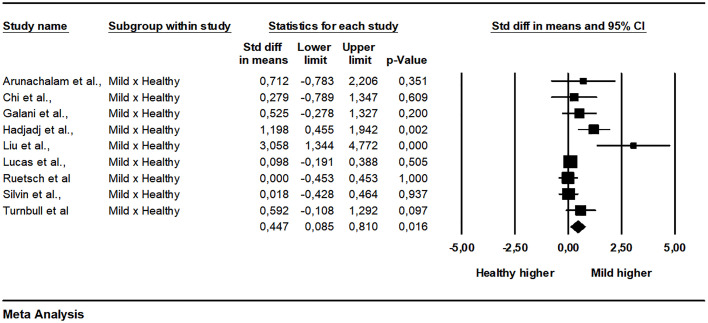
Results: There was no significant difference in plasma levels of IFN-α when comparing between mild and severe patients (SMD = -0.236, 95% CI -0.645 to 0.173, p = 0.258, I2 = 82.11), nor when comparing between patients mild and critical (SMD = 0.203, 95% CI -0.363 to 0.770, p = 0.481, I2 = 64.06). However, there was a significant difference between healthy individuals and patients with mild disease (SMD = 0.447, 95% CI 0.085 to 0.810, p = 0.016, I2 = 62.89).
Conclusions: Peripheral IFN-α cannot be used as a severity marker as it does not determine the clinical status presented by COVID-19 patients.
Keywords: COVID-19; IFN-α; biomarker; severity; type I interferon.
Copyright © 2021 da Silva, Gonçalves, Zanin, Schuch and de Souza.
Conflict of interest statement
The authors declare that the research was conducted in the absence of any commercial or financial relationships that could be construed as a potential conflict of interest.
Figures



References
-
- World Health Organization . Who Coronavirus Disease (Covid-19) Dashboard (2020). Available at: https://covid19.who.int/ (Accessed April 09, 2021).
Publication types
MeSH terms
Substances
LinkOut - more resources
Full Text Sources
Other Literature Sources
Medical
Miscellaneous
