


Changes in Circadian Rhythms Dysregulate Inflammation in Ageing: Focus on Leukocyte Trafficking
- PMID: 34054857
- PMCID: PMC8160305
- DOI: 10.3389/fimmu.2021.673405
Changes in Circadian Rhythms Dysregulate Inflammation in Ageing: Focus on Leukocyte Trafficking
Abstract
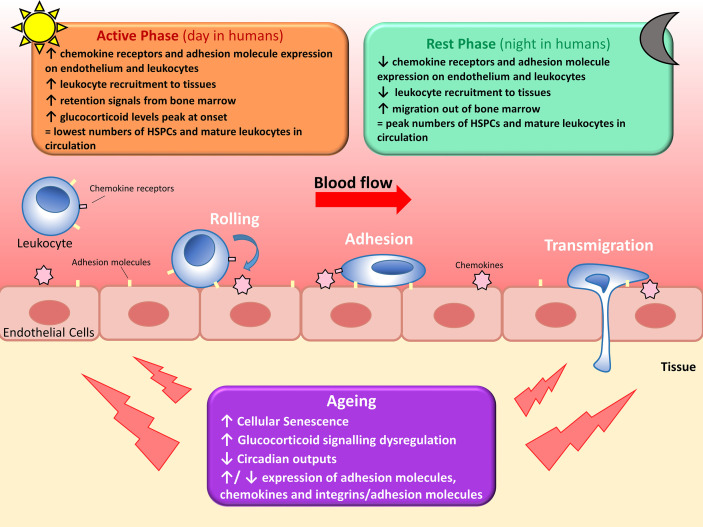
Leukocyte trafficking shows strong diurnal rhythmicity and is tightly regulated by circadian rhythms. As we age, leukocyte trafficking becomes dysregulated, contributing to the increased systemic, low-grade, chronic inflammation observed in older adults. Ageing is also associated with diminished circadian outputs and a dysregulation of the circadian rhythm. Despite this, there is little evidence to show the direct impact of age-associated dampening of circadian rhythms on the dysregulation of leukocyte trafficking. Here, we review the core mammalian circadian clock machinery and discuss the changes that occur in this biological system in ageing. In particular, we focus on the changes that occur to leukocyte trafficking rhythmicity with increasing age and consider how this impacts inflammation and the development of immune-mediated inflammatory disorders (IMIDs). We aim to encourage future ageing biology research to include a circadian approach in order to fully elucidate whether age-related circadian changes occur as a by-product of healthy ageing, or if they play a significant role in the development of IMIDs.
Keywords: chronotherapy; circadian rhythm; inflammation; leukocytes; trafficking.
Copyright © 2021 Nathan, Gibbs, Rainger and Chimen.
Conflict of interest statement
The authors declare that the research was conducted in the absence of any commercial or financial relationships that could be construed as a potential conflict of interest.
Figures
References
Publication types
MeSH terms
Grants and funding
LinkOut - more resources
Full Text Sources
Other Literature Sources
Medical
Research Materials
