Review
. 2021 May 12:12:681449.
doi: 10.3389/fimmu.2021.681449. eCollection 2021.

Aging and Options to Halt Declining Immunity to Virus Infections

Affiliations
Review

Aging and Options to Halt Declining Immunity to Virus Infections

Miguel Ángel Palacios-Pedrero et al. Front Immunol. .

Abstract

Immunosenescence is a process associated with aging that leads to dysregulation of cells of innate and adaptive immunity, which may become dysfunctional. Consequently, older adults show increased severity of viral and bacterial infections and impaired responses to vaccinations. A better understanding of the process of immunosenescence will aid the development of novel strategies to boost the immune system in older adults. In this review, we focus on major alterations of the immune system triggered by aging, and address the effect of chronic viral infections, effectiveness of vaccination of older adults and strategies to improve immune function in this vulnerable age group.

Keywords: aging; cell mediated immunity; immunosenescence; vaccine; virus infections.


Conflict of interest statement

The authors declare that the research was conducted in the absence of any commercial or financial relationships that could be construed as a potential conflict of interest.

Figures
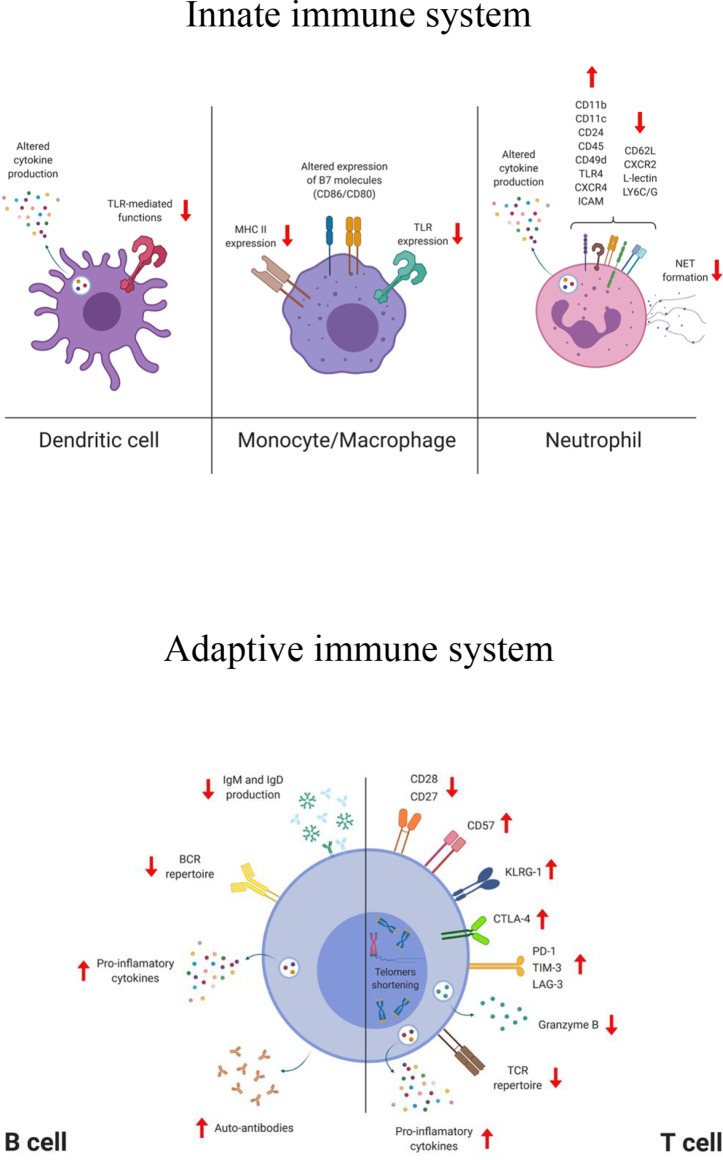
Figure 1
Figure 1
Simplified representation of the phenotypical and functional changes affecting cells of the innate and adaptive compartment during aging. TLR, toll like receptor; MHC, major histocompatibility complex; CXCR, C-X-C chemokine receptor; ICAM, intercellular adhesion molecule; LY6C/G, lymphocyte antigen 6 complex (locus C/G); NET, neutrophil extracellular trap; BCR, B cell receptor; TCR, T cell receptor; KLRG-1, killer-cell lectin like receptor G1; CTLA-4, cytotoxic T-lymphocyte antigen 4; PD-1, programmed cell death protein 1; TIM-3, T cell immunoglobulin and mucin domain-containing protein 3; LAG-3, lymphocyte-activation gene 3. The figure was created with BioRender.com.
Figure 2
Figure 2
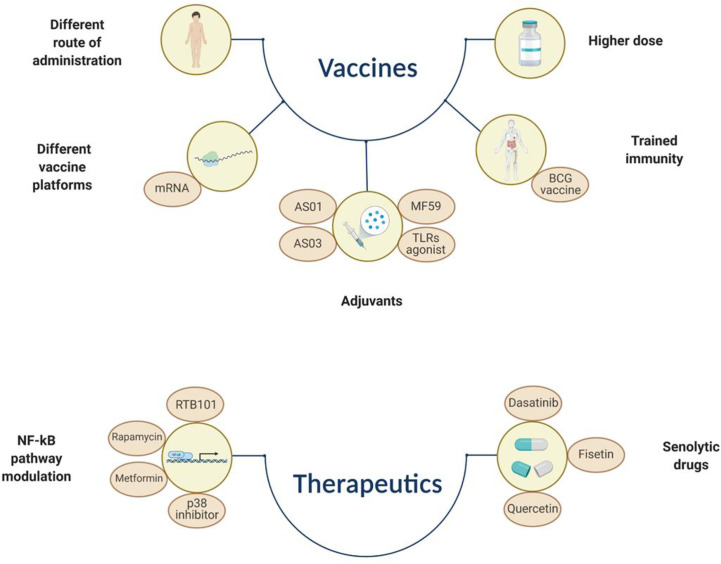
Simplified representation of different approaches that aim to overcome immunosenescence by increasing vaccine immunogenicity/efficacy or by using therapeutics that can dampen the SASP effect or induce selective apoptosis of immunosenescent cells. BCG, Bacillus Calmette–Guérin; TLR, toll like receptor. The figure was created with BioRender.com.

Similar articles

Cited by

References

    1. Walford RL. Immunologic Aspects of Aging. Klin Wochenschr (1969) 47(11):599–605. 10.1007/BF01876949 - DOI - PubMed
    1. Hainz U, Jenewein B, Asch E, Pfeiffer KP, Berger P, Grubeck-Loebenstein B. Insufficient Protection for Healthy Elderly Adults by Tetanus and TBE Vaccines. Vaccine (2005) 23(25):3232–5. 10.1016/j.vaccine.2005.01.085 - DOI - PubMed
    1. Song JY, Cheong HJ, Hwang IS, Choi WS, Jo YM, Park DW, et al. . Long-Term Immunogenicity of Influenza Vaccine Among the Elderly: Risk Factors for Poor Immune Response and Persistence. Vaccine (2010) 28(23):3929–35. 10.1016/j.vaccine.2010.03.067 - DOI - PubMed
    1. Tohme RA, Awosika-Olumo D, Nielsen C, Khuwaja S, Scott J, Xing J, et al. . Evaluation of Hepatitis B Vaccine Immunogenicity Among Older Adults During an Outbreak Response in Assisted Living Facilities. Vaccine (2011) 29(50):9316–20. 10.1016/j.vaccine.2011.10.011 - DOI - PMC - PubMed
    1. Van Der Meeren O, Crasta P, Cheuvart B, De Ridder M. Characterization of an Age-Response Relationship to GSK's Recombinant Hepatitis B Vaccine in Healthy Adults: An Integrated Analysis. Hum Vaccin Immunother (2015) 11(7):1726–9. 10.1080/21645515.2015.1039758 - DOI - PMC - PubMed

Publication types