


A Narrative Review on Therapeutic Potentials of Watercress in Human Disorders
- PMID: 34055006
- PMCID: PMC8123986
- DOI: 10.1155/2021/5516450
A Narrative Review on Therapeutic Potentials of Watercress in Human Disorders
Abstract
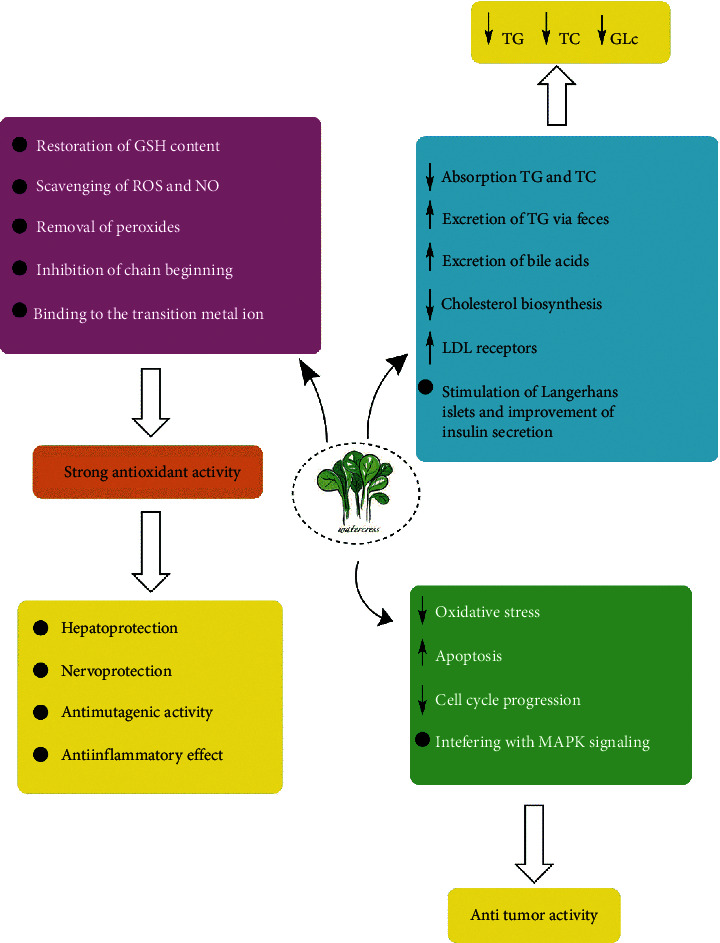
Watercress (WC) is an aquatic vegetable that belongs to the Brassicaceae family, and it often grows near water. In traditional medicine, WC is a known remedy for hypercholesterolemia, hyperglycemia, hypertension, arthritis, bronchitis, diuresis, odontalgia, and scurvy. It also acts as an antiestrogenic and can be used as a nutritional supplement. It has been reported that these therapeutic effects are due to primary metabolites such as isothiocyanates, glucosinolates, polyphenols (flavonoids, phenolic acids, and proanthocyanidins), vitamins (B1, B2, B3, B6, E, and C), terpenes (including carotenoids), and bioelements which exist in this plant. Many pharmacological studies confirm the antioxidant, antibacterial, anticancer, antipsoriatic, anti-inflammatory, cardioprotective, renoprotective, hepatoprotective, and antigenotoxicity effects of WC. The consumption of WC extract can be useful in reducing the complications of hypercholesterolemia and hyperglycemia. Furthermore, the extract of WC could markedly augment the antioxidant enzymes such as superoxide dismutase and catalase activity. Interestingly, consumption of food rich in polyphenols such as WC extract can help reduce oxidative stress, DNA damage, and cancer susceptibility. Several studies also showed that WC extract significantly reduced liver injury as a result of cholestatic hepatic injury, gamma radiation, arsenic, and acetaminophen-induced hepatotoxicity. In this review, the researchers focus on the phytochemical and biochemical characterizations of WC and its therapeutic effects in the treatment of human diseases.
Copyright © 2021 Esmaeel Panahi Kokhdan et al.
Conflict of interest statement
The authors declare that they have no conflicts of interest.
Figures
References
-
- Klimek-Szczykutowicz M., Szopa A., Ekiert H. Chemical composition, traditional and professional use in medicine, application in environmental protection, position in food and cosmetics industries, and biotechnological studies of Nasturtium officinale (watercress) - a review. Fitoterapia. 2018;129:283–292. doi: 10.1016/j.fitote.2018.05.031. - DOI - PubMed
-
- Sakil M., Polash M., Afrin S., Hossain M. Evaluation of morphological traits, phytochemical compositions and antioxidant properties of watercress leaves. Progressive Agriculture. 2019;30:10–16. doi: 10.3329/pa.v30i0.41552. - DOI
-
- Ozen T. Investigation of antioxidant properties of Nasturtium officinale (watercress) leaf extracts. Acta Poloniae Pharmaceutica. 2009;66(2):187–193. - PubMed
-
- Mousa-Al-Reza Hadjzadeh Z. R., Moradi R., Ghorbani A. Effects of hydroalcoholic extract of watercress (Nasturtium officinale) leaves on serum glucose and lipid levels in diabetic rats. Indian Journal of Physiology and Pharmacology. 2015;59:223–230. - PubMed
Publication types
LinkOut - more resources
Full Text Sources
Other Literature Sources
