. 2021 Apr 7;6(15):10288-10305.
doi: 10.1021/acsomega.1c00650. eCollection 2021 Apr 20.

Peptidomics of Haemonchus contortus

Affiliations

Peptidomics of Haemonchus contortus

Armelle Buzy et al. ACS Omega. .

Abstract

The nematode Haemonchus contortus (the barber's pole worm) is an endoparasite infecting wild and domesticated ruminants worldwide. Widespread anthelmintic resistance of H. contortus requires alternative strategies to control this parasite. Neuropeptide signaling represents a promising target for anthelmintic drugs. Identification and relative quantification of nematode neuropeptides are, therefore, required for the development of such therapeutic targets. In this work, we undertook the profiling of the whole H. contortus larvae at different stages for the direct sequencing of the neuropeptides expressed at low levels in these tissues. We set out a peptide extraction protocol and a peptidomic workflow to biochemically characterize bioactive peptides from both first-stage (L1) and third-stage larvae (L3) of H. contortus. This work led to the identification and quantification at the peptidomic level of more than 180 mature neuropeptides, including amidated and nonamidated peptides, arising from 55 precursors of H. contortus. The differential peptidomic approach provided evidence that both life stages express most FMRFamide-like peptides (FLPs) and neuropeptide-like proteins (NLPs). The H. contortus peptidome resource, established in this work, could add the discovery of neuropeptide system-targeting drugs for ruminants.


Conflict of interest statement

The authors declare no competing financial interest.

Figures

Figure 1
Figure 1
Presence of flp-gene sequences in the H. contortus databases reported in PRJEB506 (pink circle) and PRJNA205202 (blue circle) on WormBase (https://wormbase.org). Flp-20, flp-23, and flp-32 were described by McCoy et al. and flp-32 by Atkinson et al. * indicates discrepancies between sequences reported in McCoy et al. and databases from Wormbase. ** Flp-19 sequence was present in the previous PRJEB506 release (versions to 10) but not in versions 11–14.
Figure 2
Figure 2
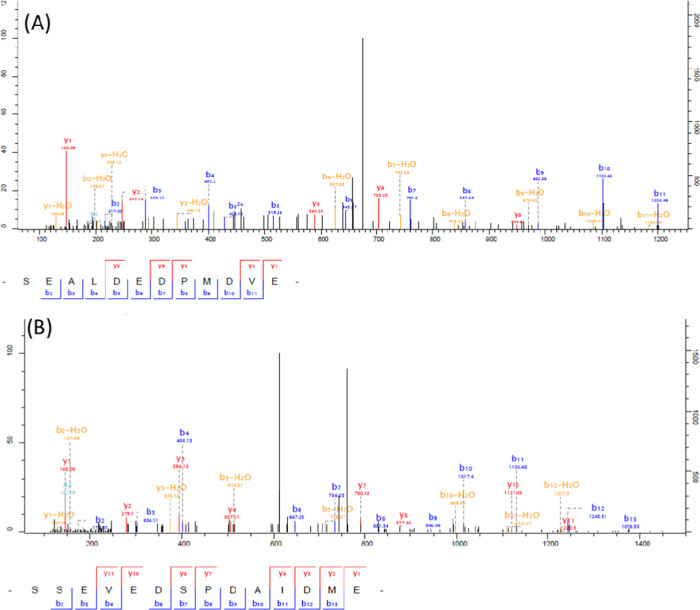
MS/MS spectra of two unmodified peptides of the H. contortusflp-6. The fragmentation schemes enabled the identification of the peptide SEALDEDPMDVE in the WormBase, PRJEB506.WBPS10 database analysis (A), and of the peptide SSEVEDSPDAIDME upon the analysis of both PRJEB506.WBPS14 and PRJNA205202.WBPS14 WormBase (B).
Figure 3
Figure 3
Sequence alignments of H. contortusflp-11 (sequence in the BioProject PRJEB506 protein fasta file, Wormbase source) with C. elegansflp-11 (UniProtKB source). Sequences were aligned using the Clustal Omega program (http://www.clustal.org). Predicted signal peptide is indicated in italics. Putative mono- and di-basic cleavage sites are shown in red. The potential C-terminal glycine residues for amidation are indicated in brown. C. elegans peptide data shown in the study of Van Bael et al. are highlighted in blue. H. contortus FLP peptide sequences identified in this study are shown in bold green with the sequence of the unmodified peptides being underlined. The amidated glutamine residues identified in both species are indicated in purple.
Figure 4
Figure 4
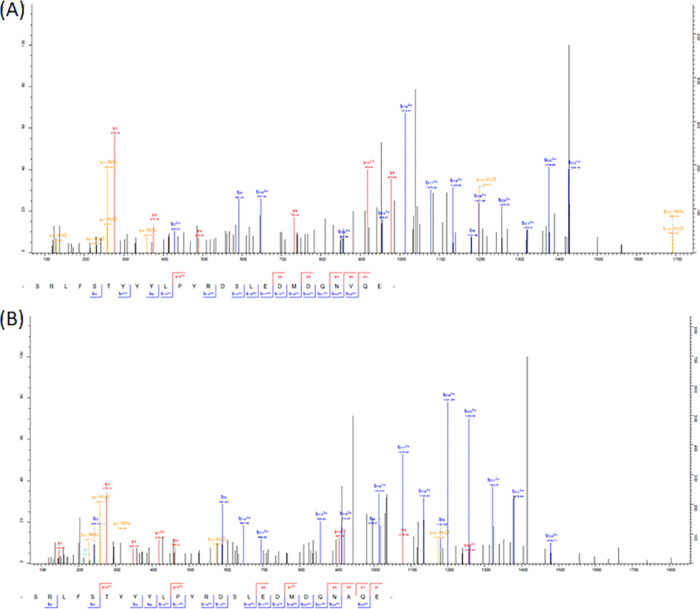
MS/MS spectra of two peptides of the H. contortus neuropeptide precursor encoded by nlp-5. The fragmentation schemes allowed the identification of the peptide SRLFSTYYYLPYRDSLEDMDQNVQE from the WormBase PRJEB506 data set analysis (A) and of the peptide SRLFSTYYYLPYRDSLEDMDQNAQE from analysis of the WormBase PRJNA205202 data set (B).
Figure 5
Figure 5
MS/MS spectra of the C-terminal peptides of nlp-17 (A), nlp-67 (B), and nlp-71 (C) of H. contortus. The fragmentation schemes allow the unambiguous identification of the presence of a disulfide bridge between two cysteine residues for the three peptides.
Figure 6
Figure 6
Relative abundance of flp-encoded (highlighted in blue) and nlp-encoded peptides (highlighted in red) in the L1 larvae stage (A) and L3 larvae stage (B) of H. contortus. The most intense peptides identified are indicated.
Figure 7
Figure 7
Volcano plot showing peptides differentially expressed between L1 larvae and L3 larvae of H. contortus. The x-axis represents the log2 fold-change (FC) of L3 versus L1. The y-axis represents the p-value from a t test applied between four L1 biological replicates and three L3 biological replicates. All data are shown in Table S2. Peptides with FC < −3 and p-value <0.01, statistically more expressed in L1 stage, are highlighted in green and peptides with FC > 3 and p-value <0.01, statistically more expressed in L3 stage, are highlighted in red. For the purpose of clarity, peptides are only annotated by the precursor name.
Figure 8
Figure 8
Relative label-free quantification of four nlp-3 encoded peptides (A) and of two nlp-10 encoded peptides (B) between the first-stage (L1) and third-stage larvae (L3) of H. contortus. The boxplots were obtained from four L1 biological replicates and from three L3 biological replicates. The zone below the inferior red line (value of 16.6) indicates very low or no expression. The zone between the two red lines corresponds to a low expression zone.

References

    1. Besier R. B.; Kahn L. P.; Sargison N. D.; Van Wyk J. A. The Pathophysiology, Ecology and Epidemiology of Haemonchus contortus Infection in Small Ruminants. Adv. Parasitol. 2016, 93, 95–143. - PubMed
    1. Gasser R. B.; von Samson-Himmelstjerna G. Haemonchus contortus and haemonchosis– past, present and future trends. Adv. Parasitol. 2016, 93, 1–666.
    1. Veglia E. The anatomy and life history of the Haemonchus contortus. Rep. Dir. Vet. Res. 1915, 3–4, 347–500.
    1. Brown L. A.; Jones A. K.; Buckingham S. D.; Mee C. J.; Sattelle D. B. Contributions from Caenorhabditis elegans functional genetics to antiparasitic drug target identification and validation: nicotinic acetylcholine receptors, a case study. Int. J. Parasitol. 2006, 36, 617–624. 10.1016/j.ijpara.2006.01.016. - DOI - PubMed
    1. Martin R. J.; Robertson A. P. Control of Nematode Parasites with Agents Acting on Neuro-Musculature Systems: Lessons for Neuropeptide Ligand Discovery. Adv. Exp. Med. Biol. 2010, 692, 138–154. - PMC - PubMed

LinkOut - more resources