


Association Cortex Is Essential to Reverse Hemianopia by Multisensory Training
- PMID: 34056645
- PMCID: PMC8491673
- DOI: 10.1093/cercor/bhab138
Association Cortex Is Essential to Reverse Hemianopia by Multisensory Training
Abstract
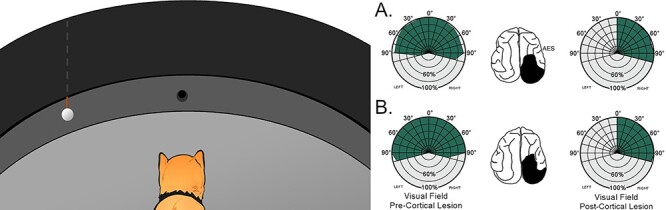
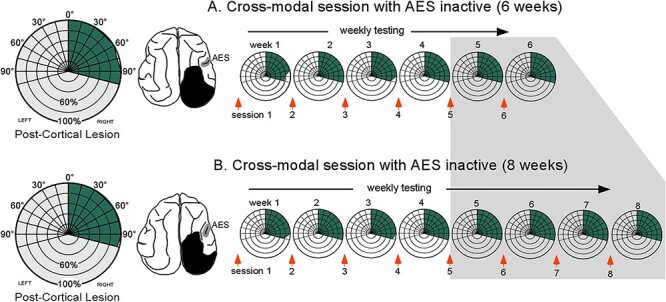
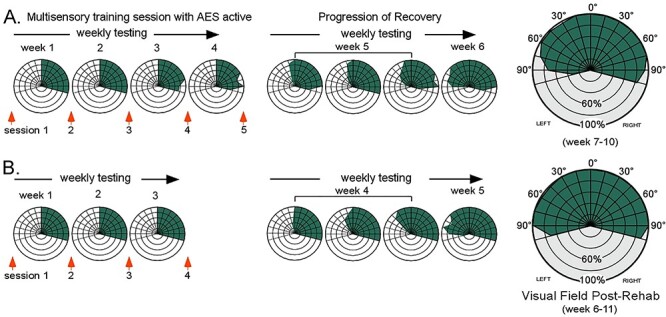
Hemianopia induced by unilateral visual cortex lesions can be resolved by repeatedly exposing the blinded hemifield to auditory-visual stimuli. This rehabilitative "training" paradigm depends on mechanisms of multisensory plasticity that restore the lost visual responsiveness of multisensory neurons in the ipsilesional superior colliculus (SC) so that they can once again support vision in the blinded hemifield. These changes are thought to operate via the convergent visual and auditory signals relayed to the SC from association cortex (the anterior ectosylvian sulcus [AES], in cat). The present study tested this assumption by cryogenically deactivating ipsilesional AES in hemianopic, anesthetized cats during weekly multisensory training sessions. No signs of visual recovery were evident in this condition, even after providing animals with up to twice the number of training sessions required for effective rehabilitation. Subsequent training under the same conditions, but with AES active, reversed the hemianopia within the normal timeframe. These results indicate that the corticotectal circuit that is normally engaged in SC multisensory plasticity has to be operational for the brain to use visual-auditory experience to resolve hemianopia.
Keywords: colliculus; ectosylvian; hemianopia; multisensory; rehabilitation.
© The Author(s) 2021. Published by Oxford University Press. All rights reserved. For permissions, please e-mail: journals.permissions@oup.com.
Figures
References
Publication types
MeSH terms
Grants and funding
LinkOut - more resources
Full Text Sources
Other Literature Sources
Miscellaneous
