


Chicken embryo as a model in epigenetic research
- PMID: 34058565
- PMCID: PMC8170499
- DOI: 10.1016/j.psj.2021.101164
Chicken embryo as a model in epigenetic research
Abstract
Epigenetics is defined as the study of changes in gene function that are mitotically or meiotically heritable and do not lead to a change in DNA sequence. Epigenetic modifications are important mechanisms that fine tune the expression of genes in response to extracellular signals and environmental changes. In vertebrates, crucial epigenetic reprogramming events occur during early embryogenesis and germ cell development. Chicken embryo, which develops external to the mother's body, can be easily manipulated in vivo and in vitro, and hence, it is an excellent model for performing epigenetic studies. Environmental factors such as temperature can affect the development of an embryo into the phenotype of an adult. A better understanding of the environmental impact on embryo development can be achieved by analyzing the direct effects of epigenetic modifications as well as their molecular background and their intergenerational and transgenerational inheritance. In this overview, the current possibility of epigenetic changes during chicken embryonic development and their effects on long-term postembryonic development are discussed.
Keywords: chicken embryo; epigenetics; in ovo; primordial germ cells.
Copyright © 2021 The Authors. Published by Elsevier Inc. All rights reserved.
Figures
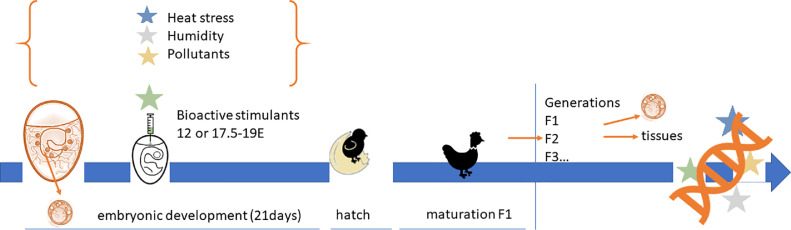
References
-
- Al-Zghoul M.B., Sukker H., Ababneh M.M. Effect of thermal manipulation of broilers embryos on the response toheat-induced oxidative stress. Poult. Sci. 2019;98:991–1001. - PubMed
-
- Bednarczyk M., Stadnicka K., Kozłowska I., Abiuso C., Tavaniello S., Dankowiakowska A., Sławińska A., Maiorano G. Influence of different prebiotics and mode of their administration on broiler chicken performance. Animal. 2016:1271–1279. - PubMed
-
- Bednarczyk M., Urbanowski M., Gulewicz P., Kasperczyk K., Maiorano G., Szwaczkowski T. Field and in vitro study on prebiotic effect of raffinose family oligosaccharides in chickens. Bull. Vet. Inst. Pulawy. 2011;55:465–469.
Publication types
MeSH terms
LinkOut - more resources
Full Text Sources
