


Racial and Ethnic Disparities in Adverse Perinatal Outcomes at Term
- PMID: 34058765
- PMCID: PMC8630098
- DOI: 10.1055/s-0041-1730348
Racial and Ethnic Disparities in Adverse Perinatal Outcomes at Term
Abstract
Objective: This study aimed to evaluate whether racial and ethnic disparities in adverse perinatal outcomes exist at term.
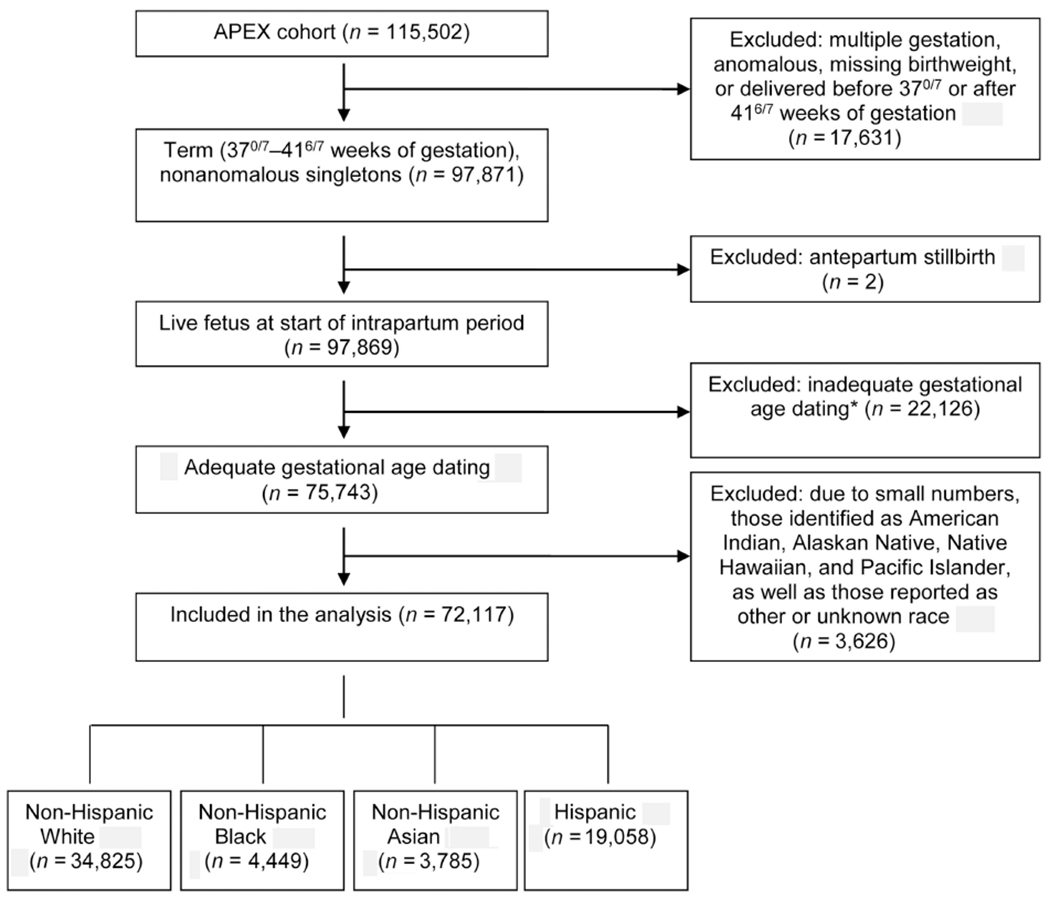
Study design: We performed a secondary analysis of a multicenter observational study of 115,502 pregnant patients and their neonates (2008-2011). Singleton, nonanomalous pregnancies delivered from 37 to 41 weeks were included. Race and ethnicity were abstracted from the medical record and categorized as non-Hispanic White (White; referent), non-Hispanic Black (Black), non-Hispanic Asian (Asian), or Hispanic. The primary outcome was an adverse perinatal composite defined as perinatal death, Apgar score < 4 at 5 minutes, ventilator support, hypoxic-ischemic encephalopathy, subgaleal hemorrhage, skeletal fracture, infant stay greater than maternal stay (by ≥ 3 days), brachial plexus palsy, or facial nerve palsy.
Results: Of the 72,117 patients included, 48% were White, 20% Black, 5% Asian, and 26% Hispanic. The unadjusted risk of the primary outcome was highest for neonates of Black patients (3.1%, unadjusted relative risk [uRR] = 1.16, 95% confidence interval [CI]: 1.04-1.30), lowest for neonates of Hispanic patients (2.1%, uRR = 0.80, 95% CI: 0.71-0.89), and no different for neonates of Asian (2.6%), compared with those of White patients (2.7%). In the adjusted model including age, body mass index (BMI), smoking, obstetric history, and high-risk pregnancy, differences in risk for the primary outcome were no longer observed for neonates of Black (adjusted relative risk [aRR] = 1.06, 95% CI: 0.94-1.19) and Hispanic (aRR = 0.92, 95% CI: 0.81-1.04) patients. Adding insurance to the model lowered the risk for both groups (aRR = 0.85, 95% CI: 0.75-0.96 for Black; aRR = 0.68, 95% CI: 0.59-0.78 for Hispanic).
Conclusion: Although neonates of Black patients have the highest frequency of adverse perinatal outcomes at term, after adjustment for sociodemographic factors, this higher risk is no longer observed, suggesting the importance of developing strategies that address social determinants of health to lessen extant health disparities.
Key points: · Term neonates of Black patients have the highest crude frequency of adverse perinatal outcomes.. · After adjustment for confounders, higher risk for neonates of Black patients is no longer observed.. · Disparities in outcomes are strongly related to insurance status..
Thieme. All rights reserved.
Conflict of interest statement
None declared.
Figures
References
-
- Center for Disease Control and Prevention. Health equity. Accessed October 8, 2020 at: https://www.cdc.gov/chronicdisease/healthequity/index.htm
-
- Center for Disease Control and Prevention. Social determinants of health: know what affects health. Accessed October 8, 2020 at: https://www.cdc.gov/socialdeterminants/index.htm
-
- Committee on Health Care for Underserved Women. ACOG committee opinion no. 649: racial and ethnic disparities in obstetrics and gynecology. Obstet Gynecol 2015;126(06):e130–e134 - PubMed
Publication types
MeSH terms
Grants and funding
- UG1 HD027869/HD/NICHD NIH HHS/United States
- UG1 HD027915/HD/NICHD NIH HHS/United States
- U10 HD040485/HD/NICHD NIH HHS/United States
- U10 HD034116/HD/NICHD NIH HHS/United States
- U10 HD027917/HD/NICHD NIH HHS/United States
- UG1 HD040485/HD/NICHD NIH HHS/United States
- UG1 HD040500/HD/NICHD NIH HHS/United States
- U10 HD053118/HD/NICHD NIH HHS/United States
- UL1 RR024989/RR/NCRR NIH HHS/United States
- U10 HD040500/HD/NICHD NIH HHS/United States
- U10 HD040544/HD/NICHD NIH HHS/United States
- UL1 TR002548/TR/NCATS NIH HHS/United States
- UL1 RR025764/RR/NCRR NIH HHS/United States
- UG1 HD034116/HD/NICHD NIH HHS/United States
- UG1 HD040560/HD/NICHD NIH HHS/United States
- UG1 HD053097/HD/NICHD NIH HHS/United States
- UG1 HD040544/HD/NICHD NIH HHS/United States
- UG1 HD034208/HD/NICHD NIH HHS/United States
- UG1 HD040512/HD/NICHD NIH HHS/United States
- U10 HD027869/HD/NICHD NIH HHS/United States
- U10 HD027915/HD/NICHD NIH HHS/United States
- UG1 HD040545/HD/NICHD NIH HHS/United States
- U10 HD040560/HD/NICHD NIH HHS/United States
- U10 HD034208/HD/NICHD NIH HHS/United States
- U10 HD053097/HD/NICHD NIH HHS/United States
- U10 HD040512/HD/NICHD NIH HHS/United States
- U10 HD021410/HD/NICHD NIH HHS/United States
- U10 HD036801/HD/NICHD NIH HHS/United States
- U24 HD036801/HD/NICHD NIH HHS/United States
- U10 HD040545/HD/NICHD NIH HHS/United States
- U01 HD036801/HD/NICHD NIH HHS/United States
- HD21410/National Institute of Child Health and Human Development
- HD27869/National Institute of Child Health and Human Development
- HD27915/National Institute of Child Health and Human Development
- HD27917/National Institute of Child Health and Human Development
- HD34116/National Institute of Child Health and Human Development
- HD34208/National Institute of Child Health and Human Development
- HD36801/National Institute of Child Health and Human Development
- HD40500/National Institute of Child Health and Human Development
- HD40512/National Institute of Child Health and Human Development
- HD40544/National Institute of Child Health and Human Development
- HD40545/National Institute of Child Health and Human Development
- HD40560/National Institute of Child Health and Human Development
- HD40485/National Institute of Child Health and Human Development
- HD53097/National Institute of Child Health and Human Development
- HD53118/National Institute of Child Health and Human Development
- UL1 RR024989/RR/NCRR NIH HHS/United States
- 5UL1 RR025764/RR/NCRR NIH HHS/United States
