


Safety and efficacy of umbilical cord-derived Wharton's jelly compared to hyaluronic acid and saline for knee osteoarthritis: study protocol for a randomized, controlled, single-blind, multi-center trial
- PMID: 34059080
- PMCID: PMC8165766
- DOI: 10.1186/s13018-021-02475-6
Safety and efficacy of umbilical cord-derived Wharton's jelly compared to hyaluronic acid and saline for knee osteoarthritis: study protocol for a randomized, controlled, single-blind, multi-center trial
Abstract
Background: Osteoarthritis (OA) is the most common joint disorder in the United States of America (USA) with a fast-rising prevalence. Current treatment modalities are limited, and total knee replacement surgeries have shown disadvantages, especially for grade II/III OA. The interest in the use of biologics, including umbilical cord (UC)-derived Wharton's jelly (WJ), has grown in recent years. The results from a preliminary study demonstrated the presence of essential components of regenerative medicine, namely growth factors, cytokines, hyaluronic acid (HA), and extracellular vesicles, including exosomes, in WJ. The proposed study aims to evaluate the safety and efficacy of intra-articular injection of UC-derived WJ for the treatment of knee OA symptoms.
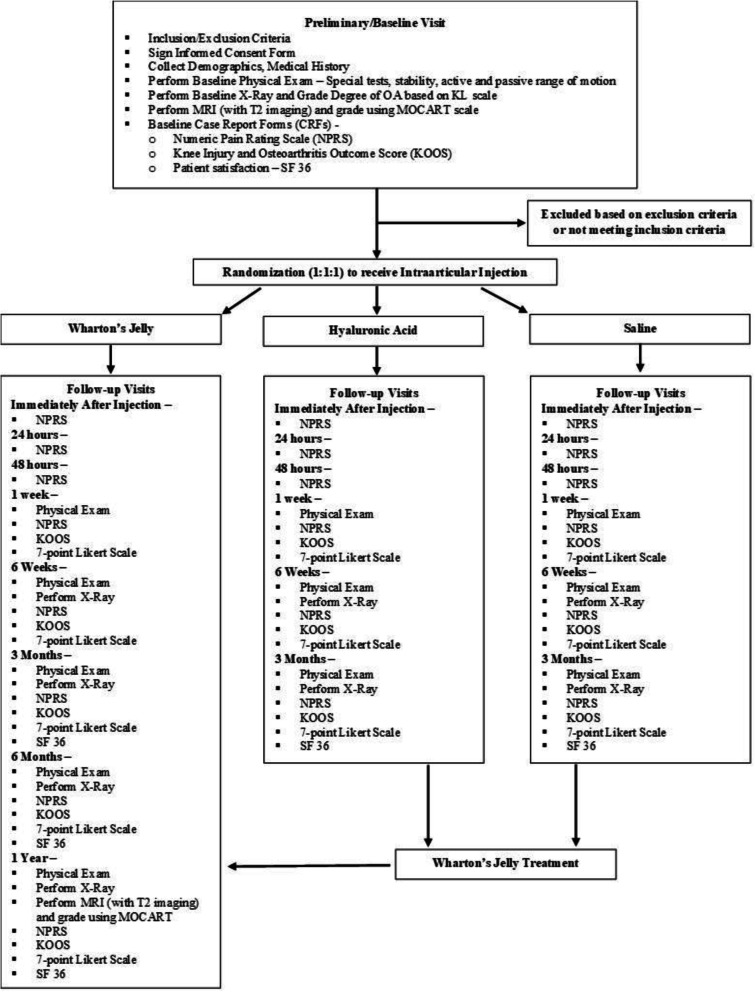
Methods: A randomized, controlled, single-blind, multi-center, prospective study will be conducted in which the safety and efficacy of intra-articular administration of UC-derived WJ are compared to HA (control) and saline (placebo control) in patients suffering from grade II/III knee OA. A total of 168 participants with grade II or III knee OA on the KL scale will be recruited across 53 sites in the USA with 56 participants in each arm and followed for 1 year post-injection. Patient satisfaction, Numeric Pain Rating Scale, Knee Injury and Osteoarthritis Outcome Score, 36-Item Short Form Survey (SF-36), and 7-point Likert Scale will be used to assess the participants. Physical exams, X-rays, and MRI with Magnetic Resonance Observation of Cartilage Repair Tissue score will be used to assess improvement in associated anatomy.
Discussion: The study results will provide valuable information into the safety and efficacy of intra-articular administration of Wharton's jelly for grade II/III knee osteoarthritis. The results of this study will also add to the treatment options available for grade II/III OA as well as help facilitate the development of a more focused treatment strategy for patients.
Trial registration: ClinicalTrials.gov, NCT04711304 . Registered on January 15, 2021.
Keywords: Biologics; Exosomes; Extracellular vesicles; Growth factors; Hyaluronic acid; Knee osteoarthritis; Randomized controlled trial; Regenerative medicine; Umbilical cord; Wharton’s jelly.
Conflict of interest statement
AG is a consultant for BioIntegrate. HJL and SFE own equity in BioIntegrate. The remaining authors declare that they have no competing interests.
References
-
- Van Manen MD, Nace J, Mont MA. Management of primary knee osteoarthritis and indications for total knee arthroplasty for general practitioners. J Am Osteopath Assoc. 2012;112(11):709–715. - PubMed
-
- Losina E, Thornhill TS, Rome BN, Wright J, Katz JN. The dramatic increase in total knee replacement utilization rates in the United States cannot be fully explained by growth in population size and the obesity epidemic. J Bone Joint Surg Am. 2012;94(3):201–207. doi: 10.2106/JBJS.J.01958. - DOI - PMC - PubMed
-
- Farr J, Gomoll AH, Yanke AB, Strauss EJ, Mowry KC, ASA Study Group A randomized controlled single-blind study demonstrating superiority of amniotic suspension allograft injection over hyaluronic acid and saline control for modification of knee osteoarthritis symptoms. J Knee Surg. 2019;32(11):1143–1154. doi: 10.1055/s-0039-1696672. - DOI - PubMed
Publication types
MeSH terms
Substances
Associated data
Grants and funding
LinkOut - more resources
Full Text Sources
Medical
