


Neutrophil-to-lymphocyte ratio is associated with increased cerebral blood flow velocity in acute bacterial meningitis
- PMID: 34059730
- PMCID: PMC8166920
- DOI: 10.1038/s41598-021-90816-0
Neutrophil-to-lymphocyte ratio is associated with increased cerebral blood flow velocity in acute bacterial meningitis
Abstract
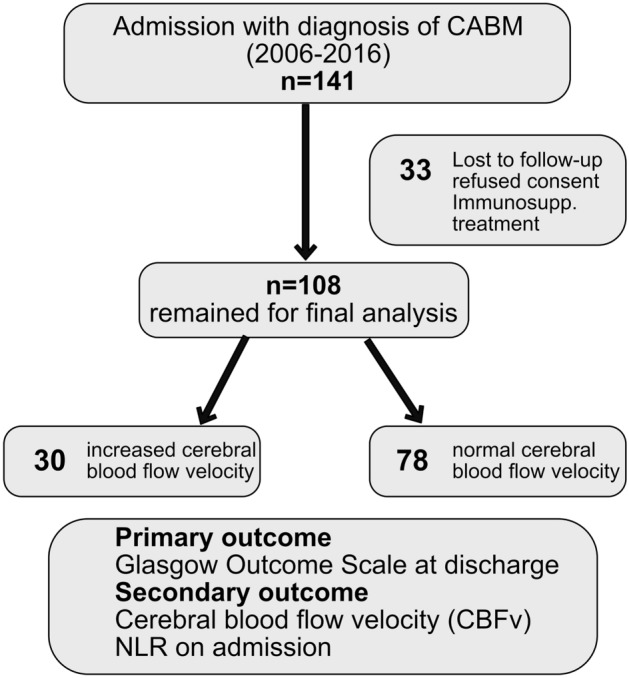
In community-acquired bacterial meningitis (CABM) intracranial vascular alterations are devastating complications which are triggered by neuroinflammation and result in worse clinical outcome. The Neutrophil-to-Lymphocyte ratio (NLR) represents a reliable parameter of the inflammatory response. In this study we analyzed the association between NLR and elevated cerebral blood flow velocity (CBFv) in CABM-patients. This study included all (CABM)-patients admitted to a German tertiary center between 2006 and 2016. Patients' demographics, in-hospital measures, neuroradiological data and clinical outcome were retrieved from institutional databases. CBFv was assessed by transcranial doppler (TCD). Patients', radiological and laboratory characteristics were compared between patients with/without elevated CBFv. Multivariate-analysis investigated parameters independently associated with elevated CBFv. Receiver operating characteristic(ROC-)curve analysis was undertaken to identify the best cut-off for NLR to discriminate between increased CBFv. 108 patients with CABM were identified. 27.8% (30/108) showed elevated CBFv. Patients with elevated CBFv and normal CBFv, respectively had a worse clinical status on admission (Glasgow Coma Scale: 12 [9-14] vs. 14 [11-15]; p = 0.005) and required more often intensive care (30/30 [100.0%] vs. 63/78 [80.8%]; p = 0.01).The causative pathogen was S. pneumoniae in 70%. Patients with elevated CBFv developed more often cerebrovascular complications with delayed cerebral ischemia (DCI) within hospital stay (p = 0.031). A significantly higher admission-NLR was observed in patients with elevated CBFv (median [IQR]: elevated CBFv:24.0 [20.4-30.2] vs. normal CBFv:13.5 [8.4-19.5]; p < 0.001). Multivariate analysis, revealed NLR to be significantly associated with increased CBFv (Odds ratio [95%CI] 1.042 [1.003-1.084]; p = 0.036). ROC-analysis identified a NLR of 20.9 as best cut-off value to discriminate between elevated CBFv (AUC = 0.713, p < 0.0001, Youden's Index = 0.441;elevated CBFv: NLR ≥ 20.9 19/30[63.5%] vs. normal CBFv: NLR > 20.9 15/78[19.2%]; p < 0.001). Intracranial vascular complications are common among CABM-patients and are a risk factor for unfavorable outcome at discharge. Elevated NLR is independently associated with high CBFv and may be useful in predicting patients' prognosis.
Conflict of interest statement
Dr. Giede-Jeppe reports no disclosures. Mr. Atay reports no disclosures. Dr. Koehn reports no disclosures. Dr. Mrochen reports no disclosures. Dr. Luecking reports no disclosures. Dr. Hoelter reports no disclosures. Dr. Volbers reports personal fees from Pfizer AG/Bristol-Myers Squibb SA, personal fees from Bayer AG, grants from Institutional grant (Inselspital), personal fees from Ipsen Pharma, personal fees from CSL Behring, outside the submitted work. Prof. Huttner reports research grants by Novartis, Medtronic, UCB Pharma and Portola Pharmaceuticals. HBH reports personal fees from Bayer AG, Boehringer Ingelheim, Daiichi Sankyo, Medtronic, CLS Behring, UCB Pharma and Portola Pharmaceuticals. Dr. Hueske reports no disclosures. Dr. Bobinger reports no disclosures.
Figures


References
Publication types
MeSH terms
LinkOut - more resources
Full Text Sources
