


Genomic Epidemiology of Carbapenemase-Producing Enterobacterales at a Hospital System in Toronto, Ontario, Canada, 2007 to 2018
- PMID: 34060902
- PMCID: PMC8284452
- DOI: 10.1128/AAC.00360-21
Genomic Epidemiology of Carbapenemase-Producing Enterobacterales at a Hospital System in Toronto, Ontario, Canada, 2007 to 2018
Abstract
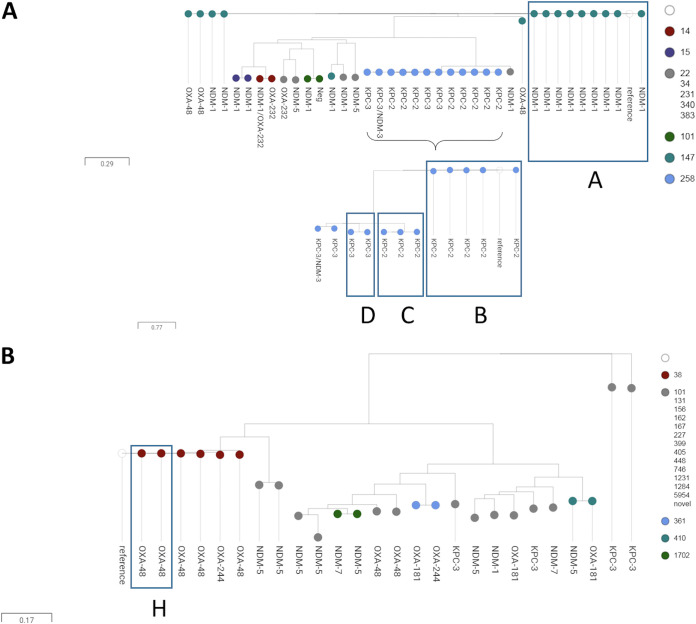
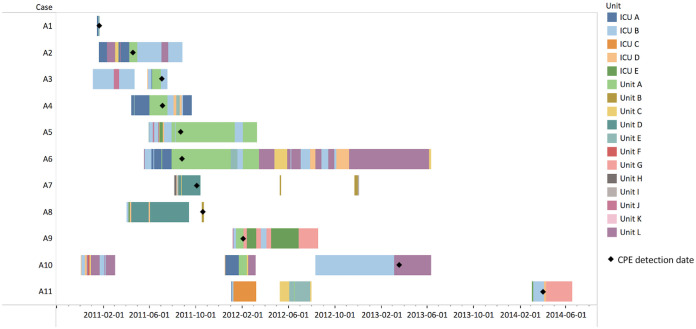
At a hospital system (H1) in Ontario, Canada, we investigated whether whole-genome sequencing (WGS) altered initial epidemiological interpretation of carbapenemase-producing Enterobacterales (CPE) transmission. We included patients with CPE colonization/infection identified by population-based surveillance from October 2007 to August 2018 who received health care at H1 in the year before/after CPE detection. H1 reported epidemiological transmission clusters. We combined single nucleotide variant (SNV) analysis, plasmid characterization, and epidemiological data. Eighty-five patients were included. H1 identified 7 epidemiological transmission clusters, namely, A to G, involving 24/85 (28%) patients. SNV analysis confirmed transmission clusters C, D, and G and identified two additional cases belonging to cluster A. One was a travel-related case that was the likely index case (0 to 6 SNVs from other isolates); this case stayed on the same unit as the initially presumed index case 4 months prior to detection of the initially presumed index case on another unit. The second additional case occupied a room previously occupied by 5 cluster A cases. Plasmid sequence analysis excluded a case from cluster A and identified clusters E and F as possibly two parts of a single cluster. SNV analysis also identified a case without direct epidemiologic links that was 18 to 21 SNVs away from cluster B, suggesting possible undetected interhospital transmission. SNV and plasmid sequence analysis identified cases belonging to transmission clusters that conventional epidemiology missed and excluded other cases. Implementation of routine WGS to complement epidemiological transmission investigations has the potential to improve prevention and control of CPE in hospitals.
Keywords: beta-lactamases; carbapenem-resistant Enterobacteriaceae; disease transmission; genomic epidemiology; public health.
Figures
References
-
- Souli M, Galani I, Antoniadou A, Papadomichelakis E, Poulakou G, Panagea T, Vourli S, Zerva L, Armaganidis A, Kanellakopoulou K, Giamarellou H. 2010. An outbreak of infection due to beta‐lactamase Klebsiella pneumoniae carbapenemase 2-producing K. pneumoniae in a Greek University Hospital: molecular characterization, epidemiology, and outcomes. Clin Infect Dis 50:364–373. 10.1086/649865. - DOI - PubMed
-
- Tumbarello M, Viale P, Viscoli C, Trecarichi EM, Tumietto F, Marchese A, Spanu T, Ambretti S, Ginocchio F, Cristini F, Losito AR, Tedeschi S, Cauda R, Bassetti M. 2012. Predictors of mortality in bloodstream infections caused by Klebsiella pneumoniae carbapenemase-producing K. pneumoniae: importance of combination therapy. Clin Infect Dis 55:943–950. 10.1093/cid/cis588. - DOI - PubMed
Publication types
MeSH terms
Substances
Grants and funding
LinkOut - more resources
Full Text Sources
Medical
Research Materials
Miscellaneous
