. 2021 Sep 27;8(1):G87-G136.
doi: 10.1530/ERP-20-0034.

The assessment of mitral valve disease: a guideline from the British Society of Echocardiography

Affiliations

The assessment of mitral valve disease: a guideline from the British Society of Echocardiography

Shaun Robinson et al. Echo Res Pract. .

Abstract

Mitral valve disease is common. Mitral regurgitation is the second most frequent indication for valve surgery in Europe and despite the decline of rheumatic fever in Western societies, mitral stenosis of any aetiology is a regular finding in all echo departments. Mitral valve disease is, therefore, one of the most common pathologies encountered by echocardiographers, as both a primary indication for echocardiography and a secondary finding when investigating other cardiovascular disease processes. Transthoracic, transoesophageal and exercise stress echocardiography play a crucial role in the assessment of mitral valve disease and are essential to identifying the aetiology, mechanism and severity of disease, and for helping to determine the appropriate timing and method of intervention. This guideline from the British Society of Echocardiography (BSE) describes the assessment of mitral regurgitation and mitral stenosis, and replaces previous BSE guidelines that describe the echocardiographic assessment of mitral anatomy prior to mitral valve repair surgery and percutaneous mitral valvuloplasty. It provides a comprehensive description of the imaging techniques (and their limitations) employed in the assessment of mitral valve disease. It describes a step-wise approach to identifying: aetiology and mechanism, disease severity, reparability and secondary effects on chamber geometry, function and pressures. Advanced echocardiographic techniques are described for both transthoracic and transoesophageal modalities, including TOE and exercise testing.

Keywords: mitral regurgitation; mitral stenosis; tranoesophageal echocardiography; transthoracic echocardiography.


Figures
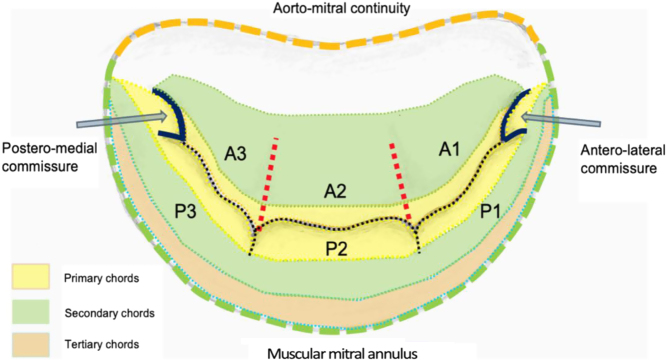
Figure 1
Figure 1
Mitral valve anatomy – ventricular surface (1).
Figure 2
Figure 2
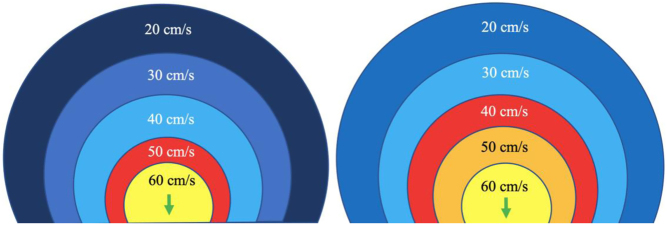
Schematic on the left demonstrates the PISA at a Nyquist limit of 50 cm/s, any velocity exceeding this will alias and be assigned a colour representative for the opposite direction. The schematic on the right demonstrates the PISA at a Nyquist limit of 40 cm/s. This increases the size of the PISA being imaged and improves measurement accuracy (1).
Figure 3
Figure 3
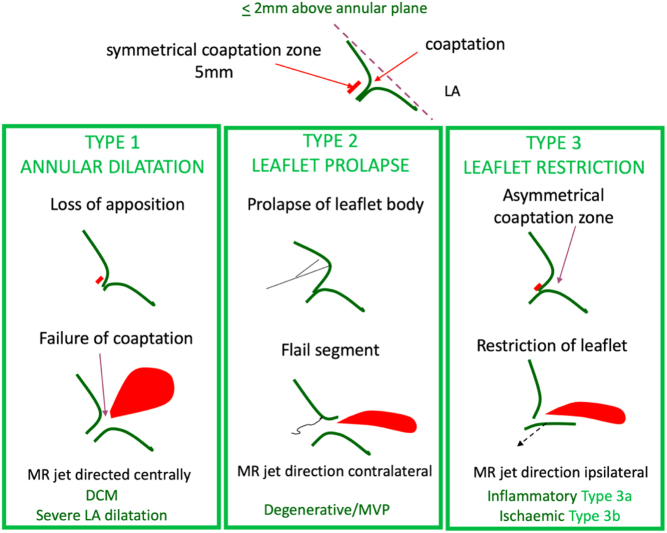
Mechanism of MR is described in terms of leaflet motion. The top diagram depicts normal leaflet function in systole in a competent mitral valve. Carpentier’s classification categorises this concept into three types. Type 1: normal leaflet motion with annular dilatation and increasing loss of coaptation as the two leaflets are pulled apart. Type 2: excessive leaflet motion where there is prolapse of redundant tissue above the level of the MV annulus into the LA, or when, due to the loss of primary chordal support, the tip of the leaflet everts and ‘points’ into the left atrium, called flail. Type 3 describes reduced leaflet motion, termed leaflet restriction. This can be due to primary leaflet disease where the leaflet is shortened due to retraction, in turn restricting excursion during the cardiac cycle. This restriction of motion prevents the leaflets from forming an adequate coapation height (tissue overlap). This is categorised as type 3a. Type 3b describes leaflets that are anatomically normal, but that are tethered due to a disease of the left ventricle. The left ventricle is dilated and or there are underlying wall motion abnormalities effecting papillary muscle function resulting in increased tension on the subvalvular apparatus. This in turn leads to tethering of the leaflets into the LV and prevents their return towards the annular plane to meet the opposite leaflet in systole, with resultant mitral regurgitation (1).
Figure 4
Figure 4
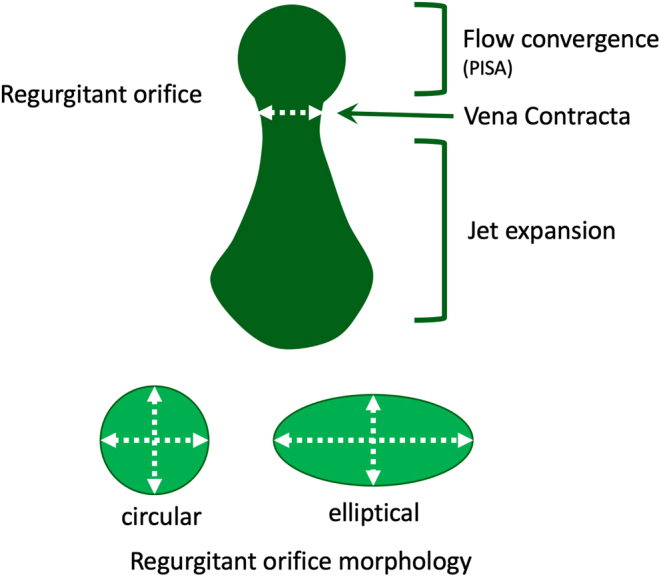
Diagrammatic illustration of regurgitant jet morphology. The three jet components are shown: flow convergence, vena contracta (narrowest portion of the jet as it enters the regurgitant orifice and is just distal to the true anatomic orifice), jet expansion into the receiving chamber (1).
Figure 5
Figure 5
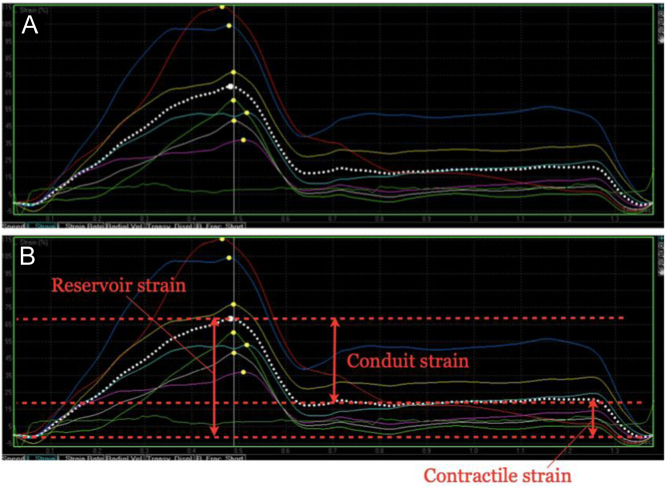
LA strain imaging from the LA-focussed apical windows. The zero-reference point should be marked as mitral valve opening, which usually corresponds to the onset of the QRS on the ECG. A typical time–deformation curve is displayed in (A), with the coloured traces representing the six individual segments of the LA, and the dotted white trace the average value (or global strain). Reservoir, conduit and contractile strain are annotated in image (B). This process should be repeated from both the four- and two-chamber windows and the average values reported.
Figure 6
Figure 6
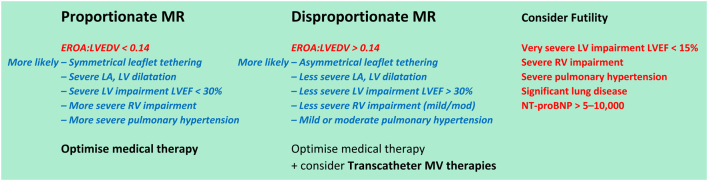
Proportionate vs disproportionate MR.
Figure 7
Figure 7
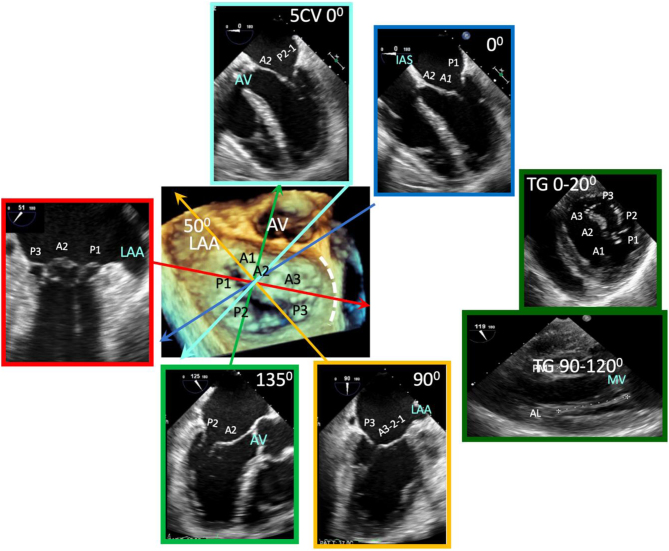
TOE imaging planes.
Figure 8
Figure 8
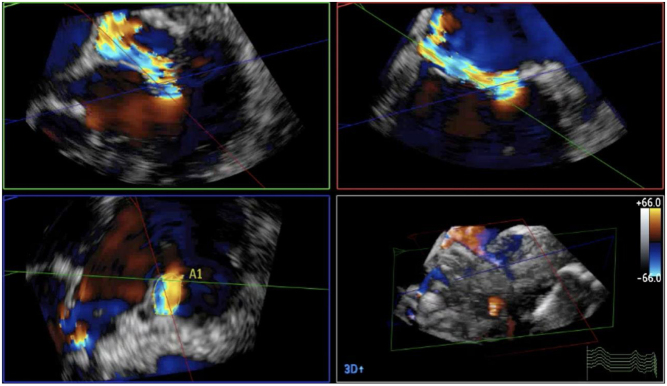
3D CFD assessment of the MV.

References

    1. Rana B, Robinson S. Transthoracic anatomy and pathology: valves. In Oxford Specialist Handbooks in Cardiology: Echcardiography, 3rd ed, pp 287–324. Eds Leeson P, Monteiro C, Augustin D, Becher H. Oxford, UK: Oxford University Press, 2020.
    1. Hung J.Mitral valve anatomy, quantification of mitral regurgitation, and timing of surgical intervention for mitral regurgitation. In The Practice of Clinical Echocardiography, 4th ed, pp 330–350. Ed Otto C. Philadelphia, PA, USA: Elsevier Saunders, 2012.
    1. McCarthy KP, Ring L, Rana BS. Anatomy of the mitral valve: understanding the mitral valve complex in mitral regurgitation. European Journal of Echocardiography 201011i3–i9. (10.1093/ejechocard/jeq153) - DOI - PubMed
    1. Angelini A, Ho SY, Thiene G, Anderson RH. Anatomy of the mitral valve. In Mitral Valve: Floppy Mitral Valve, Mitral Valve Prolapse, Mitral Valve Regurgitation, 2nd ed., pp 5–29. Eds Boudoulas H, Wooley CF. New York, NY, USA: Futura Publishing Company, 2000.
    1. Ho SY.Anatomy of the mitral valve. Heart 200288(Supplement 4) iv5–i10. (10.1136/heart.88.suppl_4.iv5) - DOI - PMC - PubMed