Evaluating spatiotemporal dynamics of snakebite in Sri Lanka: Monthly incidence mapping from a national representative survey sample
- PMID: 34061839
- PMCID: PMC8195360
- DOI: 10.1371/journal.pntd.0009447
Evaluating spatiotemporal dynamics of snakebite in Sri Lanka: Monthly incidence mapping from a national representative survey sample
Abstract
Background: Snakebite incidence shows both spatial and temporal variation. However, no study has evaluated spatiotemporal patterns of snakebites across a country or region in detail. We used a nationally representative population sample to evaluate spatiotemporal patterns of snakebite in Sri Lanka.
Methodology: We conducted a community-based cross-sectional survey representing all nine provinces of Sri Lanka. We interviewed 165 665 people (0.8% of the national population), and snakebite events reported by the respondents were recorded. Sri Lanka is an agricultural country; its central, southern and western parts receive rain mainly from Southwest monsoon (May to September) and northern and eastern parts receive rain mainly from Northeast monsoon (November to February). We developed spatiotemporal models using multivariate Poisson process modelling to explain monthly snakebite and envenoming incidences in the country. These models were developed at the provincial level to explain local spatiotemporal patterns.
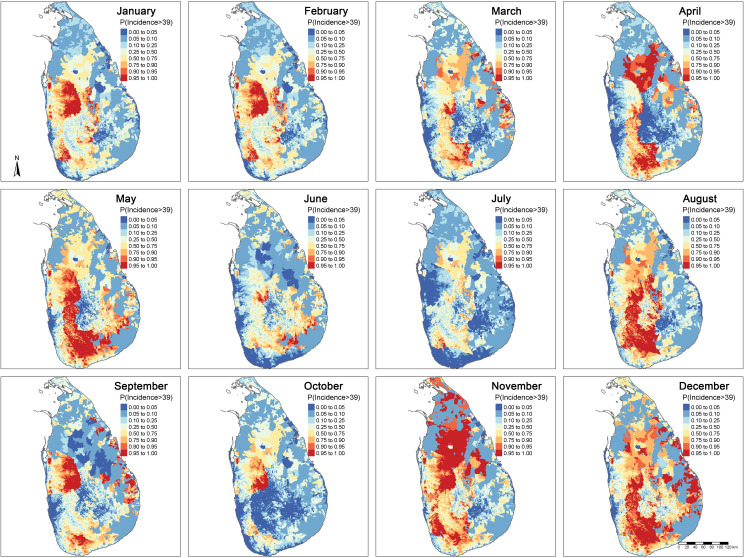
Principal findings: Snakebites and envenomings showed clear spatiotemporal patterns. Snakebite hotspots were found in North-Central, North-West, South-West and Eastern Sri Lanka. They exhibited biannual seasonal patterns except in South-Western inlands, which showed triannual seasonality. Envenoming hotspots were confined to North-Central, East and South-West parts of the country. Hotspots in North-Central regions showed triannual seasonal patterns and South-West regions had annual patterns. Hotspots remained persistent throughout the year in Eastern regions. The overall monthly snakebite and envenoming incidences in Sri Lanka were 39 (95%CI: 38-40) and 19 (95%CI: 13-30) per 100 000, respectively, translating into 110 000 (95%CI: 107 500-112 500) snakebites and 45 000 (95%CI: 32 000-73 000) envenomings in a calendar year.
Conclusions/significance: This study provides information on community-based monthly incidence of snakebites and envenomings over the whole country. Thus, it provides useful insights into healthcare decision-making, such as, prioritizing locations to establish specialized centres for snakebite management and allocating resources based on risk assessments which take into account both location and season.
Conflict of interest statement
The authors have declared that no competing interests exist.
Figures



References
-
- Snakebite envenoming: a strategy for prevention and control. Geneva; 2019. - PubMed
-
- Kasturiratne A, Wickremasinghe AR, de Silva N, Gunawardena NK, Pathmeswaran A, Premaratna R, et al. The global burden of snakebite: A literature analysis and modelling based on regional estimates of envenoming and deaths. PLoS Med. 2008;5:1591–1604. doi: 10.1371/journal.pmed.0050218 - DOI - PMC - PubMed
-
- Burt TP, Weerasinghe KDN. Rainfall distributions in Sri Lanka in time and space: An analysis based on daily rainfall data. Climate. 2014. doi: 10.3390/cli2040242 - DOI
Publication types
MeSH terms
Grants and funding
LinkOut - more resources
Full Text Sources