Review
. 2021 May 5;10(5):407.
doi: 10.3390/biology10050407.

Musashi-1-A Stemness RBP for Cancer Therapy?

Affiliations
Review

Musashi-1-A Stemness RBP for Cancer Therapy?

Nadine Bley et al. Biology (Basel). .

Abstract

The RNA-binding protein Musashi-1 (MSI1) promotes stemness during development and cancer. By controlling target mRNA turnover and translation, MSI1 is implicated in the regulation of cancer hallmarks such as cell cycle or Notch signaling. Thereby, the protein enhanced cancer growth and therapy resistance to standard regimes. Due to its specific expression pattern and diverse functions, MSI1 represents an interesting target for cancer therapy in the future. In this review we summarize previous findings on MSI1's implications in developmental processes of other organisms. We revisit MSI1's expression in a set of solid cancers, describe mechanistic details and implications in MSI1 associated cancer hallmark pathways and highlight current research in drug development identifying the first MSI1-directed inhibitors with anti-tumor activity.

Keywords: MSI1; RNA–binding protein; cancer; cell cycle; musashi–1; signaling; stemness.


Conflict of interest statement

The authors declare no conflict of interest.

Figures
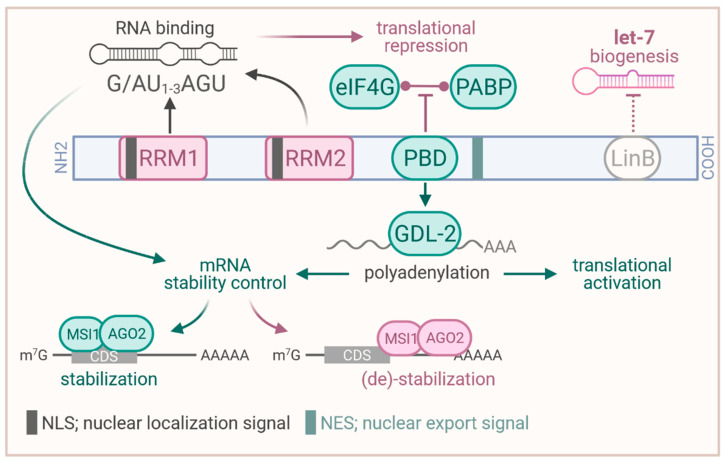
Figure 1
Figure 1
Structure of the MSI1 protein and proposed functions. RRM, RNA recognition motif; PBD; PABP binding domain (binding site to PABP and GLD–2); PABP, poly(A) binding protein; LinB, binding site to LIN28B; CDS, coding sequence. Created with www.BioRender.com (accessed on 29 April 2021).
Figure 2
Figure 2
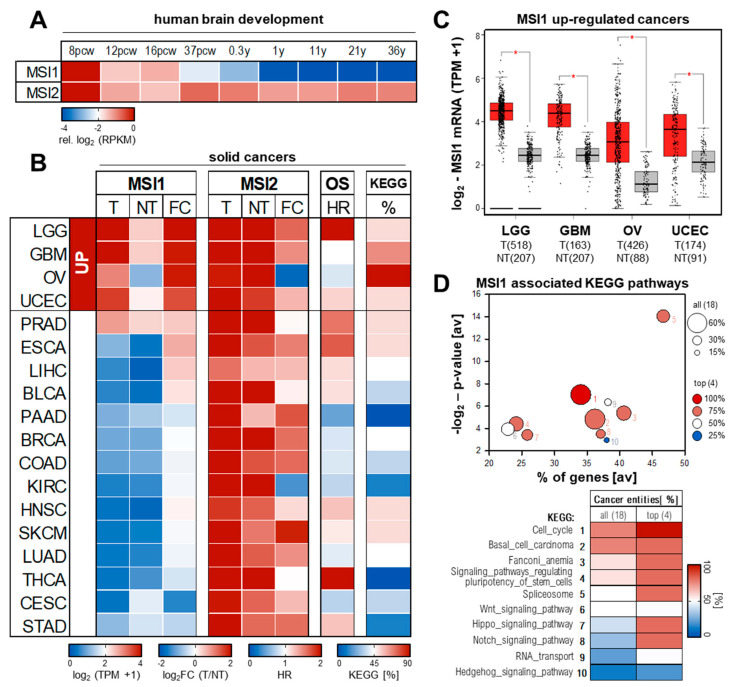
MSI1 expression and conserved association to hallmark of cancer pathways. (A) MSI1 and MSI2 expression in human brain development. Expression values (from https://www.brainspan.org/, accessed on 30 March 2021) in the neural plate determined by RNA–Seq is shown relative to 8 pcw. Pcw, post conception week; y, years. (BD) Average (B) and total (C) expression values of MSI1 and MSI2 for tumor (T; TCGA, red) and non–tumor (NT; TCGA and GTEx, gray) tissues as well as fold changes (FC) of tumor vs. non–tumor tissue were obtained from the Gepia2 database (http://gepia2.cancer–pku.cn, accessed on 30 March 2021). Association of MSI1 with overall survival (B; OS) indicated as hazardous ratio (HR) was determined by KM plotter (https://kmplot.com/, accessed on 30 March 2021). The association of MSI1 positively correlated genes with cancer hallmark related KEGG (Kyoto Encyclopedia of Genes and Genomes) pathways was determined using the R2 database (https://hgserver1.amc.nl/, accessed on 30 March 2021). Top 10 of conserved associated pathways are shown as bubble diagram and heatmap (D) with number indicating ranking. The percentage of altered KEGG pathways (top 10) for the respective tumor entities is shown as heatmap (B, KEGG). BLCA, Bladder Urothelial Carcinoma; BRCA, Breast invasive carcinoma; CESC, Cervical squamous cell carcinoma and endocervical adenocarcinoma; COAD, Colon adenocarcinoma; ESCA, Esophageal carcinoma; GBM, Glioblastoma multiforme; HNSC, Head and Neck squamous cell carcinoma; KIRC, Kidney renal clear cell carcinoma; LGG, Brain Lower Grade Glioma; LIHC, Liver hepatocellular carcinoma; LUAD, Lung adenocarcinoma; OV, Ovarian serous cystadenocarcinoma; PAAD, Pancreatic adenocarcinoma; PRAD, Prostate adenocarcinoma; SKCM, Skin Cutaneous Melanoma; STAD, Stomach adenocarcinoma; THCA, Thyroid carcinoma; UCEC, Uterine Corpus Endometrial Carcinoma.
Figure 3
Figure 3
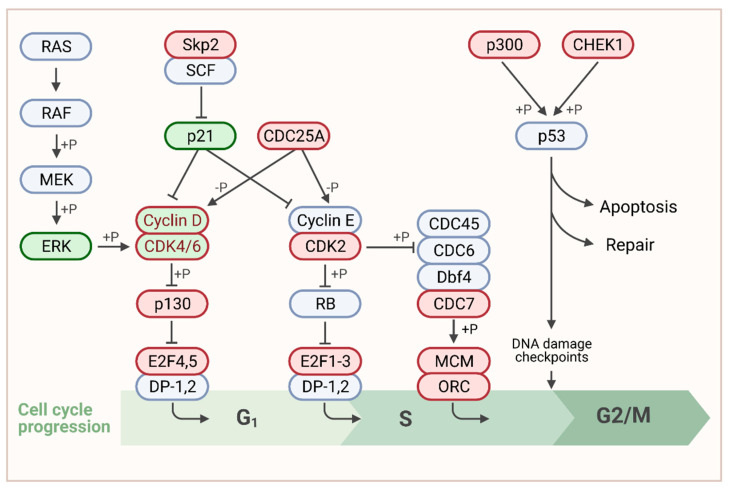
Association of MSI1 expression with cell cycle related genes. Schematic representation of the G1/S focus part of the KEGG: cell_cycle pathway according to (https://www.genome.jp/, accessed on 30 March 2021). For the entire pathway please refer to Supplementary Materials, Figure S1. Published MSI1 target transcripts are depicted in green. Genes that were positively correlated to MSI1 in more than 50% of cancer entities are shown in red. Genes that belong to both categories are shown in dual color. Created with www.BioRender.com, accessed on 31 March 2021.

References

    1. Gerstberger S., Hafner M., Tuschl T. A census of human RNA–binding proteins. Nat. Rev. Genet. 2014;15:829–845. doi: 10.1038/nrg3813. - DOI - PMC - PubMed
    1. Kang D., Lee Y., Lee J.S. RNA–Binding Proteins in Cancer: Functional and Therapeutic Perspectives. Cancers. 2020;12 doi: 10.3390/cancers12092699. - DOI - PMC - PubMed
    1. Weisse J., Rosemann J., Krauspe V., Kappler M., Eckert A.W., Haemmerle M., Gutschner T. RNA–Binding Proteins as Regulators of Migration, Invasion and Metastasis in Oral Squamous Cell Carcinoma. Int. J. Mol. Sci. 2020;21 doi: 10.3390/ijms21186835. - DOI - PMC - PubMed
    1. Glass M., Michl P., Huttelmaier A.S. RNA Binding Proteins as Drivers and Therapeutic Target Candidates in Pancreatic Ductal Adenocarcinoma. Int. J. Mol. Sci. 2020;21 doi: 10.3390/ijms21114190. - DOI - PMC - PubMed
    1. Mohibi S., Chen X., Zhang J. Cancer the’RBP’eutics–RNA–binding proteins as therapeutic targets for cancer. Pharmacol. Ther. 2019;203:107390. doi: 10.1016/j.pharmthera.2019.07.001. - DOI - PMC - PubMed

LinkOut - more resources