. 2021 May 5;13(5):836.
doi: 10.3390/v13050836.

Phylogenetic Analysis of the 2020 West Nile Virus (WNV) Outbreak in Andalusia (Spain)

Affiliations

Phylogenetic Analysis of the 2020 West Nile Virus (WNV) Outbreak in Andalusia (Spain)

Carlos S Casimiro-Soriguer et al. Viruses. .

Abstract

During recent decades West Nile Virus (WNV) outbreaks have continuously occurred in the Mediterranean area. In August 2020 a new WNV outbreak affected 71 people with meningoencephalitis in Andalusia and six more cases were detected in Extremadura (south-west of Spain), causing a total of eight deaths. The whole genomes of four viruses were obtained and phylogenetically analyzed in the context of recent outbreaks. The Andalusian viral samples belonged to lineage 1 and were relatively similar to those of previous outbreaks which occurred in the Mediterranean region. Here we present a detailed analysis of the outbreak, including an extensive phylogenetic study. As part on this effort, we implemented a local Nextstrain server, which has become a constituent piece of regional epidemiological surveillance, wherein forthcoming genomes of environmental samples or, eventually, future outbreaks, will be included.

Keywords: West Nile Virus; epidemiology; meningoencephalitis; outbreak; phylogeny; whole genome sequencing.


Conflict of interest statement

The authors declare no conflict of interest. The funders had no role in the design of the study; in the collection, analyses, or interpretation of data; in the writing of the manuscript; or in the decision to publish the results.

Figures
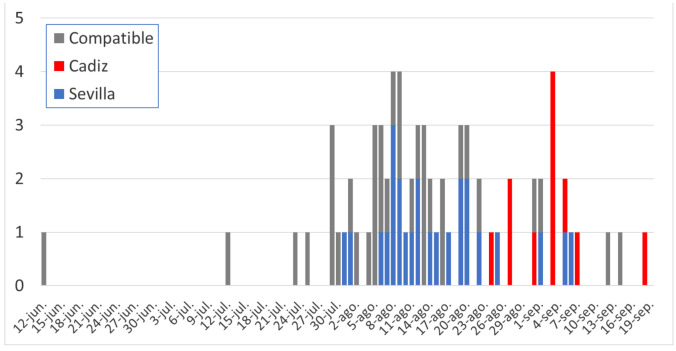
Figure 1
Figure 1
Epidemic curve of confirmed cases of WNV meningoencephalitis, by province of exposure (blue, Sevilla; red, Cádiz), as well as probable WNV cases detected by retrospective analysis (grey).
Figure 2
Figure 2
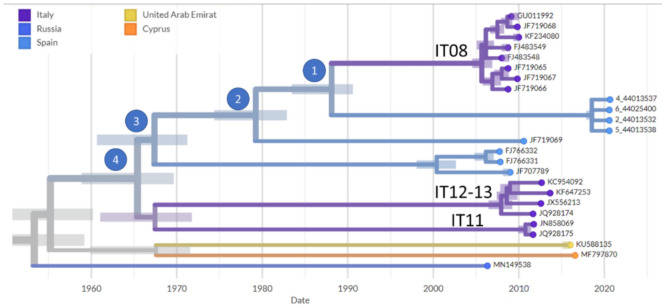
Sequences of the Spanish 2020 WNV outbreak (pale blue); the closest relatives from previous outbreaks in Italy IT08, IT11, IT12-13 (dark blue); and the sequence JF719069 from a lethal equine case in Andalusia (Spain) in 2010. Other Spanish outbreaks were: JF707789, from a mosquito in Huelva, and FJ766331 and FJ766332, from a golden eagle in Toledo [14]. Other related outbreaks from the Mediterranean region (Cyprus MF797870) [13], or adjacent locations (United Arab Emirates KU588135 and Russia MN149538) are also included. Confidence intervals for the times at which the branching points occurred are marked with bars. Branching points are labeled for the discussion.
Figure 3
Figure 3
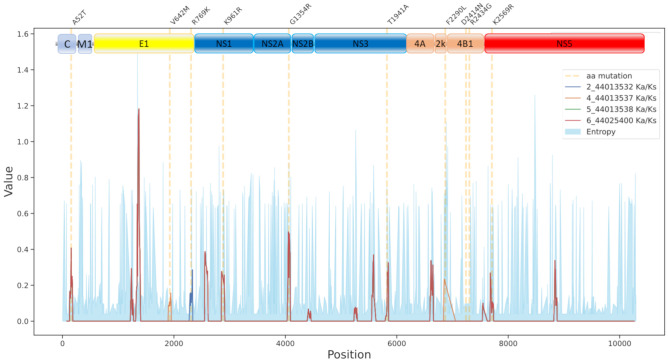
Mutational pattern observed in the Spanish outbreak with respect to its previous ancestor (branching point 1 in Figure 2) along the genome sequence. The entropy plot indicates the background variability observed in the genome of the 152 WNV sequences included in the phylogeny.

References

    1. Mackenzie J.S., Gubler D.J., Petersen L.R. Emerging flaviviruses: The spread and resurgence of Japanese encephalitis, West Nile and dengue viruses. Nat. Med. 2004;10:S98–S109. doi: 10.1038/nm1144. - DOI - PubMed
    1. Kramer L.D., Styer L.M., Ebel G.D. A global perspective on the epidemiology of West Nile virus. Annu. Rev. Entomol. 2008;53:61–81. doi: 10.1146/annurev.ento.53.103106.093258. - DOI - PubMed
    1. Hubálek Z., Halouzka J. West Nile fever—A reemerging mosquito-borne viral disease in Europe. Emerg. Infect. Dis. 1999;5:643. doi: 10.3201/eid0505.990505. - DOI - PMC - PubMed
    1. Fall G., Di Paola N., Faye M., Dia M., de Melo Freire C.C., Loucoubar C., de Andrade Zanotto P.M., Faye O. Biological and phylogenetic characteristics of West African lineages of West Nile virus. PLoS Negl. Trop. Dis. 2017;11:e0006078. doi: 10.1371/journal.pntd.0006078. - DOI - PMC - PubMed
    1. Pérez-Ramírez E., Llorente F., Del Amo J., Fall G., Lubisi A., Lecollinet S., Vázquez A., Jiménez-Clavero M.Á. Pathogenicity evaluation of twelve West Nile virus strains belonging to four lineages from five continents in a mouse model: Discrimination between three pathogenicity categories. J. Gen. Virol. 2017;98:662–670. doi: 10.1099/jgv.0.000743. - DOI - PubMed

Publication types